
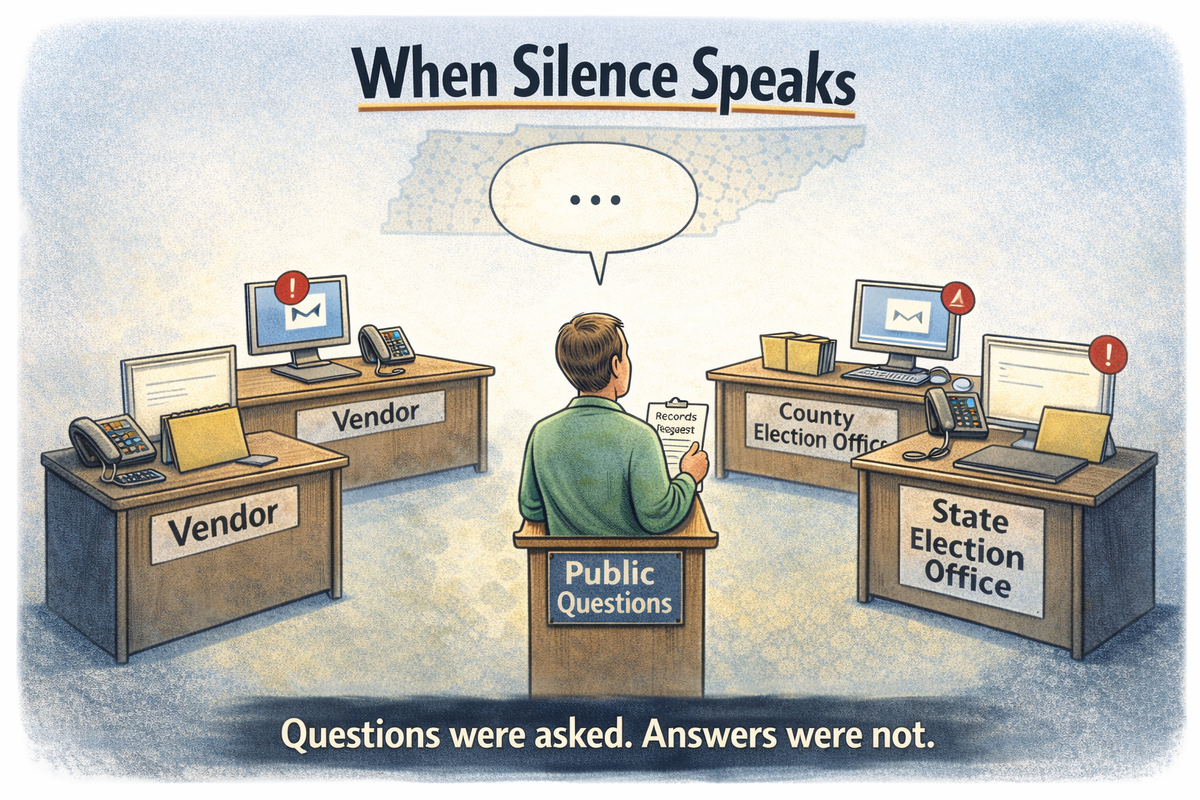
The record reviewed in this series indicates that when officials and vendors decline to answer basic questions, silence creates doubt—undermining confidence in election systems meant to earn public trust.
The record reviewed in this series indicates that when officials and vendors decline to answer basic questions, silence creates doubt in the minds of citizens who rely on election systems and processes. Over time, that silence erodes confidence in systems that are intended to earn public trust.
In a functioning democracy, trust in elections is not built on assurances alone. It is built on transparency—on the ability of citizens to understand, at least at a high level, how systems work, how decisions are made, and how oversight is exercised.
Throughout this investigation, citizens asked questions that fall squarely within that tradition. They did not accuse. They did not speculate. They politely asked for documentation:
Who provides the software that manages voter registration systems?
How was that vendor selected?
What qualifications were considered?
What cybersecurity safeguards apply?
How is compliance verified?
The answers, more often than not, were silence.
Emails went unanswered. Phone calls were not returned. Public records requests produced invoices, but little context. When pressed for clarification, officials frequently redirected inquiries elsewhere—sometimes back to the very entities already declining to respond.
This pattern is not evidence of misconduct. It is evidence of a breakdown in transparency surrounding systems the public depends on. And because vendors typically restrict internal access to proprietary systems, the practical responsibility for providing clarity falls largely on county and state election officials.
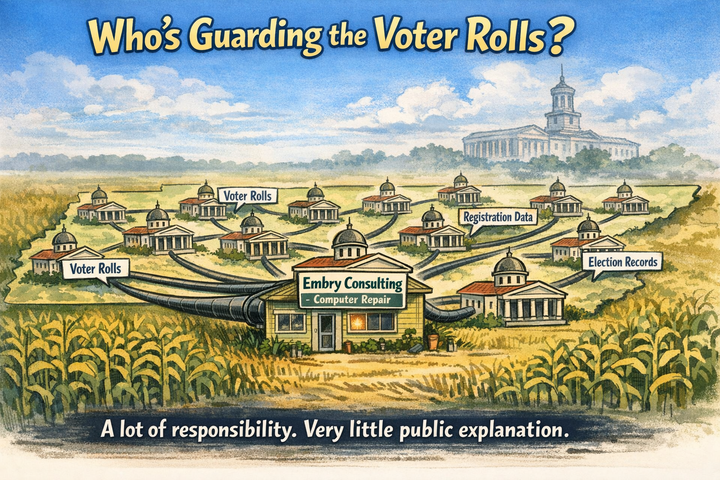
When citizens sought information from Embry Consulting LLC — a firm providing support for county voter registration databases — the company declined to answer substantive questions about its services, credentials, or security practices. In written correspondence, inquiries were redirected to local election officials. That response shifted responsibility, but did not resolve the underlying questions.
When citizens sought documentation from county election commissions, some counties provided invoices confirming payments for voter registration software support. But when asked for contracts or written agreements defining the scope of work, at least one county acknowledged that no such contract exists.
When the same questions were directed to the Tennessee Secretary of State’s Office, officials confirmed that the state has no records of contracts or invoices related to Embry Consulting. Requests for additional documentation regarding certification and cybersecurity oversight produced no substantive records.
Each of these responses, considered individually, may appear routine. Taken together, they reveal a system in which no single entity appears willing—or able—to clearly explain how a foundational component of election administration is overseen.
Silence is not the same as secrecy. Officials may believe that declining to engage protects security or avoids confusion. Vendors may believe that discussing internal practices is unnecessary or inappropriate. Counties may rely on long-standing arrangements they assume are understood.
But in the absence of documentation, silence has consequences.
When officials decline to answer basic governance questions, they create an information vacuum. That vacuum does not remain empty. It is filled by speculation, suspicion, and distrust—often amplified by voices far less careful than those asking the original questions.
Ironically, the refusal to provide clear, evidence-based explanations can undermine the very confidence officials seek to preserve.
Election administrators frequently emphasize that elections are secure and that systems are well managed. Those assurances may be entirely accurate. But trust in democratic systems does not come from statements alone. It comes from showing the work.
Other jurisdictions have recognized this. Across the country, election agencies and independent working groups publish high-level explanations of vendor selection processes, certification timelines, audit procedures, and security frameworks. These disclosures do not reveal sensitive technical details. They provide context.
They allow voters to distinguish between operational secrecy—which may be necessary—and institutional opacity, which is not.
In Tennessee, the lack of publicly available documentation leaves voters with unanswered questions about how voter registration systems are constructed, tested, selected, connected, and overseen. That uncertainty is magnified by the scale of reliance on a single vendor across nearly the entire state.
This investigation does not conclude that election officials acted improperly. It does not assert that voter rolls were compromised or that elections were affected. It documents that citizens seeking to understand how a critical system operates were, in many cases, unable to obtain basic information.
That distinction matters.
Democratic systems rely not only on legal compliance, but on public trust. When citizens cannot verify how systems are governed, confidence erodes—even when systems function exactly as intended. And when mistakes occur, that erosion deepens and becomes harder to repair.
The questions raised in this series are not radical. They are routine in any environment where significant public funds support sensitive infrastructure:
What services are provided?
Under what terms?
With what oversight?
These are not hostile questions. They are the foundation of accountability.
Throughout this series, election officials and vendors were given the opportunity to provide clarification. The absence of substantive responses is not presented as proof of wrongdoing. It is presented as a missed opportunity to strengthen public understanding.
Transparency is not a threat to election integrity. It is how integrity is demonstrated.
Tennessee law provides a framework for oversight. Public records confirm that voter registration systems are certified. Expert analysis highlights why such systems warrant careful attention. What remains missing is a clear, public explanation tying those elements together.
Until that explanation is provided and supported with documentation, voters are asked to trust systems they are rarely allowed to understand.
Trust, however, is strongest when it is informed.
Series Conclusion
This investigative series set out to answer a simple question:
Who controls Tennessee’s voter rolls, and how is that responsibility overseen?
The answer, based on public records, is incomplete.
A private vendor supports voter registration systems in nearly every Tennessee county. Hundreds of thousands of taxpayer dollars are paid each year. State law requires certification and cybersecurity consideration. Experts caution that voter registration databases deserve rigorous oversight.
What is missing is transparency.
This series does not allege misconduct. It does not claim elections were compromised. It documents facts, laws, expert context, and unanswered questions.
Those questions remain open.
If officials and vendors choose to provide documentation, many concerns could be resolved quickly. Until then, voters are left with silence — and silence is not a substitute for accountability or trust.
Call to ACTION:
Readers who are wondering what they can do, they can attend the Monday, January 12, 2026 meeting of the Tennessee State Election Commission and comment at the start of the meeting. It's an in-person meeting held in Nashville at:
12:00 Noon
Nashville Room -- Third floor
William R. Snodgrass Tennessee Tower
312 Rosa Parks Avenue
Nashville, TN 37243
Those interested in speaking will need to sign up on the list near the door
prior to the meeting to speak. They would have three minutes and it would
have to pertain to an agenda item, which could be identified closer to the
meeting. There is public parking nearby. The meeting usually lasts about
an hour.
If you want to support what we do, please consider donating a gift in order to sustain free, independent, and TRULY CONSERVATIVE media that is focused on Middle Tennessee and BEYOND!
Comments ()