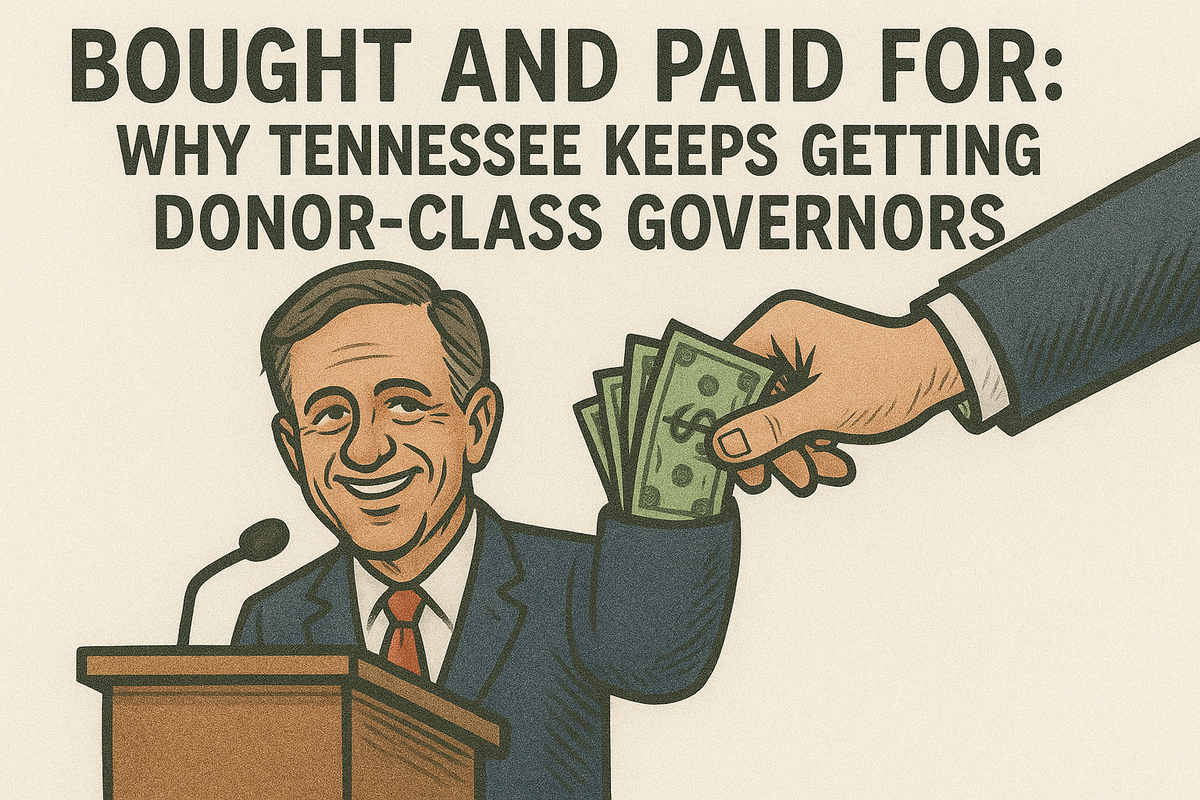
Bought and Paid For: Why Tennessee Keeps Getting Donor-Class Governors
Tennessee’s governorship keeps landing in the hands of donor-class elites. This piece exposes how mega-funding pipelines, federal loopholes, and donor influence—not voters—shape who leads the state.

For years, Tennessee voters have sensed something was fundamentally off about our statewide elections. Every four or eight years, the governor’s office lands in the hands of someone with extraordinary wealth, deep donor-class backing, or connections rooted not in Tennessee’s grassroots, but in national political and corporate ecosystems. Ordinary Tennesseans show up, cast their vote, and hope the next governor will finally be someone who understands their lives — yet somehow, the outcome always feels pre-arranged.
This isn’t paranoia. It’s not a partisan talking point. And it’s not a coincidence.
It is the predictable result of a system that, over time, has made it almost impossible for anyone without massive financial backing to win statewide office in Tennessee.
Let’s start with the obvious. Bill Haslam entered the governor’s race backed by one of the wealthiest families in Tennessee — a billionaire pipeline that effectively guaranteed media access, political clout, consultant armies, and donor enthusiasm before he ever shook a voter’s hand. Bill Lee followed a similar trajectory, buoyed by corporate support and donor-class enthusiasm that grassroots candidates simply couldn’t compete with. Each time, everyday Tennesseans were told they had a meaningful choice. But the truth is that the financial playing field was tilted beyond recognition long before Election Day.
Over the years, this dynamic hardened into a structural truth: Tennessee’s governor’s race isn’t shaped by the people — it’s shaped by money. And once a pattern becomes routine, it becomes invisible. Voters see polished ads, statewide bus tours, and talking points about “faith, family, and freedom,” but they rarely see the financial scaffolding that makes it all possible.
This scaffolding didn’t emerge overnight. It was built gradually by both federal and state forces — a federal law that reshaped political fundraising nationwide, and Tennessee’s permissive campaign finance rules that allowed the donor class to dominate statewide elections without meaningful friction.
By the time Tennesseans realized what was happening, the donor-class pipeline was already running on autopilot.
Today, the financial threshold required to compete in a governor’s race virtually guarantees that only:
- Multi-millionaires
- Nationally connected political figures
- Wealthy business owners
- Or federally funded incumbents
ever make it to the starting line. Everyone else — small-town conservatives, grassroots fighters, local leaders, community champions — are effectively priced out before the race begins.
That’s not democracy.
That’s a managed marketplace.
And Tennesseans feel it. They see the distance between their lived experiences and the polished, consultant-crafted messaging pouring out of donor-class campaigns. They sense that the candidates running the show live in a different universe — one insulated by wealth, national attention, and political machinery.
The most dangerous part?
People begin to assume this is simply “how politics works.”
They stop questioning it.
They stop imagining alternatives.
They stop believing a regular Tennessean could ever win again.
This demoralization is not accidental — it’s a function of the system itself. A system where money doesn’t just influence elections; it predetermines them. Where consultants, PACs, and national networks decide viability long before voters get a say. Where the governor’s office is not a public trust but a donor-powered asset.
This is the backdrop for our four-part series.
In this series, TruthWire will reveal:
- How a 2002 federal law fundamentally changed political fundraising
- How Tennessee’s campaign finance rules opened a loophole the donor class has exploited ever since
- How money now flows from all 50 states into Tennessee elections
- And how the 2026 governor’s race may be the most donor-engineered contest yet
For too long, Tennesseans have been told to ignore the role of money in politics — as if financial machinery has no real influence on who wins and who loses. Yet every pattern, every cycle, every modern statewide election tells the same story:
Money chooses the candidates.
Money shapes the campaigns.
Money wins the race.
Voters simply ratify the outcome.
This series is designed to expose that system — clearly, plainly, and with receipts. Because Tennesseans deserve more than a governor chosen through donor-class coronation rituals.
They deserve the truth.
And it begins here.
If you want to support what we do, please consider donating a gift in order to sustain free, independent, and TRULY CONSERVATIVE media that is focused on Middle Tennessee and BEYOND!