HB1729: Tennessee Lowers the Trigger for Homeschool Intervention — as Voucher Expansion Ramps Up
HB1729 lowers homeschool intervention triggers in TN, expands reporting and remediation, and coincides with pushes to grow vouchers.

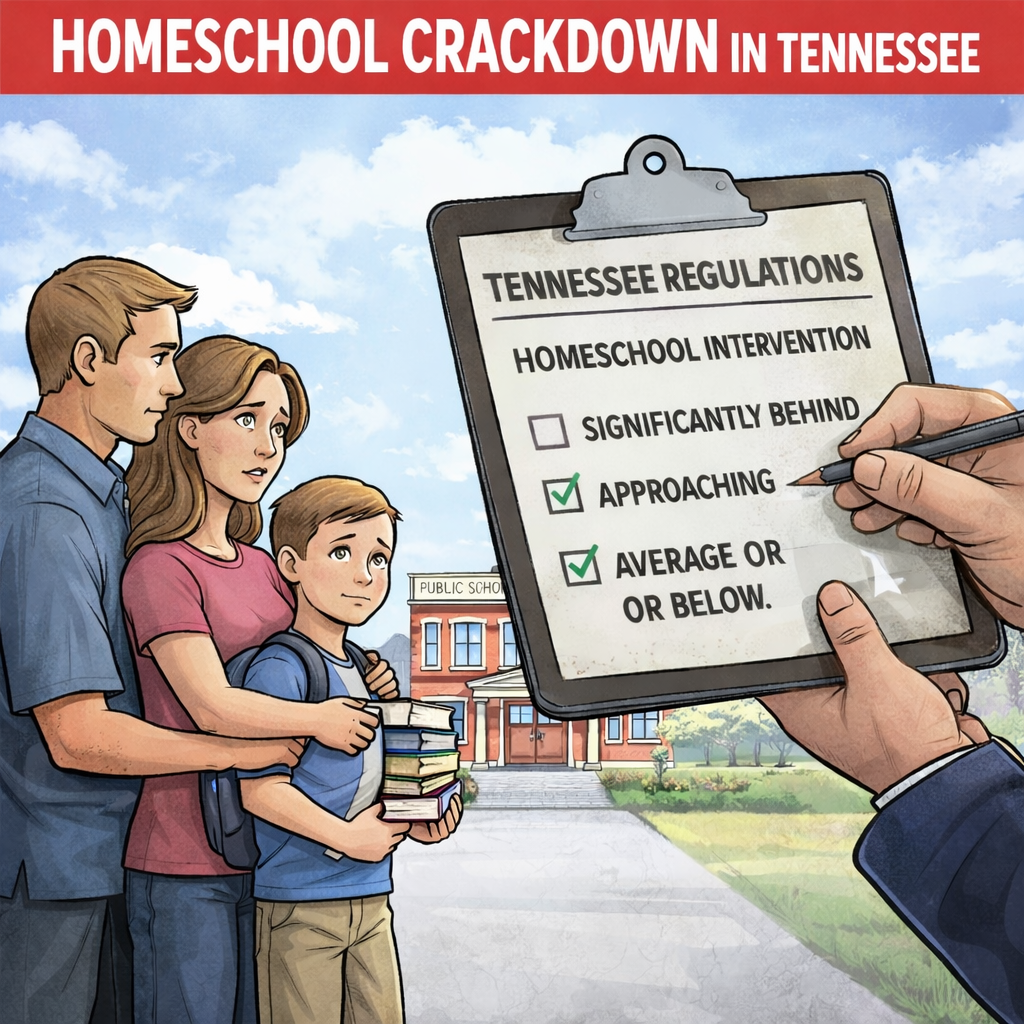
Tennessee already regulates independent homeschooling. But a newly filed bill, HB1729 (William Slater-R-D35), would change the state’s posture in a meaningful way: it lowers the threshold for when government intervention is triggered, formalizes an escalation ladder that can involve outside professionals, and preserves a pathway that can end with a local school director requiring a child to enroll in a public, private, or church-related school.
Supporters can frame the bill as “accountability” and “test integrity.” Critics will see it as a “homeschool clampdown” — especially because it lands in the same policy moment when Tennessee leaders are also pushing to expand the state’s private-school voucher program far beyond its built-in growth mechanism.
The question families are asking is straightforward: Is Tennessee tightening control over homeschooling while expanding incentives to move students into other systems the state can more easily fund, count, and regulate?
What Tennessee law says now
Under current Tennessee law in TCA 49-6-3050, independent homeschool families operate under a compliance model: register with the local school district, follow attendance requirements, and meet periodic academic checkpoints.
The most important checkpoint is testing. Under current law, homeschool students in grades 5, 7, and 9 must take standardized tests that align with the state’s testing system for public-school students. Those tests are administered through the commissioner of education or designee, or through a professional testing service approved by the local education agency (LEA).
Current law also requires reporting: results must be provided to the parent-teacher, the director of schools (local district leadership), and the state board of education.
And crucially, Tennessee’s current homeschool law already includes a backstop that can end homeschooling in defined circumstances. If a student’s scores show the child is more than one year behind grade level for two consecutive tests, and the student is not learning disabled under the statute’s standard, the director of schools may require the student to enroll in a public, private, or church-related school — with the parent retaining rights provided by law to respond.
So the authority exists today. HB1729 does not create government oversight from scratch. What it does is re-engineer when and how often the state can step in, and it lowers the “tripwire” for intervention.
What HB1729 changes: new testing routes and tighter “chain-of-custody” rules
HB1729 keeps the same grade checkpoints — 5, 7, and 9 — but offers two testing routes:
Route 1: A parent-selected nationally normed test (ELA + math).
The parent-teacher can select a standardized test that provides “nationally normed analytics,” but it must be:
- proctored by someone not related to the student,
- recorded by the test developer, and
- paid for by the parent-teacher.
Route 2: The same state board-approved standardized tests required of public-school students.
These are administered by the commissioner of education (or designee) or by an LEA-approved professional testing service. The bill specifies that the grade 9 test is not an end-of-course exam under a separate statute.
On paper, Route 1 looks like added flexibility. But it comes with a clear policy message: Tennessee wants testing that is externally verifiable. The “unrelated proctor” and “developer-recorded results” requirements create a chain-of-custody system that reduces informal or family-controlled testing arrangements.
That matters — but it isn’t the biggest change.
The biggest change: “not proficient” now starts at “approaching” or below average
The most consequential shift is how Tennessee defines “not proficient” and triggers state involvement.
Current law frames intervention around how far a student is behind grade level (measured in months or a year). HB1729 replaces that approach with a new proficiency/percentile ladder that triggers intervention earlier.
Under HB1729, a homeschool student is “not proficient” if:
- On the state test route, the student scores “approaching,” or
- On the nationally normed route, the student scores below the 50th percentile but above the 25th percentile.
In either case, the parent-teacher must consult with the director of schools.
That is a major policy shift. Under HB1729, a student who is not in the bottom quartile nationally — simply below the national median — becomes a mandatory district consultation case.
HB1729 escalates further if performance falls into the lowest band:
- State test route: performance level “below,” or
- Nationally normed route: below the 25th percentile.
When that happens, the bill requires:
1. the same test to be re-administered within one year, and
2. consultation with a licensed teacher who has appropriate certification/endorsement in the grade level or subject area to design remedial coursework, and
3. reporting that remedial plan to the director of schools.
Finally, the enforcement backstop remains — but in a way that could become easier to reach because the ladder triggers earlier. If the student completes those remediation requirements in the same subject for two consecutive test administrations, and the student is not diagnosed learning disabled by a qualified medical professional, the director of schools may require enrollment in a public, private, or church-related school, with rights provided by law to respond.
What changed, in plain English
Here’s the before-and-after that matters:
Current law tends to trigger higher-level intervention when a child is significantly behind grade level (and the most serious consequence — required enrollment — is tied to being more than a year behind for two consecutive tests).
HB1729 expands the intervention pipeline to include kids who are:
- “approaching” on state tests, or
- below average (below 50th percentile) on nationally normed tests.
That means more families can be routed into mandatory consultation, remediation planning, and reporting — the kinds of steps that create an ongoing relationship with district oversight.
This isn’t motive. It’s mechanics.
Is HB1729 intended to compel homeschoolers back into public schools?
HB1729 does not explicitly say “force homeschoolers into public schools.” It allows directors of schools to require enrollment in public, private, or church-related schools under defined conditions — just as current law already does.
But HB1729 lowers the threshold that can place a family into the escalation ladder, and that matters. If intervention starts at “approaching” or “below the median,” the practical effect is that more homeschool students are likely to generate compliance triggers. And once the state is requiring consultations, retesting, and licensed-teacher remediation plans, the state’s leverage over the homeschool arrangement increases.
You can’t honestly claim the sponsor’s private intent from the bill text alone. You can say, factually, that HB1729’s structure increases the frequency and scope of state touchpoints and expands the set of test outcomes that trigger them.
The timing question: why now, and why alongside voucher expansion?
HB1729’s rollout doesn’t happen in a vacuum. Tennessee’s broader education policy agenda is also moving aggressively on vouchers.
Tennessee’s statewide Education Freedom Scholarships program included a built-in growth mechanism that can add 5,000 seats if demand thresholds are met. But leadership has publicly pushed for a much larger expansion — with House Speaker Cameron Sexton discussing an increase of at least 20,000 seats, which would effectively double the program. Meanwhile, the governor’s administration has highlighted demand, pointing to application volumes (including a publicly reported figure of 50,304 applications for the 2026–27 cycle).
Put those tracks next to each other:
- vouchers expanding outward (public funds flowing to private schooling), and
- homeschool oversight tightening inward (earlier triggers, more mandated remediation, more reporting),
…and a legitimate public-interest question emerges: Is Tennessee reshaping the education marketplace into channels that are easier to fund and regulate — public schools, voucher-participating private schools, and a more tightly supervised homeschool track?
That’s analysis — not an accusation. But it’s grounded in what the bills do, and in what leadership is publicly pursuing.
Key questions HB1729 doesn’t answer
Even if you support oversight, HB1729 raises practical questions families will want answered:
- What exactly does “recorded by the developer” mean for data retention, privacy, and record-sharing?
- Who qualifies as an acceptable proctor under the “not related” requirement, and how is compliance verified?
- What exact procedural rights and appeals apply when a director “may require” enrollment?
- Will “approaching” or “below median” triggers create district-level pressure to intervene more aggressively than the current “one year behind” paradigm?
Supporters will argue HB1729 modernizes oversight, strengthens test integrity, and prevents children from falling behind unseen. Opponents will argue it treats “below average” as a compliance failure, turns homeschooling into co-parenting with the state, and increases government leverage at the same time Tennessee is accelerating voucher-driven exits from traditional public schools.
Either way, the bottom line is simple: HB1729 doesn’t just tweak homeschool testing — it changes the trigger points that define when the state steps into a family’s homeschool decisions.
As vouchers expand and homeschool rules tighten, many parents see the same pattern: the state nudging families into systems it can fund and regulate—while chipping away at the independence that drew them to homeschooling in the first place.
TruthWire news reached out to Robert Bortins, CEO of the world's largest classical homeschooling organization, Classical Conversations, who responded with this:
"Tennessee homeschoolers who rejected ESA funds are now facing increased state intervention anyway, proving that School Choice doesn't protect educational independence; it systematically dismantles it by establishing precedent that all education is the state's concern. The only true protection is complete separation of school and state."
The bill currently does not have a Senate sponsor, but that could change anytime.
TruthWire will continue to monitor the progress of this legislation and report back any changes or developments. If constituents wish to express their thoughts about this bill, please use this tool to find contact information, and reach out directly.
If you want to support what we do, please consider donating a gift in order to sustain free, independent, and TRULY CONSERVATIVE media that is focused on Middle Tennessee and BEYOND!