HB1971/SB1958 and the Quiet Erosion of Pre-Enforcement Constitutional Rights
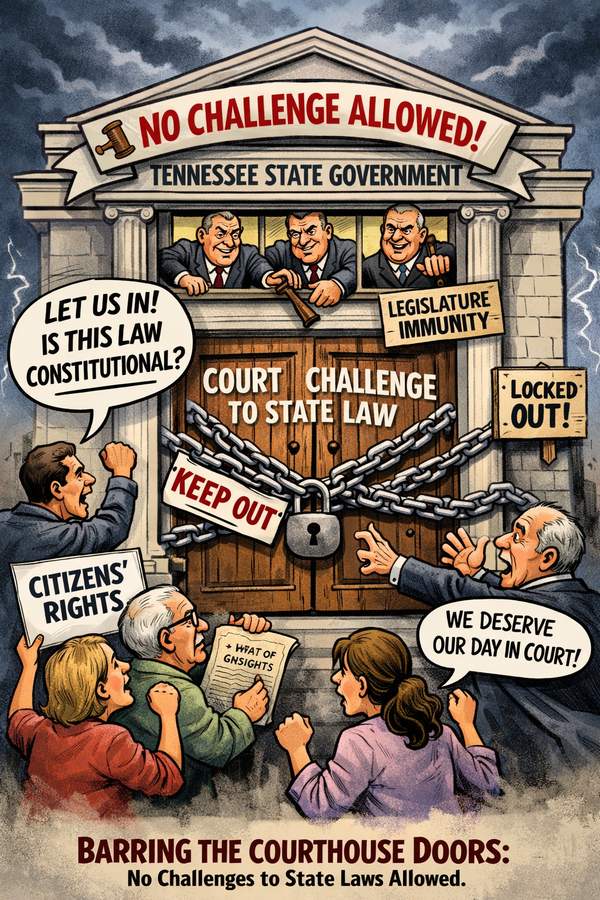
HB 1971/SB1958 shifts when citizens can challenge the state—moving from prevention to reaction. Supporters cite “frivolous lawsuits,” but the bill raises the bar to harm first. The result: less scrutiny upfront, more power for government.

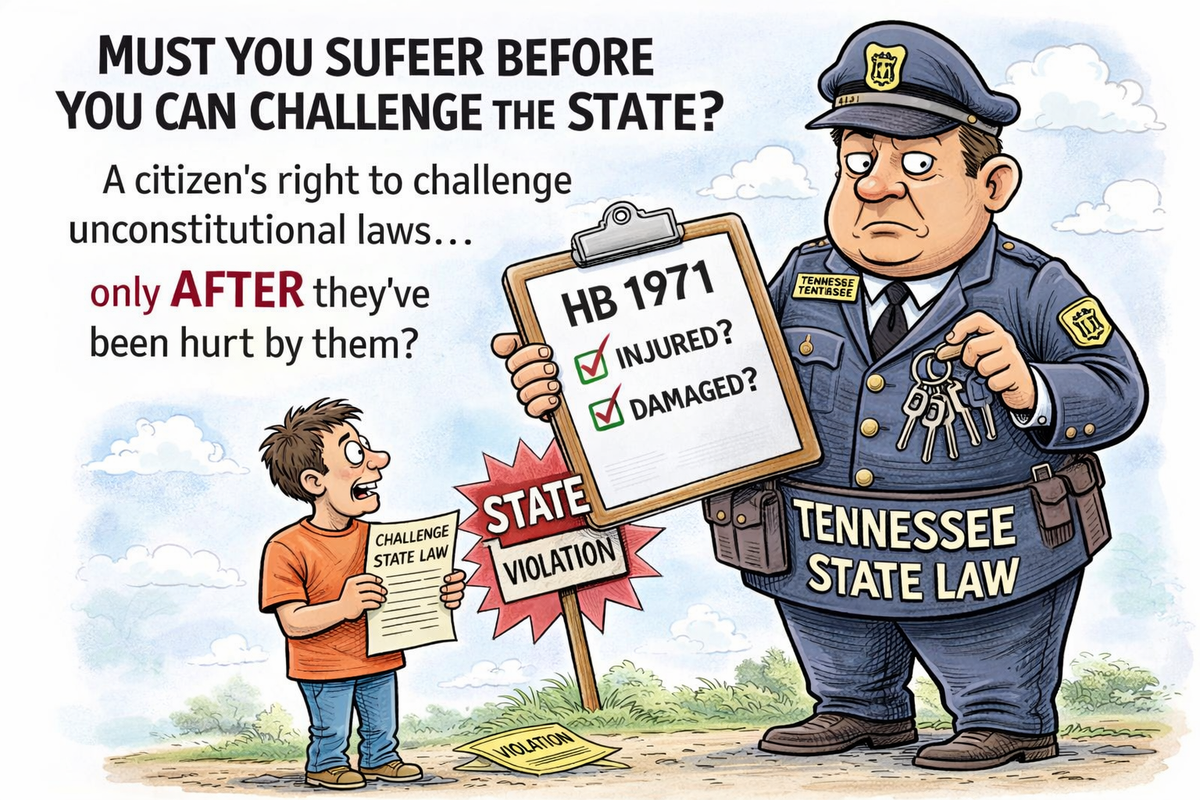
The deeper you look into HB 1971, the harder it becomes to accept the explanation being offered for it. On the surface, this bill is being framed as a necessary correction—something intended to rein in “frivolous lawsuits,” restore traditional standing requirements, and protect the state from unnecessary legal burden. But when you compare what is being said publicly, what was argued in committee, and what was privately circulated to lawmakers, a different picture emerges—one that is less about constitutional principle and more about insulating the state from being challenged.
The timeline itself is revealing. When the Senate Judiciary Committee first considered SB 1958 on March 17, the bill did not clear the hurdle. Concerns had already surfaced about whether it would make it harder for Tennesseans to challenge the constitutionality of state law. The vote was close—close enough that had Senator Kerry Roberts simply voted “no” instead of “present not voting,” the bill would have failed outright and likely never returned. It was that fragile. But when the bill came back the following week, the trajectory changed. The Attorney General’s office stepped in directly. Solicitor General Matt Rice appeared before the committee and reframed the issue, arguing that the 2018 law had opened the door to policy-driven litigation that was placing an unsustainable burden on the state. That shift matters, because it signals that this bill is not merely legislative housekeeping. It is an institutional response. The state is not simply clarifying the law—it is reacting to the cost and consequences of defending itself in court.
Nowhere is that more obvious than in the contrast between the Attorney General’s internal messaging and the official fiscal note attached to the bill. The memo circulated to lawmakers paints a picture of significant financial and operational strain, citing nearly a million dollars in litigation expenses, thousands of attorney hours, sweeping discovery demands across tens of thousands of state employees, and an ongoing burden described as unsustainable. It emphasizes cost, disruption, and resource diversion as central reasons for passing the bill. But the official fiscal note tells a completely different story: “FISCAL IMPACT: NOT SIGNIFICANT.” Those two statements cannot both be true in any meaningful sense. Either this bill is necessary to address a costly and burdensome legal environment, or its fiscal impact is negligible. The fact that lawmakers are being told both at the same time should raise an obvious concern: this is not a bill being driven purely by fiscal reality, but one being justified differently depending on the audience.
A similar contradiction appears in how the bill’s impact on constitutional rights is being described. Supporters insist the bill does not eliminate the ability to challenge unconstitutional laws. Technically, that is correct. But what they do not emphasize—what is quietly embedded in both the memo and the statutory language—is when that challenge can realistically occur. The memo itself makes this clear while attempting to reassure lawmakers, stating that citizens can still assert constitutional rights “in response to enforcement actions.” That phrase is not incidental. It reflects the very shift this bill creates.
Under the current framework, a citizen can bring a pre-enforcement challenge, asking a court whether a law is constitutional before it is used against them. That is precisely what cases like Hughes v. Lee represent. It is a front-end safeguard, allowing courts to answer the constitutional question before harm occurs. HB 1971 narrows that pathway. By removing the clearer statutory cause of action for challenges to state law, it pushes citizens toward a different posture—one where challenges are more likely to arise after enforcement or after a more concrete injury can be demonstrated. In practical terms, the system moves from protection before harm to redress after it.
That is not a minor procedural adjustment. It is a fundamental shift in how constitutional rights function. Senator John Stevens made this point in committee, even if unintentionally, when he argued that courts are for people who are injured, not for those who simply disagree with a law. That framing may hold in ordinary civil disputes, but constitutional law operates differently. It is not merely about compensating injury; it is about preventing unlawful government action in the first place. The idea that a citizen should have to wait until they are harmed—until the law is enforced, until their liberty or property is at risk—before they can effectively challenge it turns that principle on its head.
The repeated emphasis on “frivolous lawsuits” also deserves closer scrutiny. Courts already possess well-established tools to dismiss meritless claims. Standing doctrine, ripeness, jurisdiction, and motions to dismiss exist precisely to prevent weak cases from proceeding. If these lawsuits were truly frivolous, they would not survive long enough to impose the burdens the Attorney General’s office is now citing. The issue, then, is not that cases are being filed. It is that some of them are proceeding far enough to require a defense. That suggests something far less convenient than the narrative being offered: that at least some of these challenges raise legitimate constitutional questions.
In a constitutional system, that is not abuse. It is accountability. Defending the legality of government action is not an unfair burden; it is an essential function of governance. Yet this bill reflects a different impulse. Rather than accepting that responsibility, the state is attempting to make those challenges more difficult to bring at the front end. It calls that restoring sovereign immunity and reestablishing separation of powers. In practice, however, it shifts the burden away from the state and onto the citizen. The citizen bears more risk, more uncertainty, and more exposure to enforcement before relief becomes viable.
This shift runs directly against the structure of both the Tennessee Constitution and the United States Constitution. Both were designed to restrain government power, not to shield it from scrutiny. Judicial review is one of the primary mechanisms by which those restraints are enforced, and it is most meaningful when it can occur before the state imposes its will on the individual. Once that timing changes, the nature of the right changes with it. What remains may still be called a right, but it becomes harder to exercise, slower to access, and more dependent on the citizen’s willingness to absorb risk.
Supporters argue that this bill simply returns Tennessee to its pre-2018 framework, but even that claim does not withstand careful examination. The 2018 law was enacted for a reason. It reflected a recognition that the prior system did not provide a sufficiently clear or accessible pathway for constitutional challenges. To now characterize rolling that back as a restoration of order ignores that legislative history. It also ignores a basic reality of governance: when access to judicial review is narrowed, government power expands.
Perhaps most importantly, this bill is not limited to any single issue. While its justification has been tied to specific cases—abortion, redistricting, voting laws, executive authority—the mechanism being altered applies universally. The same standard will govern challenges involving free speech, religious liberty, gun rights, property rights, parental authority, and economic regulation. Once the barrier is raised, it is raised for everyone.
The most candid reading of HB 1971 is also the simplest. The state has grown frustrated with the cost, scope, and consequences of being challenged in court. Rather than accept that as part of governing under a constitutional system, it is choosing to make those challenges more difficult to bring. It is not eliminating judicial review, but it is delaying it. And in constitutional law, delay is not neutral. Delay favors power.
If the Constitution is meant to protect the people from the state, it cannot depend on the people being harmed first just to prove they needed protection.
If you want to support what we do, please consider donating a gift in order to sustain free, independent, and TRULY CONSERVATIVE media that is focused on Middle Tennessee and BEYOND!