Missing Disclosure Raises Questions in Williamson County Mayor’s Race
A Williamson County mayoral candidate’s required financial disclosures remain missing weeks after the legal deadline. As early voting nears, voters are left asking: is this oversight, or a transparency issue that deserves answers?

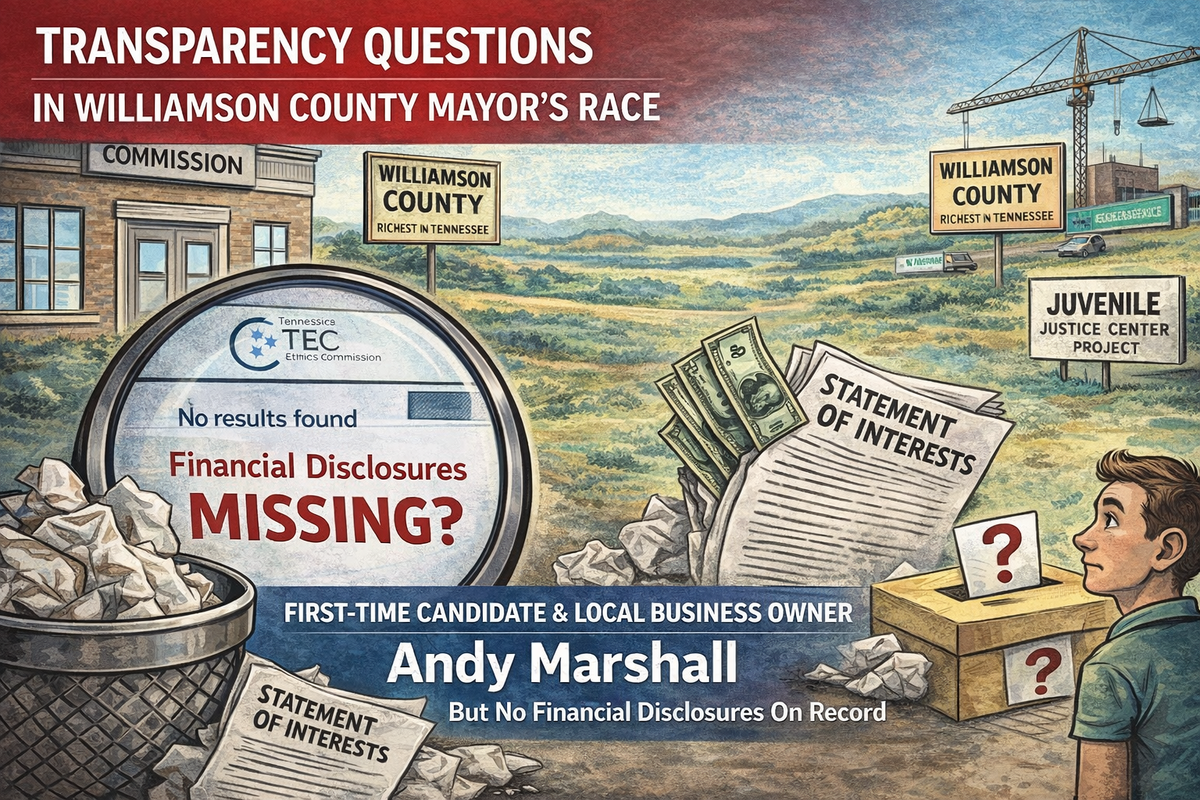
- Required financial disclosure missing: Andy Marshall’s Statement of Interests has not been posted two weeks after the March 21 deadline.
- Verified absence: Searches of the Tennessee Ethics Commission database show no filing under his name or for the Williamson County Mayor race.
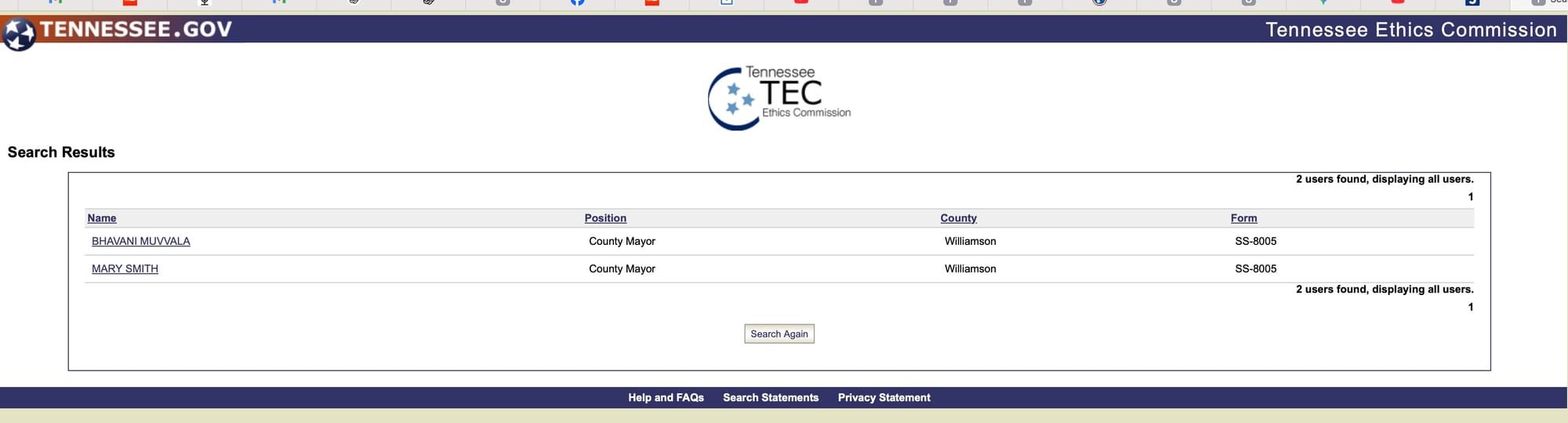
- Other candidates complied: Opponents Mary Smith and BK Muvvala filed on time and appear in the system.
- Transparency matters: These disclosures are required by law so voters can evaluate potential financial conflicts before voting.
- Timing is critical: With early voting beginning April 15, voters are being asked to decide without information they are legally entitled to review.
👉 Read the full article for complete details and context.
When voters consider a candidate for an office as consequential as county mayor, they are not simply choosing a personality or a platform, they are entrusting someone with real authority over their community, their tax dollars, and decisions that shape daily life. That level of responsibility demands transparency, particularly when it comes to financial interests that could influence how decisions are made once in office.
That is precisely why Tennessee law requires candidates to file a Statement of Interests, disclosing financial holdings and potential conflicts. These disclosures are not optional, nor are they symbolic. They exist so voters can evaluate whether a candidate’s private interests might intersect with public duties. Under state law, candidates for local public office must submit these disclosures to the Tennessee Ethics Commission within a defined timeframe, generally 30 days after the qualifying deadline, and those filings must be made publicly available.
The law is explicit about what must be disclosed and how. Required information includes financial interests, sources of income, business relationships, family-held investments, and prior bankruptcies. The filing must be completed in a prescribed format, properly witnessed, and posted as a public record. These requirements are codified across multiple sections of Tennessee law, and failure to comply is not a gray area, it is a violation that may carry civil penalties.
In the case of Williamson County mayoral candidate Andy Marshall, that transparency is not currently available to voters.
According to documentation provided to TruthWire News by a Williamson County citizen, Marshall’s Statement of Interests was due on March 21, 2026. Yet as of early April, it has not been posted publicly. This delay comes at a critical moment, with early voting set to begin April 15.
To verify whether the filing had been submitted or posted, TruthWire conducted multiple searches in the Tennessee Ethics Commission’s public database. A search for “Andy Marshall” and “Andrew Marshall” returned no results associated with a Williamson County mayoral candidate. A broader search by position,County Mayor in Williamson County, with no name entered, returned only two candidates: Mary Smith and Bhavani “BK” Muvvala. Marshall’s name did not appear.
To eliminate the possibility of a filing under a different classification, TruthWire conducted a general search using only the last name “Marshall,” with no filters for position or county. That search returned numerous individuals across Tennessee, confirming the system is active and populated. However, none of those entries included an Andy or Andrew Marshall, nor any candidate for Williamson County Mayor.
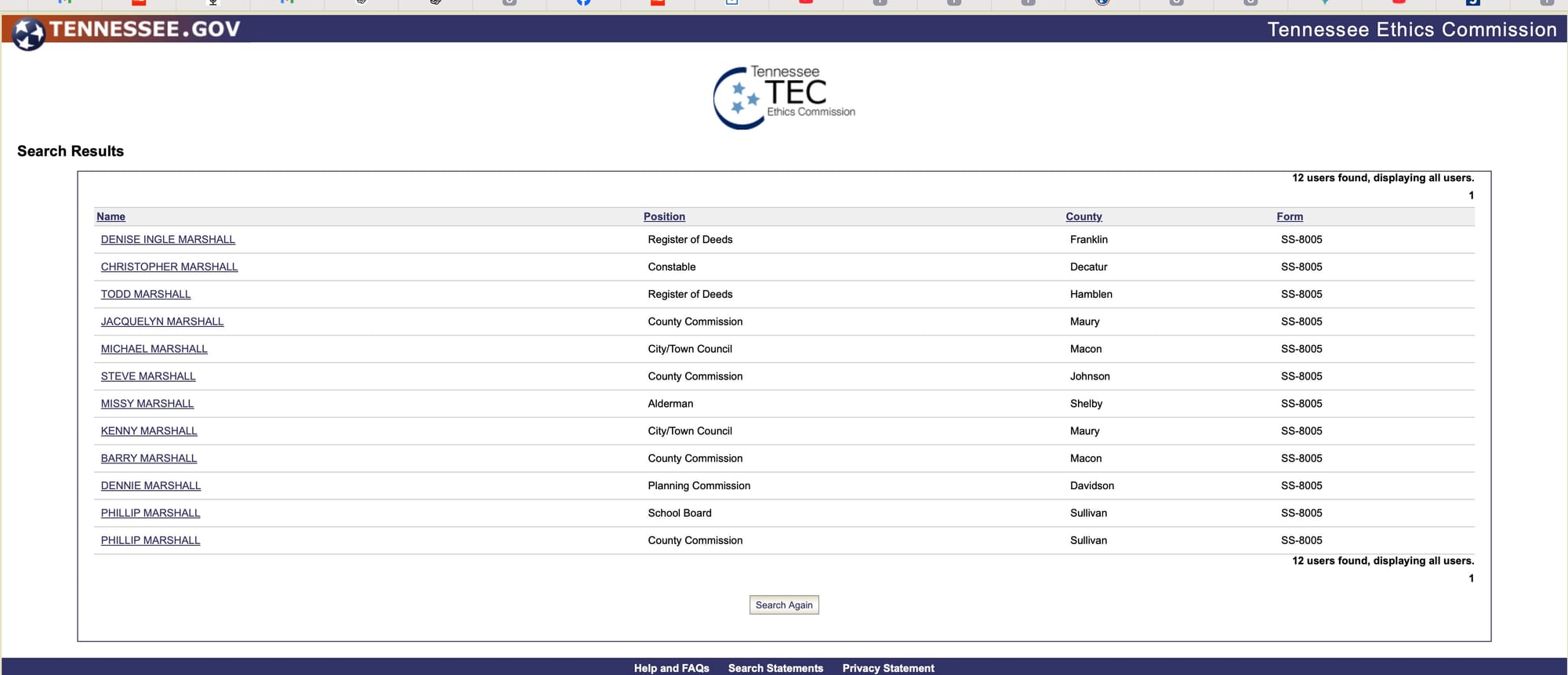
In a system specifically designed to ensure public access to candidate disclosures, the absence of a candidate from the database is not a technical detail, it is the issue.
It is also important context that Andy Marshall is a first-time candidate, but not an unknown figure. As the owner of the Puckett’s restaurant chain, he is a well-established presence in Williamson County, with deep ties to the local business and civic community. His campaign kickoff reportedly included notable figures such as Governor Bill Lee, musician Michael W. Smith, and financial advisor Dave Ramsey.
That level of connection is not unusual for a successful business owner, but it does underscore why disclosure laws exist. Candidates entering public office with extensive business relationships may naturally have more areas where private interests and public responsibilities could intersect. That is not an allegation of wrongdoing, it is precisely why transparency is required.
From a voter’s perspective, the issue is not whether those relationships exist, but whether they are disclosed in a way that allows for informed decision-making. In a role like county mayor, where decisions can involve development, contracts, and major taxpayer-funded projects, voters have a legitimate interest in understanding any financial or business interests that could be perceived, rightly or wrongly, as influencing decisions.
That interest is even more pronounced in Williamson County, widely recognized as the wealthiest county in Tennessee. The scale of public spending, development activity, and contractual opportunities is significant. Decisions made at the county level can involve multi-million-dollar projects and long-term planning that shape the region’s future.
For example, as the county considers large capital investments such as the proposed Juvenile Justice Center and other major initiatives, voters may reasonably want to review any disclosed interests that could intersect with industries involved in those efforts. Again, this is not an allegation, it is the function of disclosure laws: to provide transparency before decisions are made, not after.
Without a filed and publicly available Statement of Interests, that transparency is simply not there.
The citizen who provided documentation to TruthWire has prepared a formal complaint outlining the missed deadline and lack of public disclosure. That complaint is expected to be hand-delivered to the Tennessee Ethics Commission on Monday morning, just days before early voting begins.
The timeline itself is not in dispute. Candidates were informed of filing requirements in advance, and Tennessee law clearly defines how compliance timelines are calculated. The deadline is not flexible, it is a baseline legal requirement tied directly to transparency and accountability.
Failure to meet that requirement is not merely procedural. Under Tennessee law, violations of disclosure statutes may result in civil penalties, including escalating fines depending on the duration of noncompliance. More importantly, the requirement exists as part of a broader framework to ensure voters have access to relevant information before casting a ballot.
At the same time, enforcement does not always move at the speed of elections. The Tennessee Ethics Commission typically acts through a formal process, complaints must be filed, reviewed, and addressed. Until a complaint is formally submitted, action may not be triggered at all.
And that is where timing becomes critical.
Because while the process may begin when a complaint is delivered, the statutory deadline has already passed, and early voting is about to begin. Government processes may move deliberately, but elections do not wait.
It is also notable that Marshall’s opponents, Mary Smith and BK Muvvala, complied with the same requirement and appear in the Ethics Commission database accordingly. The process is neither unclear nor inaccessible, every candidate is subject to it, and every candidate is expected to meet it.
And that raises questions voters are left to consider. Why has the filing not been submitted or posted weeks after the deadline? Why has there been no visible urgency to resolve the issue before voting begins? And what does it say about accountability when a clearly defined legal requirement remains unmet this close to an election?
When voters choose a county mayor, they are selecting someone to manage deadlines, oversee complex operations, and make decisions that affect neighborhoods, churches, and families across the county. Those responsibilities require discipline, organization, and respect for process.
When a required financial disclosure is not just late, but absent from the public record, it inevitably invites scrutiny, not as an accusation, but as a matter of transparency.
With early voting beginning April 15, voters are being asked to make a decision without information they are legally entitled to have.
If you want to support what we do, please consider donating a gift in order to sustain free, independent, and TRULY CONSERVATIVE media that is focused on Middle Tennessee and BEYOND!