One of Multiple Party-Registration Bills Returns Today After Failing Last Session — While a Stronger Version Still Sits Stalled in the Senate
One of Tennessee’s party-registration bills returns today—after last year’s Senate stall. House moves; Senate gatekeepers decide if primaries ever close.

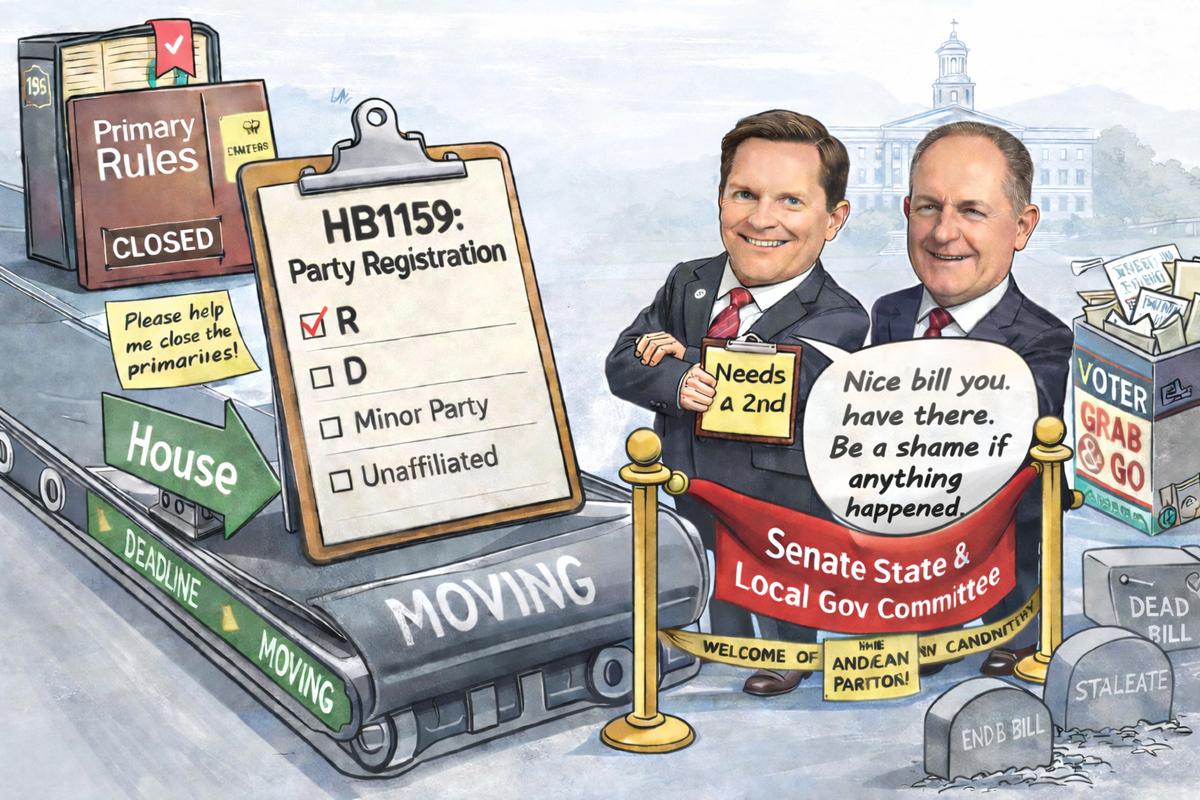
NASHVILLE — At 3:00 p.m. today, the House Elections & Campaign Finance Subcommittee is scheduled to hear HB 1159 (Rep. Susan Lynn), paired with SB 0831 (Sen. Joey Hensley), one of multiple party-registration proposals being re-presented in the new session after variations of the same concept failed to become law last year.
Supporters say these bills are meant to curb crossover voting and restore integrity to primary elections. But history suggests the biggest obstacle isn’t the House — it’s whether the Senate will allow primary reform to reach the floor.
The Bill Being Heard Today: HB 1159 / SB 0831
HB 1159 would require Tennessee’s voter registration record to include a voter’s political party affiliation (or an “unaffiliated” designation). If a voter refuses to choose, the county election commission must record the voter as unaffiliated.
In effect, this bill pushes Tennessee toward party registration by making affiliation part of the permanent record — adding friction to casual, strategic primary participation.
The Bill Still Stalled in the Senate: Todd/Lowe (HB 0886 / SB 0777)
A separate elections reform effort last session — HB 0886 (Rep. Chris Todd) / SB 0777 (Sen. Adam Lowe) — ultimately died in the Senate State & Local Government Committee for lack of a second. Lowe was not a late addition: he was always the Senate sponsor, yet he was unable to get the committee to even provide the second necessary to move it forward.
That stalled bill matters because it reflects a stricter direction than “affiliation as a label.” In this policy lane, stronger versions typically do more than record affiliation — they create a meaningful mechanism to prevent last-minute party hopping and enforce primary participation rules.
Which Approach Better Stops Crossover Voting?
Here’s the practical difference:
- HB 1159 (Lynn/Hensley) creates a party affiliation field in the voter file. That increases transparency and reduces “fluid” primary participation, but its real effectiveness depends on whether it creates a meaningful barrier to switching.
- The stronger model — and the one voters have repeatedly demanded — is the “close the books” concept: party affiliation is recorded and changes are restricted ahead of a primary by a firm deadline. That is what actually shuts down opportunistic crossover voting.
Put simply: recording affiliation is a step; locking it in ahead of the primary is the stop.
Florida’s Example: Party Registration Isn’t the Point — Enforcement Is
Florida has had closed primaries for decades, but the reason it functions as a true barrier to crossover voting is not merely that party affiliation exists — it’s that Florida built in rules that effectively “close the books.” In other words, you can’t wait until a hot primary is underway and simply flip your affiliation at the last minute without consequence. Deadlines and administrative friction matter because they force voters to make a real choice in advance.
Analysts of Florida’s political transformation have long pointed out that the state’s evolution from a perennial “swing state” into something steadily more conservative did not happen in a vacuum. A closed-primary system with real deadlines changes incentives: candidates stop campaigning to the opposing party’s voters in primaries, grassroots coalitions have a stronger hand in nomination outcomes, and the electorate’s party coalitions become more stable over time.
Whatever you think of Florida’s trajectory, it is hard to argue that “party registration without deadlines” and “party registration with deadlines” produce the same political ecosystem. They don’t.
The Senate Problem Isn’t “Support.” It’s Follow-Through.
The collapse of SB 0777 last session is revealing because the sponsor list included leadership names with real power: Senate Majority Leader Jack Johnson and House Speaker Cameron Sexton signed on as co-sponsors. These are not legislators without leverage. If they truly want something passed, they generally have the influence to move it.
Yet the bill still died in committee — producing what Tennessee voters have seen repeatedly: plausible deniability. Leadership can point to the sponsor list and claim support, while the Senate committee quietly kills the bill and nothing changes.
“Close the Primaries” Has Been Demanded for Years — Yet Bills Keep Dying
For years, Tennessee voters — and even the Tennessee GOP itself — have demanded primary reform. The cycle has become familiar:
- Primary reform bill filed
- Grassroots rally behind it
- Sponsors sign on (often including leadership)
- Senate committee stalls it
- The same issue returns next session in a slightly different form
HB 1159 is the latest entry in that cycle — a reintroduced approach that will test whether the General Assembly intends to move beyond symbolism.
The Twist: Leadership Helped Cement Open Primaries to the County Level
There’s another uncomfortable piece of context. Jack Johnson, along with Rep. Lee Reeves, passed HB 855 / SB 0799 — legislation that forces open primaries all the way down to the county level, limiting the ability of political parties to choose their nomination process under First Amendment associational principles.
That move cut against what many conservatives were demanding. Instead of empowering parties to tighten participation rules, the state moved toward a structure that effectively locks in open primaries, constraining local control.
That is the opposite of closing the primaries.
What to Watch at 3 PM
TruthWire will be watching today for:
- Whether the bill is amended to include a real deadline for party switching
- Whether members acknowledge the central obstacle: Senate committee gatekeeping
- Whether leadership signals any intention to move the stalled Senate version — or whether this is another year of “support” without passage
If HB 1159 advances, the question becomes less about the House and more about whether the Senate will do what it failed to do last session: let primary reform reach the floor — and let members vote on it in the open. To watch the live stream at 3 pm, click here.
Please reach out to the entire committee here:
(Chair)Rep Tim Rudd: rep.tim.rudd@capitol.tn.gov
Rep. Rush Bricken: rep.rush.bricken@capitol.tn.gov
Rep. Dan Howell: rep.dan.howell@capitol.tn.gov
Rep. Tom Leatherwood: rep.tom.leatherwood@capitol.tn.gov
Rep. Jerome Moon: rep.jerome.moon@capitol.tn.gov
Rep. Jason Powell: rep.jason.powell@capitol.tn.gov
Rep. Dave Wright: rep.dave.wright@capitol.tn.gov
If you want to support what we do, please consider donating a gift in order to sustain free, independent, and TRULY CONSERVATIVE media that is focused on Middle Tennessee and BEYOND!