
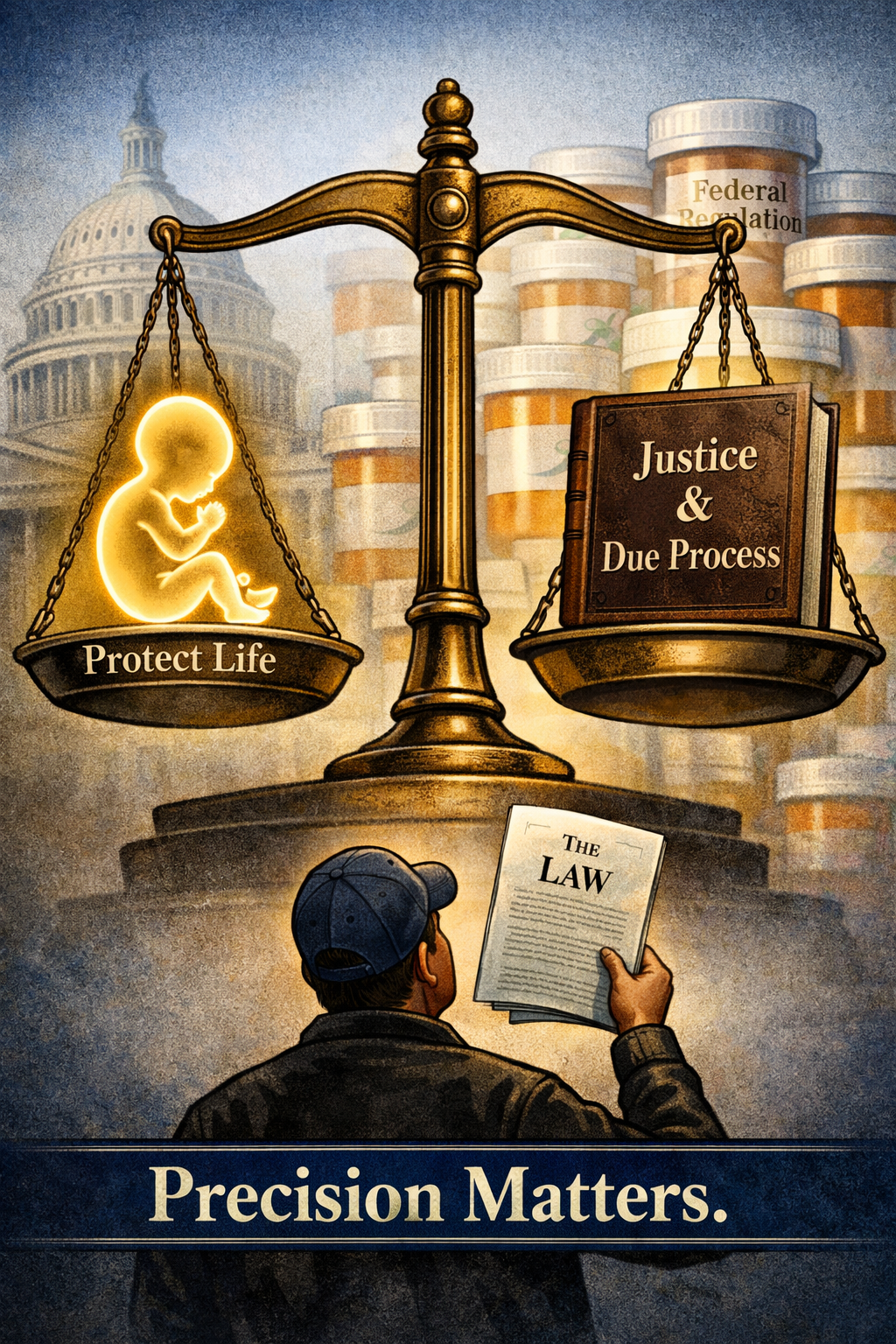
After Dobbs returned abortion policy to the states, federal deregulation of chemical abortion created unintended consequences. Protecting life now requires restoring accountability, precision in lawmaking, and justice grounded in both truth and mercy.
In the years following Dobbs v. Jackson Women’s Health Organization, state legislatures inherited responsibilities federal courts avoided for nearly half a century. Questions once filtered through constitutional litigation now fall directly upon lawmakers tasked with balancing moral conviction, legal restraint, and practical governance. Few issues illustrate that challenge more clearly than abortion policy.
For many Americans, the end of Roe v. Wade represented an opportunity to restore meaningful protections for unborn life through democratic processes. Yet the legal landscape that emerged afterward has proven far more complicated than a simple return to earlier frameworks. Abortion did not disappear. Instead, it changed form.
Chemical abortion has rapidly become the dominant method nationwide, driven less by state legislation than by federal regulatory decisions made long before Dobbs returned authority to the states.
When the Food and Drug Administration first approved mifepristone at the end of the Clinton administration, the agency imposed significant safeguards recognizing the seriousness of the drug’s risks. Physicians were required to dispense the medication in person, confirm gestational age, rule out ectopic pregnancy, and provide follow-up care capable of addressing complications. Those restrictions reflected an understanding that abortion drugs were not simply another prescription medication. They involved substantial medical judgment and carried potentially life-threatening consequences if used improperly.
Over time, those guardrails weakened.
Regulatory revisions expanded eligibility windows, reduced physician oversight requirements, and narrowed adverse-event reporting obligations. During the period of extraordinary federal emergency powers beginning in 2020, remaining in-person dispensing requirements were suspended through litigation and agency discretion. What began as temporary flexibility soon became permanent policy. In December 2021, the Biden administration eliminated the in-person dispensing requirement altogether, allowing abortion drugs to be prescribed remotely and shipped through interstate courier networks.
By early 2023, certified pharmacies were authorized to distribute mifepristone by mail wherever state law permitted.
These changes occurred before many states regained authority to regulate abortion following Dobbs.
The result was predictable.
States suddenly tasked with protecting unborn life found themselves confronting a nationwide pharmaceutical distribution system largely shaped by federal administrative action rather than local democratic choice.
Polling suggests voters recognized the shift. Research summarized by the Family Research Council, drawing upon survey data conducted by Susan B. Anthony Pro-Life America, found significant concern among Republican voters regarding abortion drugs prescribed remotely without physician oversight or shipped across state lines. Many respondents viewed those changes as bypassing longstanding medical safeguards.
Historical timelines documenting the regulatory history of mifepristone also include criminal misuse cases involving abortion drugs administered without consent, including abusive partners secretly drugging pregnant women. Such incidents underscore a reality often overlooked in political debate: abortion policy exists within complicated human circumstances shaped by coercion, manipulation, and vulnerability.
Yet frustration with federal deregulation has increasingly pushed states toward criminal law responses that may not ultimately address the underlying problem.
Even if a future administration restores stricter dispensing safeguards for mifepristone, another complication remains.
Misoprostol — widely prescribed for ulcers, miscarriage management, labor induction, and postpartum care — is deeply embedded throughout American medicine. Because it serves numerous legitimate purposes unrelated to abortion, broad restrictions on distribution would collide directly with routine healthcare.
In practical terms, chemical abortion no longer depends entirely upon a single regulated drug.
That reality complicates attempts to address a nationwide pharmaceutical distribution problem through criminal penalties directed primarily at individuals rather than systems.
Some legislative proposals have therefore turned toward expanding criminal statutes themselves, seeking to extend identical homicide or assault protections to unborn children from fertilization forward. The moral instinct behind those efforts is clear. If unborn life possesses inherent dignity, equal protection appears logically consistent.
Yet pregnancy introduces legal circumstances fundamentally different from traditional criminal law.
A born person exists independently.
An unborn child does not.
Criminal statutes governing homicide assume separate actors capable of independent intent and independent action. Pregnancy necessarily intertwines two lives within a single body, often under circumstances shaped by forces beyond the control of the person carrying the child. Domestic abuse, financial coercion, trafficking, addiction, mental incapacity, or credible threats from partners or family members may influence decisions long before investigators attempt to reconstruct events.
Courts throughout the United States have imposed significant prison sentences in multiple prosecutions involving individuals who fraudulently or covertly administered abortifacient drugs to pregnant women without their knowledge or consent.
Supporters sometimes argue that additional statutory safeguards are unnecessary because existing homicide defenses already recognize duress or lack of intent. Courts, they suggest, would simply apply those doctrines as they would in any other case involving a born victim.
In theory, that assumption depends upon institutional restraint.
Recent experience suggests caution.
During covid, beginning in 2020, Americans witnessed how rapidly government authority could expand when statutory ambiguity permitted broad interpretation. Policies affecting employment, education, travel, and personal medical decisions shifted quickly as agencies exercised authority expansively in response to perceived necessity.
Regardless of individual views about those policies, one lesson became difficult to ignore: when government believes authority exists, it exercises it.
Modern governance increasingly treats ambiguity as permission rather than limitation.
Criminal statutes drafted without explicit safeguards therefore place extraordinary weight on prosecutorial discretion. Prosecutors are elected officials operating within political environments shaped by public pressure and shifting priorities. Laws written broadly enough to depend upon assumed mercy may eventually be enforced by individuals whose decisions are influenced as much by political climate as legal philosophy.
Pregnancy magnifies that risk.
Because the unborn child exists entirely within another body, intent and autonomy cannot be separated as cleanly as they can between independent persons. Abuse, coercion, incapacity, or manipulation may shape decisions long before legal scrutiny begins.
Justice should not depend upon whether restraint happens to prevail in each election cycle.
It should be written into the law itself.
Historically, American abortion enforcement reflected a distinction between intentional wrongdoing and circumstances shaped by compromised autonomy. Enforcement traditionally focused on those performing unlawful procedures or profiting from them rather than presuming identical culpability in every circumstance involving the mother herself.
Safeguards written into law do not weaken protection for life. They clarify intent so that justice targets deliberate wrongdoing without capturing victims of circumstances the criminal law was never meant to punish.
The deeper challenge facing pro-life states today did not begin in state legislatures.
It began with federal regulatory decisions made before those states regained authority to act.
Until the federal government revisits the dismantling of safeguards originally implemented at the end of the Clinton administration, loosened during covid, and ultimately eliminated under the Biden administration, states seeking to protect unborn life will continue confronting a regulatory landscape largely beyond their control.
Faced with that reality, legislatures may feel compelled to adopt increasingly severe criminal deterrents simply to counteract access created elsewhere.
But deterrence drafted in frustration, risks enforcement shaped by politics rather than justice.
A deeper concern underlying many of these debates is whether law can accomplish moral transformation through punishment alone. Within the Christian tradition, long reflected in Western legal thought, government is entrusted with the authority to wield the sword for the preservation of justice — not as a substitute for conscience or repentance within the people themselves. Laws divorced from the moral consent of those governed risk becoming instruments of coercion rather than guardians of order.
History repeatedly demonstrates that even well-intentioned moral mandates imposed upon an unwilling or unprepared society can resemble the very systems Americans instinctively reject — regimes where compliance is compelled without conviction. A nation seeking to protect life must therefore ensure that its laws reflect both righteousness and restraint, persuading hearts where possible and reserving punishment for clear and intentional wrongdoing.
The Food and Drug Administration is now conducting a renewed review of mifepristone even as several states pursue litigation seeking restoration of earlier safeguards. At the same time, the Department of Justice has asked federal courts to stay portions of that litigation while the agency completes its scientific review — an acknowledgment that regulatory action may again reshape the legal framework.
The regulatory question is open once more.
Citizens who believe unborn life deserves protection must recognize that the overturning of Roe v. Wade did not settle the issue; rather, it shifted the focus to the federal level. Despite state-level bans, the rise of telemedicine and the dismantling of long-standing FDA safety regulations have created a new reality where abortion drugs can bypass state lines. Because these federal agencies operate under authority granted by Congress, the most effective strategy for meaningful change is to engage with Senators and Representatives. They hold the power to demand rigorous oversight, reform agency leadership, and ensure that federal regulations once again prioritize the protection of women and the unborn
Restoring accountable dispensing safeguards and transparent reporting requirements addresses the root of the modern abortion landscape, rather than forcing states into impossible choices.
Protecting unborn children should never require abandoning mercy toward women confronting coercion or compromised autonomy.
Law written with precision can preserve both.
In the years ahead, lawmakers will be judged not only by how strongly they acted, but by whether they chose solutions capable of protecting life without sacrificing the principles of justice that give law its legitimacy.
If you want to support what we do, please consider donating a gift in order to sustain free, independent, and TRULY CONSERVATIVE media that is focused on Middle Tennessee and BEYOND!
Comments ()