Reagan Day Gala Straw Poll Sparks Competing Narratives as Lara Logan Issues Stark Warning to Republicans
Williamson County’s Reagan Day Gala drew 600+ Republicans, but the governor’s straw poll quickly sparked debate. Critics say the “70% victory” headline masks deeper questions about turnout, ticket purchases, and what the results really reveal.

The Williamson County Republican Party’s annual Reagan Day Gala drew more than 600 attendees Friday night at the Franklin Marriott Cool Springs, once again cementing its status as the county party’s largest political gathering of the year. But while the event itself was widely viewed as a major success for the Williamson County Republican Party, much of the post-event discussion has centered on a gubernatorial straw poll that has generated sharply different interpretations among activists and campaigns.
The poll included three prominent Republican figures: Marsha Blackburn, John Rose, and Monty Fritts.
Before the results began circulating online, however, the evening itself had already been widely praised by attendees.
More than 630 tickets were sold, with additional VIP guests filling the venue. The event’s theme celebrated the approaching 250th anniversary of American independence, with Revolutionary-era imagery woven throughout the program.
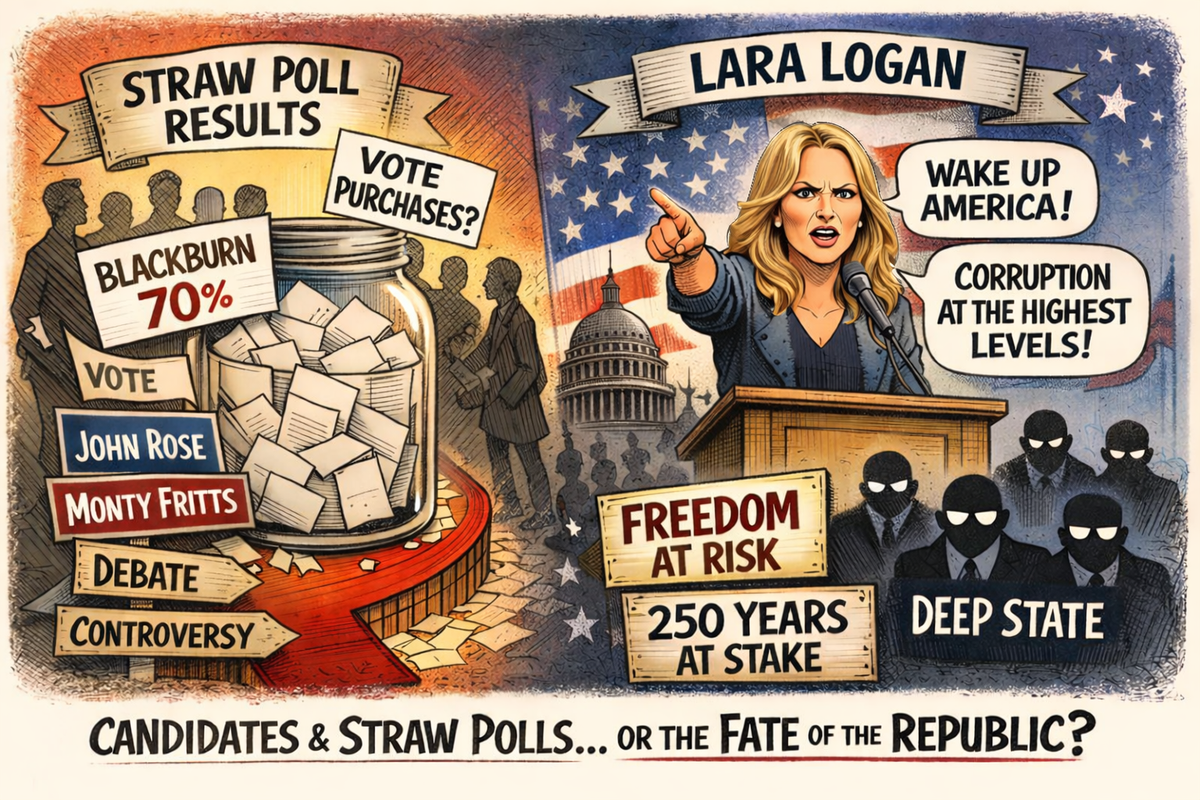
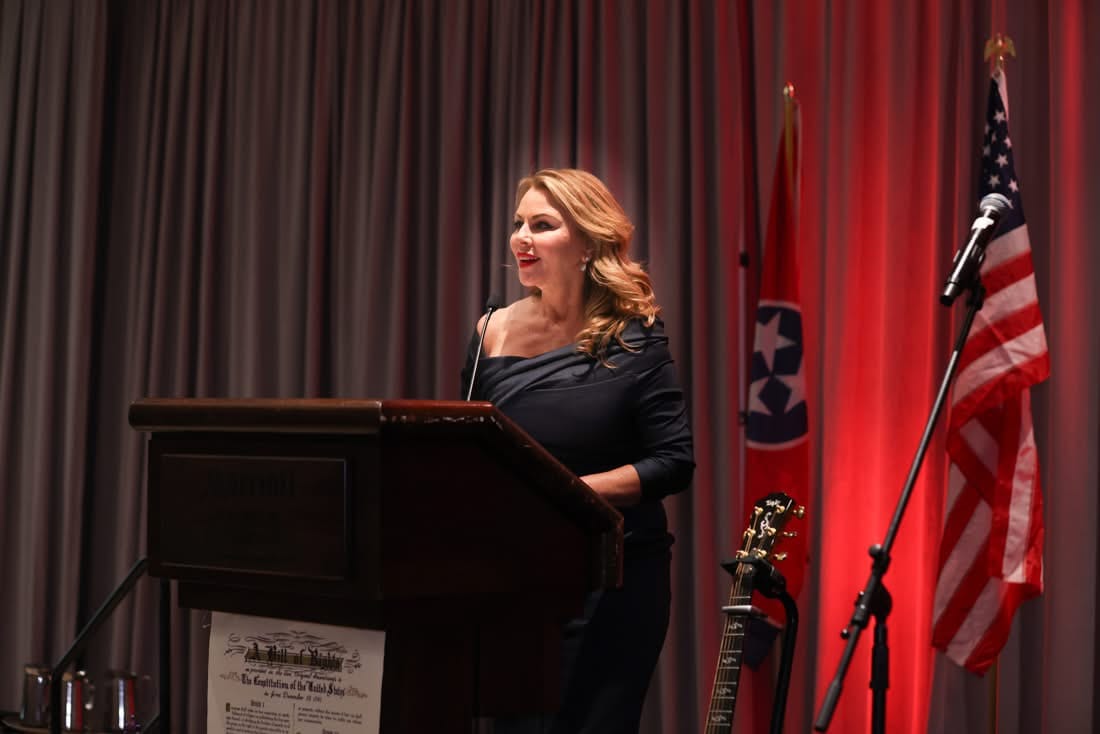
The keynote address was delivered by investigative journalist Lara Logan, whose remarks quickly became one of the defining moments of the evening. Logan delivered a sweeping warning that corruption and political influence have infiltrated the highest levels of the federal government and urged Americans to recognize what she described as a pivotal moment in the nation’s history. Her message—that citizens must awaken to the dangers facing the republic or risk losing freedoms preserved for nearly 250 years—resonated strongly with many in attendance.Still, it was the straw poll results that soon dominated discussion across Tennessee political circles.
Of the 374 ballots cast in the gubernatorial race, Marsha Blackburn received 70.6 percent of the vote. Monty Fritts finished second with 15.8 percent, while John Rose came in third with 13.6 percent.
Supporters of Blackburn quickly pointed to the results as confirmation of her political strength heading into the 2026 gubernatorial primary. Blackburn thanked supporters on social media shortly after the event concluded, celebrating the outcome and expressing appreciation for those who attended.
Yet the meaning of the results quickly became a subject of debate.
Of the more than 630 attendees at the gala, only 374 ultimately cast votes in the governor’s straw poll—approximately 59 percent participation. Several logistical factors contributed to that figure. In order to preserve ballot secrecy, only one person at a time was allowed to enter the voting area, creating lines that reportedly stretched for much of the evening. Many attendees faced a choice between waiting 20 to 30 minutes to vote or returning to the program.
As a result, a significant number of people present never cast ballots.
Another factor attracting attention involved campaign ticket purchases. According to figures discussed among party activists, entities connected to Blackburn’s campaign purchased roughly 310 tickets to the event. Those purchases included tickets bought directly by the campaign as well as additional tickets purchased by Team Tennessee PAC, a political action committee associated with Republican strategist Ward Baker.
By comparison, the campaign of John Rose reportedly purchased 10 tickets, while Monty Fritts neither purchased tickets nor attended the event.
Supporters of Blackburn note that purchasing tables and blocks of tickets is a common practice at political fundraisers and provides significant financial support to local party organizations.
Critics argue that large ticket purchases can influence straw poll outcomes because participation is limited to those physically present at the event.
Ironically, many of the same voices who typically align with Marsha Blackburn, Jack Johnson, and other establishment Republicans often make a nearly identical argument against party voting conventions. In that context, they contend that restricting participation to those able to attend in person effectively disenfranchises party members who, for any number of reasons, are unable to be present to cast a vote.
Which leads to the apparent conclusion that holding a vote on a single day, in a single room, using paper ballots becomes acceptable—so long as participation is effectively determined by one’s ability to pay.
Another factor shaping the conversation is geography. Marsha Blackburn resides in Williamson County and previously served as chair of the county party decades earlier, giving her deep political roots in the area.
Even so, some observers noted that Monty Fritts finished second despite not attending the event, not purchasing tickets, and not delivering a speech. For his supporters, that outcome suggests a meaningful level of grassroots support among Republican voters even without traditional campaign spending or event participation.
Meanwhile, the results have raised questions among some activists about the campaign of John Rose, who has spent significantly more on early campaign efforts but finished third in the poll.
The reaction to the straw poll also illustrates how quickly political narratives can take shape. While the official totals from the Williamson County Republican Party were not released until the following day, after the event concluded, a graphic circulated on social media declaring that Marsha Blackburn the winner of the gubernatorial straw poll.
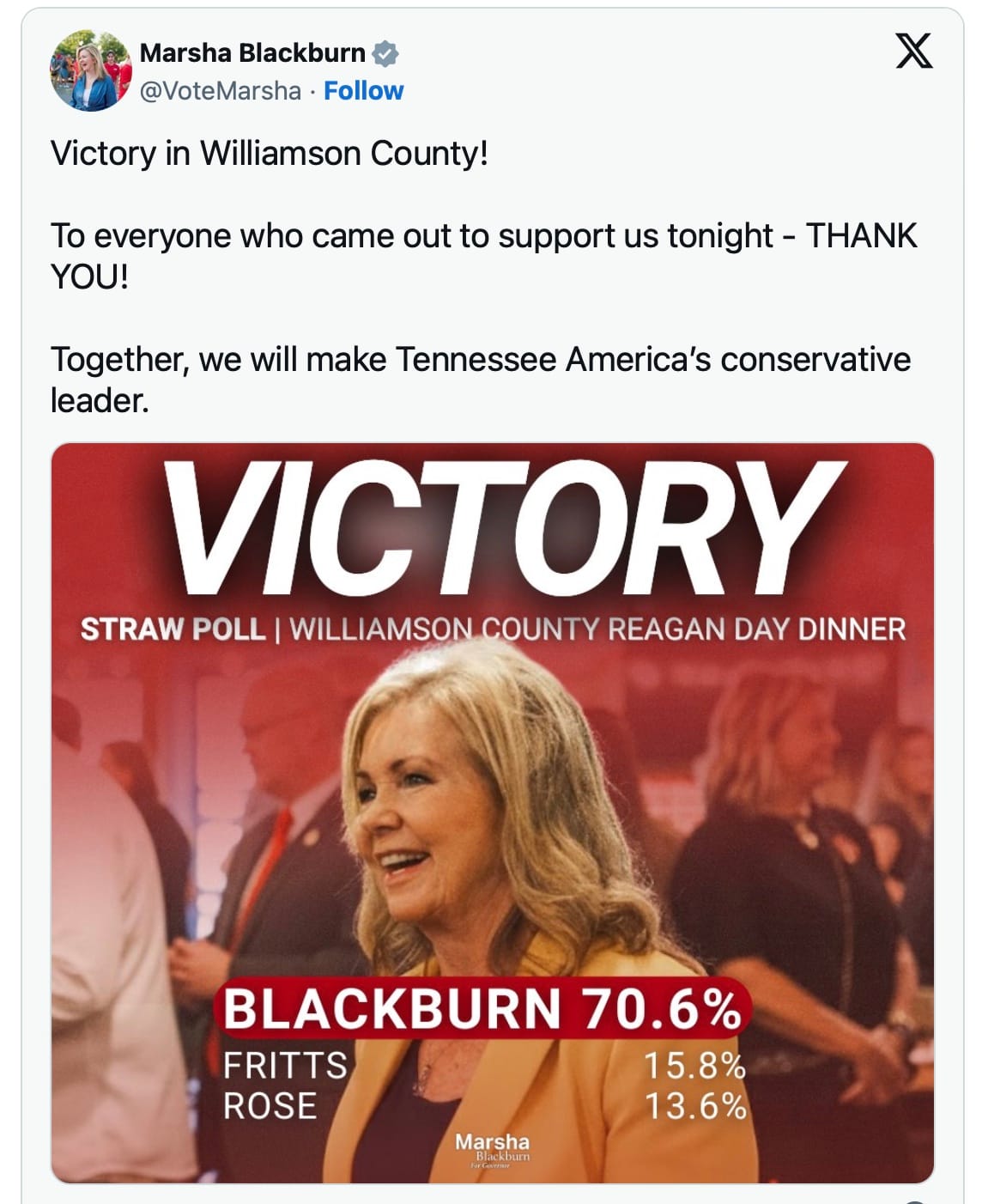
While the graphic circulating on social media suggested that Marsha Blackburn captured roughly “70%” of the vote, the underlying numbers tell a more nuanced story. The official tally showed 264 votes for Blackburn, 59 for Monty Fritts, and 51 for John Rose. While that percentage reflects the ballots actually cast, critics argue that presenting the result as a sweeping show of support overlooks the broader context of the evening. With hundreds of seats reportedly reserved through campaign-related ticket purchases, and a significant number of attendees choosing not to wait in the lengthy voting line, the headline figure conveys an impression of overwhelming grassroots enthusiasm that does not fully reflect the composition of the room or the dynamics surrounding the vote.
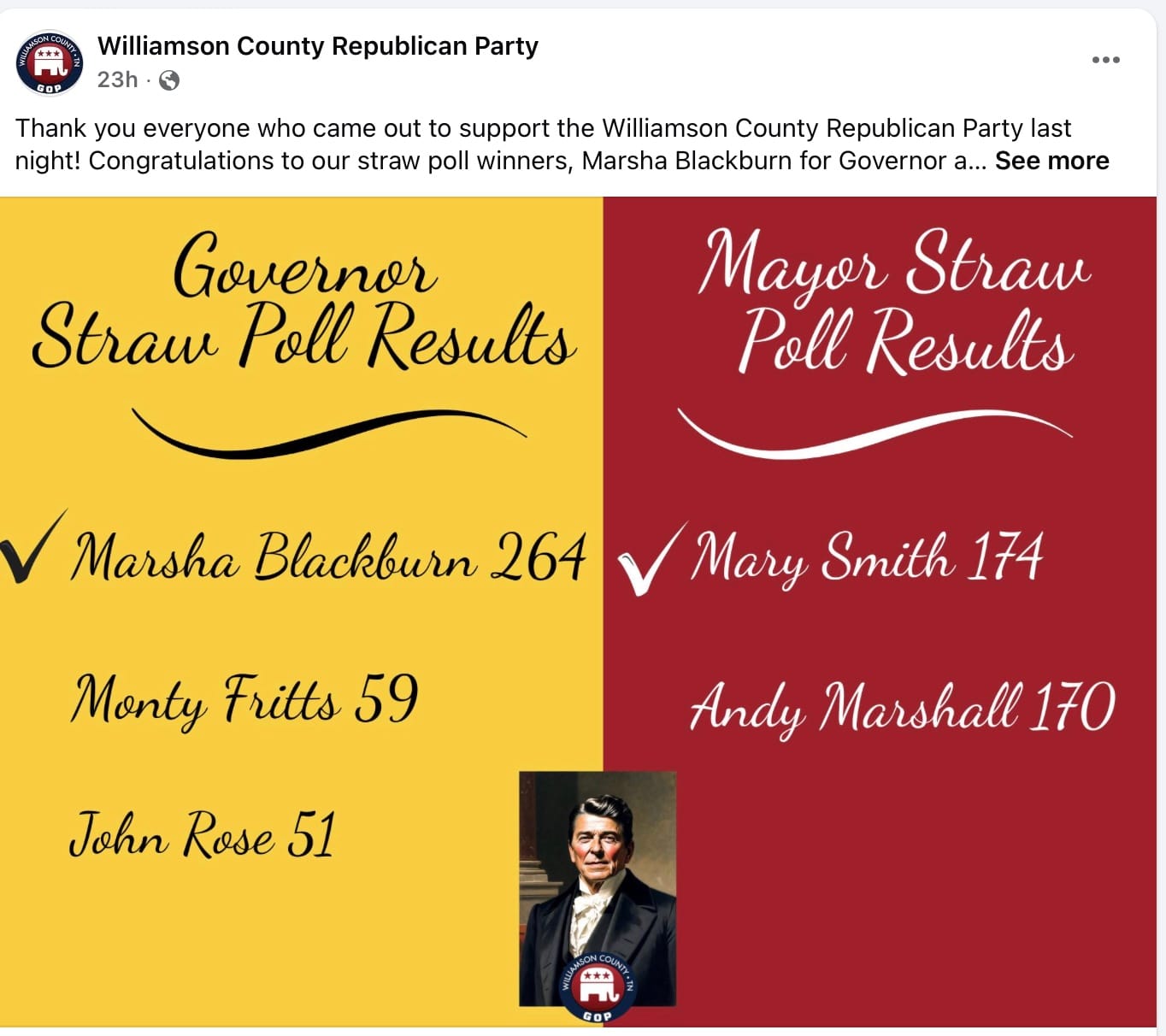
While the gubernatorial race dominated headlines, the mayoral straw poll may provide a clearer snapshot of the political dynamics within Williamson County itself. In that race, Mary Smith narrowly edged out Andy Marshall by a vote of 174 to 170. Unlike the governor’s race, where large numbers of tickets were distributed through campaign purchases, the mayoral contest appears to have been less affected by those dynamics. As a result, some observers view the close result as a more accurate reflection of the ongoing power struggle that has shaped Williamson County Republican politics over the past several years.
In the end, the competing interpretations of the straw poll say as much about political messaging as they do about the numbers themselves. Supporters of Marsha Blackburn view the result as a clear demonstration of her campaign’s reach and organization heading into the gubernatorial primary. Others argue that the headline percentages simplify what was, in reality, a far more complicated set of circumstances influencing the outcome of the vote.
Yet for many in the room, the lasting impression of the evening was not the jars of ballots or the percentages posted online, but the message delivered by Lara Logan. Her warning that corruption has infiltrated the highest levels of the federal government—and that Americans must recognize the moment before it is too late—served as a sobering reminder that the internal battles within the Republican Party are taking place against the backdrop of a far greater struggle over the future of the republic itself.
If Logan’s warning resonated with the audience, the real takeaway from the evening may be that the political battles unfolding in places like Williamson County are only one front in a much larger struggle over the future of the American republic.
If you want to support what we do, please consider donating a gift in order to sustain free, independent, and TRULY CONSERVATIVE media that is focused on Middle Tennessee and BEYOND!