
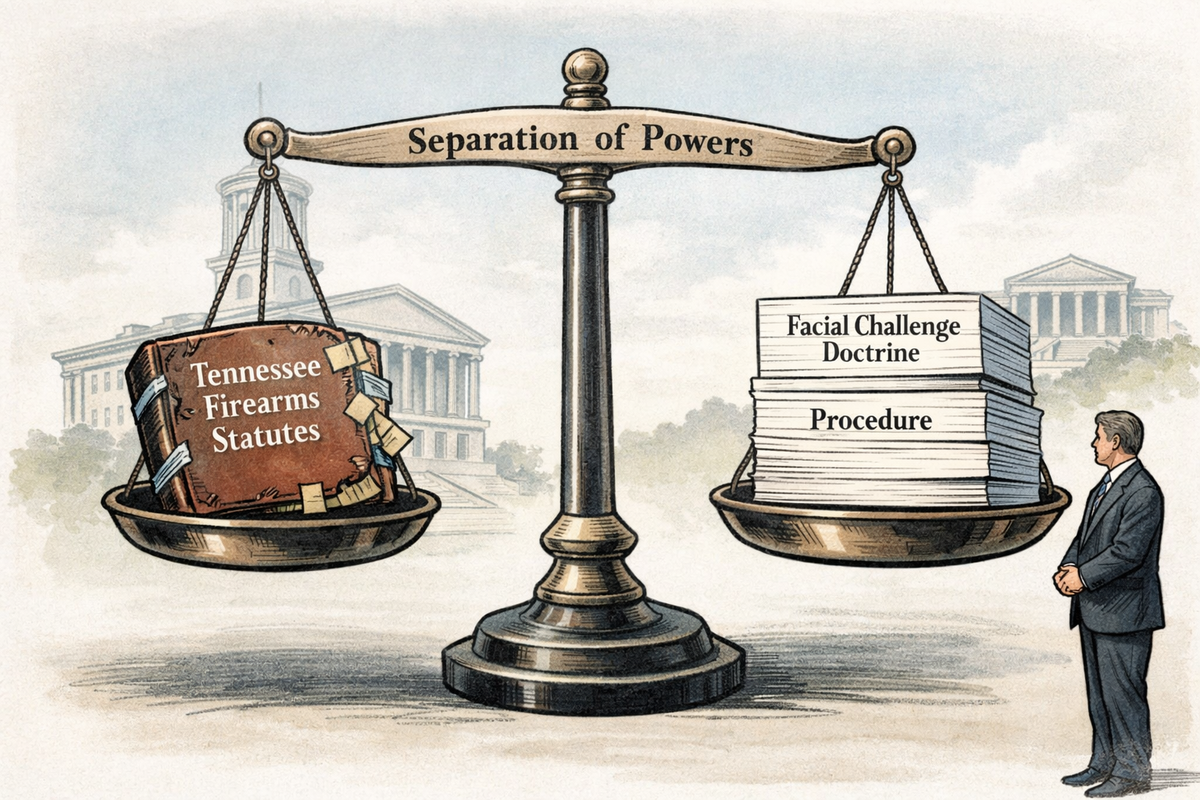
AG Skrmetti defended Tennessee’s gun law on procedure, not constitutionality, arguing courts must defer to lawmakers despite acknowledged defects.
BRENTWOOD, Tenn. — Tennessee Attorney General Jonathan Skrmetti appeared in person at a small group discussion in Brentwood attended by approximately 40 conservative voters, where he addressed questions surrounding Hughes v. Lee, the ongoing litigation challenging Tennessee’s “intent to go armed” statute and related firearms restrictions.
Skrmetti opened the discussion by outlining his office’s rationale for continuing to defend the statute, despite a unanimous three-judge panel having ruled portions of the law unconstitutional. His explanation centered not on support for the substance of the law, but on procedural doctrine and separation-of-powers concerns.
The Attorney General’s stated rationale
Skrmetti emphasized that Hughes v. Lee was brought as a facial constitutional challenge, rather than an as-applied challenge. He explained that under established constitutional law, facial challenges are subject to a high evidentiary burden: plaintiffs must show that no set of circumstances exists under which the law could be constitutionally applied.
He stated that the three-judge trial court erred by invalidating the statute based on its overall sweep rather than applying that strict facial-challenge standard. In his view, the court’s approach improperly allowed it to nullify statutory provisions that may still have constitutionally permissible applications.
Throughout his remarks, Skrmetti described Tennessee’s firearms statutes as complex and historically layered, referring to them as a “Frankenstein’s monster” created by a broad prohibition followed by numerous exceptions. He acknowledged that this structure creates confusion and invites litigation, particularly in the wake of New York State Rifle & Pistol Association v. Bruen, which he said significantly altered Second Amendment jurisprudence.
Skrmetti cited examples of what he considers potentially constitutional applications of the challenged laws, including restrictions on explosive devices and limits on firearm possession by minors. He also noted that licensing regimes for firearms have historically been upheld by courts, even if Tennessee does not currently require handgun permits.
Acknowledgment of constitutional problems
Skrmetti did not dispute that Tennessee’s gun laws face constitutional difficulties after Bruen. He stated multiple times that there are “constitutional problems” with the state’s current statutory framework and conceded that certain applications—such as carrying a long gun for self-defense in rural circumstances—would likely be difficult for the state to defend if challenged as applied.
He referenced a prior decision by his office not to defend an age-based restriction on handgun possession for adults aged 18–20, explaining that the law lacked historical support and was therefore unconstitutional under Bruen. He distinguished that situation from Hughes based on the procedural posture of the case.
Separation of powers and institutional concerns
Skrmetti framed his decision to appeal as rooted in separation-of-powers principles. He argued that courts have authority to block unconstitutional applications of laws but should not invalidate entire statutes when portions may remain constitutional. He warned that relaxing facial-challenge standards could shift policymaking power from the legislature to the judiciary.
He further stated that his office relies on strict facial-challenge doctrine in numerous other contexts, including abortion, First Amendment, and gender-identity litigation. According to Skrmetti, selectively abandoning that standard in firearms cases would undermine the state’s credibility in future litigation.
During the discussion, Skrmetti also commented on the structure of his office, noting that the Tennessee Attorney General is appointed rather than elected statewide and is therefore insulated from direct voter accountability. He described the position as one of the most insulated roles in state government and cautioned against expanding the attorney general’s discretion to decide unilaterally which laws remain enforceable.
In that context, he asserted that he believes himself to be “by far the most conservative attorney general in Tennessee history,” while warning that future occupants of the office may not share those views. He argued that institutional guardrails must be maintained regardless of who holds the position.
Legislative inaction and firearms legislation
Several audience members raised concerns about long-standing legislative inaction, noting that Tennessee has had a Republican supermajority for more than two decades yet retains firearms laws dating back to the Jim Crow era.
Questions regarding recent firearms legislation were posed by Kelly Jackson of TruthWire News, who asked whether newly enacted statutes expanding definitions and enhancing penalties could further compound the constitutional deficiencies already identified in Tennessee’s firearms framework.
Specifically, Jackson referenced SB 1075 and SB 1082, both carried during the most recent legislative session by State Senator Jack Johnson, (the former being co-sponsored by House Speaker Cameron Sexton) the Senate Majority Leader and the Senator representing Williamson County.
SB 1075 expanded the statutory definition of a machine gun and increased penalties associated with unlawful possession, while SB 1082 enhanced criminal penalties tied to possession of a firearm in connection with the “intent to go armed” clause, even in cases involving non-violent or reckless conduct.
Jackson questioned whether these measures, rather than curing existing constitutional issues, risk further entrenching or exacerbating them.
Skrmetti responded that he had not closely reviewed the specific bills discussed and suggested there may be additional statutory or factual considerations involved. He reiterated that legislative policymaking decisions rest with the General Assembly, and that if lawmakers do not address constitutional deficiencies, courts will increasingly do so through litigation.
Ongoing disagreement over approach
While Skrmetti’s explanation focused on procedural doctrine and institutional structure, some attendees expressed concern that defending a statute acknowledged to be constitutionally problematic—based solely on litigation posture—delays meaningful resolution and perpetuates uncertainty for law-abiding Tennesseans.
The approach articulated at the meeting prioritizes adherence to facial-challenge standards over immediate constitutional alignment of the statute itself. Whether that balance appropriately protects individual rights while preserving institutional structure remains a point of disagreement among those present.
Conclusion
The Brentwood discussion highlighted a growing tension within Tennessee’s conservative community: broad agreement that existing firearms laws are constitutionally flawed, paired with differing views on whether courts or the legislature should be compelled—directly or indirectly—to resolve those flaws.
Skrmetti made clear that his office’s defense of the law in Hughes v. Lee is grounded in procedural and separation-of-powers considerations rather than endorsement of the statute’s substance. Whether that approach ultimately promotes constitutional clarity or prolongs legal uncertainty will likely remain a subject of debate as the case continues.
If you want to support what we do, please consider donating a gift in order to sustain free, independent, and TRULY CONSERVATIVE media that is focused on Middle Tennessee and BEYOND!
Comments ()