The $6 Million Loophole: How Federal Money Legally Buys Tennessee’s Governor Race
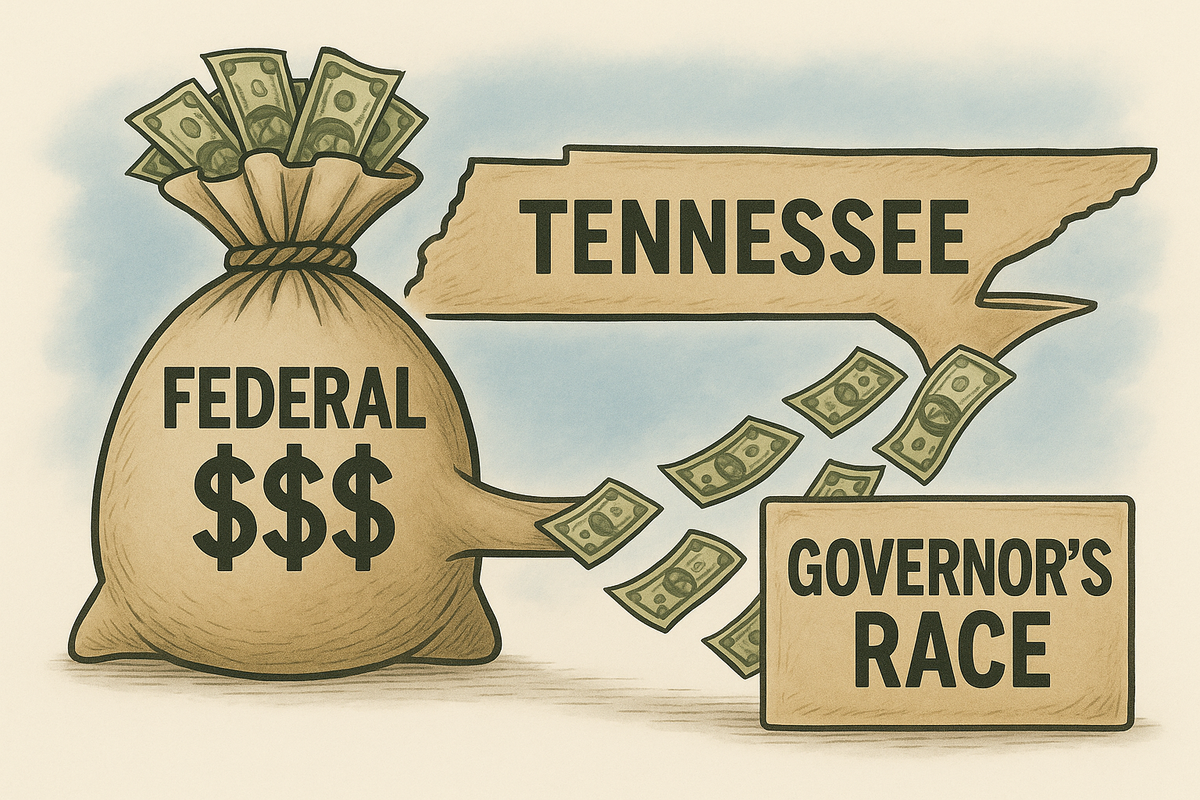
Tennessee bans direct federal-to-state cash transfers — but federal PACs can legally spend millions on consultants & ads that become the state campaign. Marsha Blackburn just spent $6M this way. It’s legal. It’s unfair. It’s how governors are chosen now.

Most Tennesseans still believe federal campaign money and state campaign money live in completely separate universes. Money raised for a U.S. Senate race stays in Washington. Money raised for governor stays in Tennessee. The jobs are different. The issues are different. The donors are usually different. And the voters directly affected by the decisions are certainly different.Tennessee law, however, hands federal officeholders a structural advantage so large that no purely state-level candidate can ever hope to overcome it.
On paper, Tennessee prohibits a candidate from transferring funds directly from a federal campaign account — or from a leadership PAC the candidate controls — into a state campaign account (T.C.A. § 2-10-114(g). That sounds like a solid firewall.In practice, the wall is made of chicken wire.
A sitting U.S. Senator or Congressman spends years cultivating a national donor list. Through digital fundraising, Fox News hits, and conservative podcasts, they pull in millions from California, New York, Texas, Florida — places that will never vote in a Tennessee governor’s race. When that same federal officeholder decides to come home and run for governor, state law stops them from simply writing a check from “Friends of Senator X” to “Senator X for Governor.”
But here’s what the law does NOT stop:They can use their federal leadership PAC and joint fundraising committees to spend every last one of those nationally raised dollars on consultants, pollsters, digital advertising firms, opposition researchers, travel, event spaces, and staff salaries — all of whom immediately become the backbone of the forthcoming state campaign.
In Senator Marsha Blackburn’s case, her two main federal entities — MARSHA PAC and the Tennessee Victory Fund — spent more than $6 million in the first seven months of 2025 alone. Millions went to the exact same consulting firms, media buyers, and strategists who are now publicly listed on her gubernatorial payroll. The money never had to be “transferred” into her state account; it was simply spent in Tennessee, for Tennessee purposes, while she was still technically a federal candidate.That spending is 100% legal under both FEC rules and Tennessee law.
No state senator, no mayor, no business owner who has never held federal office has a multi-million-dollar national fundraising machine they can spend down with virtually no state-level oversight before they even announce. A grassroots conservative cannot email donors in Manhattan or Silicon Valley and then turn around and hire the best consultants in Nashville with those funds. A small-town leader cannot quietly build a seven-figure war chest “just in case” they run for governor someday.Only someone who has already held federal office can.The practical effect is identical to a direct transfer: the federal candidate walks into the Tennessee governor’s race with infrastructure, data, relationships, and momentum that took years and millions of out-of-state dollars to create — all before the first state campaign finance report is ever filed.
Meanwhile, every other candidate starts at zero.This is why Tennessee’s open gubernatorial races so often feel pre-ordained. Long before voters tune in, the financial and organizational starting line has already been moved miles down the track for the candidate with the national brand.Self-funders can write personal checks.
National political celebrities can spend down federal PACs.
Everyone else passes the hat at the local grassroots monthly meetings.
Tennessee is one of only a handful of states that has never seriously restricted this practice. Some states ban the spending entirely. Others impose strict dollar caps or force every dollar to be re-raised under state limits once a federal candidate declares. Tennessee has chosen to do nothing meaningful.Until the General Assembly closes this advantage, the candidate with the biggest national donor list and the fattest federal PACs will keep entering our governor’s race already holding most of the cards.
It isn’t illegal.
It isn’t even complicated.
But it is the single biggest reason donor-class money — much of it from outside Tennessee — keeps deciding who gets to be governor of Tennessee.
If you want to support what we do, please consider donating a gift in order to sustain free, independent, and TRULY CONSERVATIVE media that is focused on Middle Tennessee and BEYOND!