
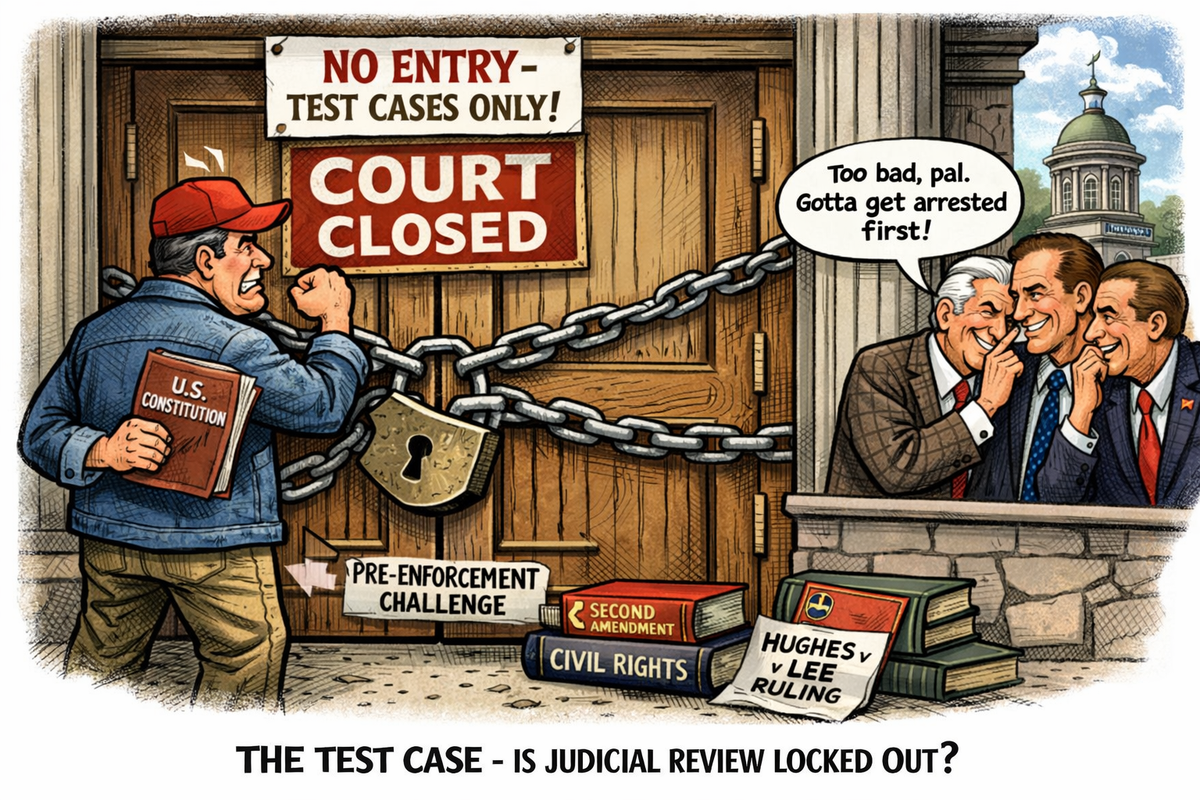
After a major court ruling, a quiet bill in Nashville nearly closed courthouse doors to citizens challenging state laws before arrest or punishment. What SB1958 would change, why it matters, and why Tennesseans should pay attention now closely.
How SB 1958 Could Have Forced Citizens to Risk Arrest Before Courts Reviewed Unconstitutional Laws — And Why It May Still Return.
Most Tennesseans assume constitutional questions are settled in courtrooms after careful review and public debate. Few realize how much depends on whether citizens are even allowed into those courtrooms in the first place.
Last August, a unanimous three-judge panel ruled in Stephen Hughes et al. v. Bill Lee et al. that portions of Tennessee’s longstanding “intent to go armed” statute and related park carry restrictions violated both the Tennessee Constitution and the Second Amendment. The court declared those statutes unconstitutional, void, and of no effect. While post-judgment motions and appeals continue to shape the ruling’s ultimate finality, the decision exposed significant constitutional vulnerabilities within parts of Tennessee’s statutory framework and raised difficult questions about how long flawed laws can remain enforceable while litigation unfolds.
Only months later, legislation quietly appeared in the Tennessee General Assembly that would have made it significantly harder for citizens to bring similar constitutional challenges against state laws in the future.
The proposal — Senate Bill 1958 and its House companion HB 1971 — did not focus on taxes, crime policy, or education funding. Instead, it targeted something far more fundamental: whether Tennesseans can ask courts to determine if a state law violates constitutional protections before someone is arrested, fined, disciplined, or financially harmed.
Most people never heard about it.
Under existing Tennessee law, an affected citizen may seek declaratory or injunctive relief to challenge the legality or constitutionality of governmental action. These cases do not involve damages or financial awards. They exist for a narrower purpose — allowing courts to answer constitutional questions before irreversible consequences occur. The Legislature itself reinforced that safeguard in 2018 when lawmakers clarified citizens’ ability to bring such actions against unconstitutional government conduct.
That pre-enforcement pathway proved central in Hughes v. Lee. Rather than waiting to be prosecuted under the challenged statutes, the plaintiffs argued they faced a credible threat of enforcement based on conduct they intended to engage in, including lawful firearm carry in locations restricted by state law. The three-judge panel accepted that standing argument, allowing constitutional review before criminal penalties were imposed.
John Harris, counsel for the plaintiffs in Hughes v. Lee and chair of the Tennessee Firearms Association, explained that the case depended on that ability to challenge enforcement before punishment occurred.
“We demonstrated a credible threat of enforcement,” Harris said in an interview discussing the litigation. “That’s exactly what they want to get rid of.”
SB 1958 proposed narrowing that pathway significantly. As written, the bill limited this cause of action to political subdivisions such as counties or municipalities while expressly excluding challenges to the validity or constitutionality of state statutes. In practical terms, the state would gain a powerful procedural argument to block lawsuits seeking advance judicial review of laws passed by the General Assembly.
The consequences are not abstract.
If lawmakers enacted a firearm restriction later found unconstitutional, citizens could face the choice of complying with a potentially invalid law or risking arrest to test it. If a statute limited speech or religious expression in professional or educational settings, individuals might have to endure discipline or termination before courts even considered whether the law violated constitutional protections. Property owners confronting regulatory penalties could find themselves financially cornered long before a judge reviewed the legality of the statute involved.
Courts are not intended to function only after damage has been done. Judicial review exists precisely to prevent unconstitutional enforcement before harm occurs. Removing that pathway does not eliminate constitutional questions. It simply raises the cost of asking them.
Supporters described the legislation as addressing nuisance litigation. Yet the Legislature’s own Fiscal Note concluded the bill would have no significant financial impact. In plain terms, Tennessee was not facing a measurable taxpayer burden defending these cases. Serious constitutional challenges already proceed before three-judge panels rather than individual trial judges, a safeguard designed to discourage casual filings and ensure careful review.
If the change was not driven by cost savings, it is reasonable to ask what problem lawmakers believed they were solving.
That question becomes harder to ignore when viewed alongside the timing of Hughes v. Lee.
Attorney General Jonathan Skrmetti has publicly explained that his office continued defending the challenged firearms statutes largely on procedural and separation-of-powers grounds rather than endorsement of the laws themselves. He emphasized the demanding standards governing facial constitutional challenges and warned against courts invalidating entire statutory schemes where some applications might remain permissible. At the same time, he acknowledged that portions of Tennessee’s firearms laws face significant constitutional difficulty following the United States Supreme Court’s decision in New York State Rifle & Pistol Association v. Bruen.
In other words, even state leadership recognized serious constitutional vulnerability within existing statutes.
SB 1958 was filed January 22, 2026, months after the Hughes ruling and as litigation surrounding the decision continued to develop. Whether coincidence or deliberate timing, the overlap invites scrutiny. Limiting the procedural pathway citizens use to challenge state statutes inevitably affects future litigation when courts are actively striking down laws through that very mechanism.
John Harris noted that the amended complaint filed in Hughes v. Lee relied upon the same statutory cause of action now targeted by SB 1958. Following the trial court’s unanimous ruling, the filing raised a question that now extends beyond the litigation itself:
“Given the fact that the three-judge trial court unanimously found these statutes to be unconstitutional violations of the Second Amendment, one must wonder whether the current legislative efforts to repeal Tenn. Code Ann. §1-3-121 are in retaliation for the victory that was achieved in Hughes v. Lee, particularly when the fiscal note determined that the existence of this statute isn’t costing taxpayers anything.”
The Legislature has offered other explanations for the proposal, including concerns about litigation burdens. However, the fiscal analysis accompanying the bill reported no significant financial savings from eliminating the cause of action.
This is not speculation about motive. It is an observation about consequence.
The Senate Judiciary Committee heard SB 1958 on February 17, 2026. The vote ended tied, with one senator present but not voting. Because the committee deadlocked rather than formally rejecting the bill, it stalled but was not killed.
Many assumed the issue was settled.
It was not.
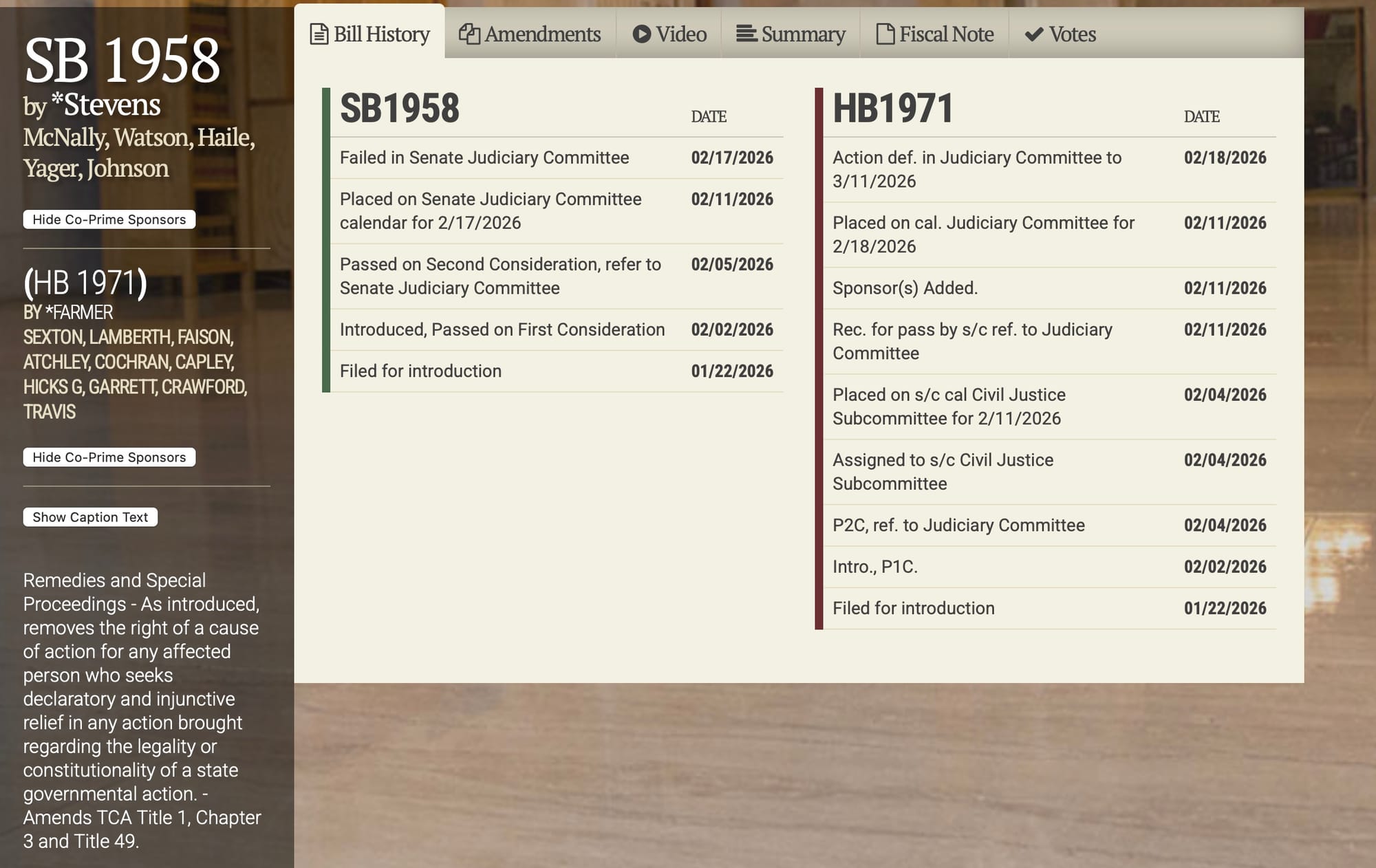
The House companion bill, HB 1971, remains active and is currently scheduled for consideration in the House Judiciary Committee on March 11. Under Tennessee legislative procedure, advancement in one chamber can revive stalled companion legislation in the other. If the House version moves forward, lawmakers in the Senate may again be asked to consider whether Tennesseans should retain pre-enforcement access to constitutional review of state laws.
Legislative calendars do not wait for public awareness to catch up.
According to official Tennessee General Assembly records, Senate sponsorship included Senator John Stevens as prime sponsor alongside Lieutenant Governor Randy McNally and Senators Bo Watson, Ferrell Haile, Ken Yager, and Jack Johnson. These are experienced lawmakers familiar with constitutional litigation and legislative procedure.
Voters may reasonably decide for themselves why limiting citizen access to constitutional review was viewed as necessary at this particular moment.
In a constitutional republic, citizens should not have to risk arrest, prosecution, or financial harm simply to learn whether a law complies with constitutional limits. Judicial review functions as a safeguard precisely because government power is not presumed to be infallible. When courts review laws before enforcement occurs, constitutional clarity benefits both citizens and the state itself.
SB 1958 stalled once because Tennesseans began paying attention. The question now is whether that attention continues before the next vote occurs.
Citizens who believe constitutional questions should be answered before enforcement should consider contacting members of the House Judiciary Committee prior to the March 11 hearing. Ask why the bill limits challenges against state statutes while preserving them against local governments. Ask whether lawmakers believe citizens should become test cases before courts can intervene.
Contact your own representative and senator as well. Ask whether they intend to support revival of the legislation if the House companion advances.
Procedural safeguards rarely disappear through dramatic headlines. More often, they change quietly, through language most citizens never read and committee votes few people watch. SB 1958 was not a debate about firearms policy, speech regulation, or property rights themselves. It was a debate about whether access to constitutional review remains a right exercised before enforcement or a privilege earned afterward.
The House Judiciary Committee now holds the next decision.
If HB 1971 advances on March 11, legislation that already stalled once could return with renewed momentum. And if that happens, Tennesseans may soon discover that the most important rights are not always lost through sweeping prohibitions, but through procedural changes few people noticed until the door was already closed.
Self-government rarely fails because citizens disagree. It fails when people assume someone else is watching closely enough to speak up first.
If readers wish to contact each member of the House Judiciary Committee you can find their contact information below:
Rep. Andrew Farmer District (R) Committee Chair: rep.andrew.farmer@capitol.tn.gov
Rep Elaine Davis District 18 (R) Committee Vice-Chair: rep.elaine.davis@capitol.tn.gov
Rep Becky Alexander District 7 (R): rep.rebecca.alexander@capitol.tn.gov
Rep Fred Atchley District 12 (R): rep.fred.atchley@capitol.tn.gov
Rep Gino Bulso District 61 (R): rep.gino.bulso@capitol.tn.gov
Rep Clay Doggett District 70 (R): rep.clay.doggett@capitol.tn.gov
Rep Rick Eldridge District 10 (R): rep.rick.eldridge@capitol.tn.gov
Rep Johnny Garrett District 45 (R): rep.johnny.garrett@capitol.tn.gov
Rep G.A. Hardaway District 93 (D): rep.ga.hardaway@capitol.tn.gov
Rep Torrey Harris District 91 (D): rep.torrey.harris@capitol.tn.gov
Rep Gloria Johnson District 90 (D) : rep.gloria.johnson@capitol.tn.gov
Rep Kelly Keisling District 38 (R): rep.kelly.keisling@capitol.tn.gov
Rep Williams Lamberth District 44 (R): rep.william.lamberth@capitol.tn.gov
Rep Mary Littleton District 78 (R) : rep.mary.littleton@capitol.tn.gov
Rep Jason Powell District 53 (D) : rep.jason.powell@capitol.tn.gov
Rep Lowell Russell District 21 (R): rep.lowell.russell@capitol.tn.gov
Rep Gabby Salinas District 96 (D): rep.gabby.salinas@capitol.tn.gov
Rep Rick Scarbrough District 33 (R): rep.rick.scarbrough@capitol.tn.gov
Rep Tom Stinnett District 20 (R): rep.tom.stinnett@capitol.tn.gov
Rep Chris Todd District 73 (R): rep.chris.todd@capitol.tn.gov
Rep Joe Towns Jr. District 84 (D): rep.joe.towns@capitol.tn.gov
Rep Ron Travis District 31 (R) : rep.ron.travis@capitol.tn.gov
If you want to support what we do, please consider donating a gift in order to sustain free, independent, and TRULY CONSERVATIVE media that is focused on Middle Tennessee and BEYOND!

Comments ()