The Federal Law That Broke American Elections: How McCain–Feingold Nationalized Political Money
McCain–Feingold didn’t clean up politics—it nationalized campaign money. The law rerouted donations into candidate war chests, digital platforms, and out-of-state networks, reshaping fundraising and paving the way for donor-class dominance in Tennessee.

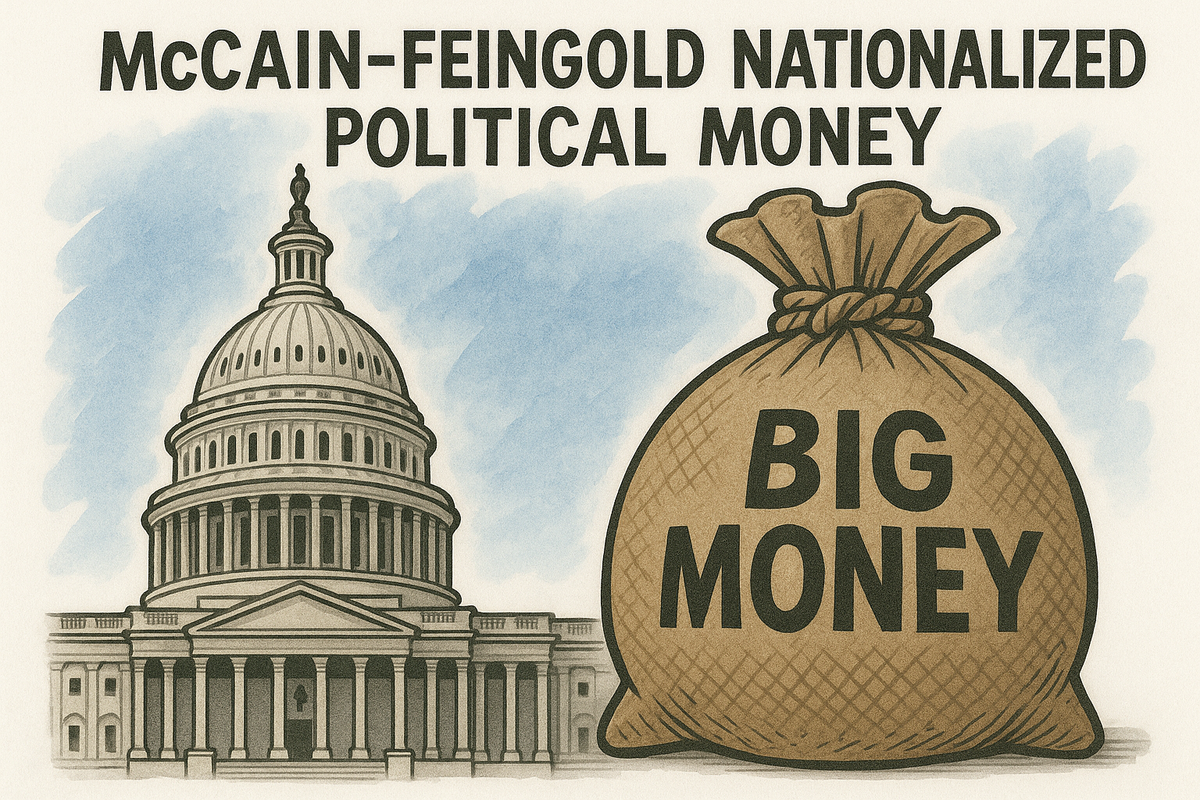
Most Tennesseans have no idea how a 2002 federal law — one they’ve likely never read, never voted on, and never discussed — reshaped the entire political fundraising landscape and directly contributes to why Tennessee keeps ending up with donor-class governors. That law is the Bipartisan Campaign Reform Act of 2002, better known as McCain–Feingold.
Sold as a cleanup job for American politics, the law did almost the opposite.
Before McCain–Feingold, national political parties accepted “soft money” — large, unrestricted donations from individuals, corporations, and unions. These funds flowed through party committees, which at least created a centralized structure for oversight, accountability, and traceability. Reformers believed soft money was dangerous and corrupting, and they weren’t entirely wrong. But their solution produced consequences far worse than the original problem.
When Congress banned soft money, they didn’t remove it from the system — they rerouted it. Massive donations that once flowed transparently through party channels suddenly needed a new home. And they found one in candidate-controlled federal committees and in the emerging online fundraising platforms that would come to dominate American politics.
McCain–Feingold unintentionally created the era of:
- Nationalized political fundraising
- Small-dollar digital donation culture
- Candidate-centered war chests
- Out-of-state donor dominance
- Hyper-partisan fundraising incentives
- ActBlue and WinRed digital super-machines
It also created a financial dynamic few Americans understand: federal candidates now raise most of their money from outside their own states. For U.S. Senators, this means the majority of financial support comes not from the people they represent, but from national ideological networks, corporations, nonprofits, and political influencers.
McCain–Feingold reshaped political incentives entirely. Instead of relying on a state’s voters, candidates are pushed — almost forced — to build national brands that appeal to donors in California, New York, Texas, or Washington, D.C. Once that national donor base is built, the fundraising machine never stops. The email blasts never stop. The digital pressure never stops. Federal candidates become political brands instead of public servants.
They don’t just have supporters. They have customers.
And here is one of the most overlooked consequences:
This nationalization of political money didn’t stay confined to federal races — it bled into state politics.
Even Tennessee legislative races now operate in the donor environment McCain–Feingold created. Candidates running for offices meant to be accountable to a handful of counties are increasingly funded by donors who have no connection to those communities at all. Jack Johnson’s 2022 reelection campaign is a prime example: 85% of his itemized contributions came from outside Tennessee.
That is the McCain–Feingold effect — a fundraising culture where national donor pipelines overshadow local voter support, even in the smallest corners of state government.
(We will explore this downward impact on state and county races in a separate TruthWire series.)
But here is the crucial point for this report:
Even Tennessee governors who never held federal office have been shaped by McCain–Feingold.
Bill Haslam and Bill Lee never served in Washington. They didn’t rely on federal war chests or congressional donor lists. But they did run in a political landscape transformed by McCain–Feingold, one where:
- State campaigns now require massive funding
- Donor expectations are nationalized, not local
- Big-money networks are the norm
- Political consultants drive messaging strategy
- Statewide viability depends on securing large, sophisticated fundraising pipelines
McCain–Feingold permanently raised the cost of entry for leadership at every level. It may as well have been called "The Incumbent Insurance Policy Act".
But 2026 introduces something Tennessee has never seen in the post–McCain–Feingold era:
A federal politician entering the governor’s race with a multimillion-dollar federal war chest.
Marsha Blackburn is the prototype of the system McCain–Feingold created. She has spent years cultivating a nationwide donor audience, and WinRed — a direct descendant of the McCain–Feingold fundraising landscape — processes contributions for her from all corners of the country.
This is why Blackburn can raise millions without depending on Tennessee donors. It’s why her cash on hand approaches $5 million. And it’s why, when she steps into the governor’s race, she brings with her not just a campaign — but a national political machine built under federal rules.
McCain–Feingold created the pipeline.
Tennessee’s campaign laws leave the state gates wide open.
And in 2026, those two forces will collide for the first time in our history.
But McCain–Feingold is only half the story.
In Article 3, we reveal the state-level loophole that turns federal campaign cash into a weapon inside Tennessee elections — a loophole untouched for decades, and one about to be used on a scale we’ve never seen.
If you want to support what we do, please consider donating a gift in order to sustain free, independent, and TRULY CONSERVATIVE media that is focused on Middle Tennessee and BEYOND!