Two Visions, One County: What the Williamson County Mayoral Debate Really Revealed
A sharp debate revealed more than policy differences—it exposed a divide between management and accountability, rhetoric and reality, and raised serious questions about debt, growth, transparency, and who ultimately pays.

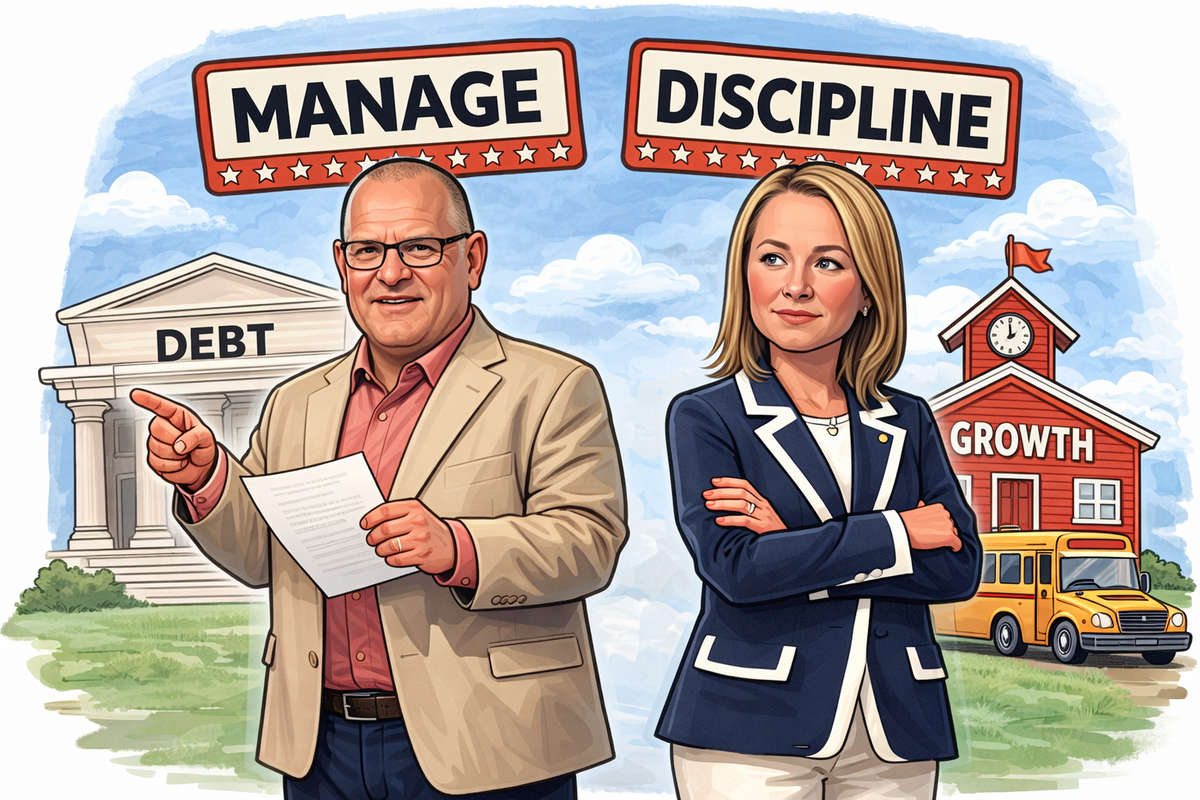
5 Key Highlights:
- The debate exposed a core divide: Marshall emphasized management and relationships, while Smith focused on discipline, oversight, and accountability.
- Debt became central, with conflicting narratives—Marshall downplayed the burden, while data shows Williamson carries high per-capita debt (~$4,431).
- Growth and infrastructure revealed a key tension: collaboration vs. structural control over decisions that create taxpayer-funded obligations.
- The failed annexation bill (HB 2419 / SB 2311) highlighted opposing views on local control, raising questions about who should bear responsibility for growth decisions.
- Endorsements vs. engagement: Marshall leaned on support from city leaders, while Smith’s backing reflects direct constituent interaction and accountability.
- READ ENTIRE ARTICLE BELOW 👇
For a debate where both candidates largely agreed on the problems facing Williamson County, what stood out most Monday night was not disagreement over symptoms. It was instinct, and, at key moments, a gap between how those problems were described and what the underlying facts actually show.
Growth is outpacing infrastructure. Traffic is eroding quality of life. Costs are rising. Debt is mounting. On the surface, Andy Marshall and Commissioner Mary Smith sounded aligned. But as the evening unfolded, it became clear they are not offering two versions of the same solution. They are offering two fundamentally different ways of thinking about government, accountability, and who ultimately bears the cost of decisions made at the top.
Marshall opened as the outsider businessman, telling voters, “I stand before you… as a man who owes everything to this community,” and emphasizing that Williamson County’s problems are “fixable.” Smith grounded her case in experience, saying she has “sat through dozens of county commission and committee meetings… dug into our budget… [and] delivered real solutions.” One framed leadership as something proven through building. The other framed it as something earned through understanding. That contrast might have remained stylistic if not for what followed when the conversation turned to debt.
Marshall framed the county’s position as a set of choices: “You either lean heavily into the AAA bond rating… or you raise taxes… or you cut budgets.” He then extended that logic further, saying, “We can take our debt for schools to a 40-year AAA bond rating… I think that’s being good stewards of our debt.” And in defending the county’s position, he added that Williamson County has the “lowest debt per capita” among the surrounding counties.
That claim is not accurate, and it matters because it underpins the broader argument he was making.
According to the Tennessee Comptroller’s FY2024 audit summary, Williamson County’s debt per capita is approximately $4,431, reflecting roughly $1.1 billion in total outstanding debt. That places it toward the higher end among Tennessee counties, not the lowest, and notably higher than at least some neighboring counties with significantly lower per-capita debt. Williamson is not a low-debt county. It is a high-debt county with the capacity to service that debt. Those are not the same thing, and presenting them as if they are leads to a fundamentally different understanding of the county’s financial position.
That context changes how Marshall’s earlier statement lands. When he says extending debt to 40 years is “good stewardship,” he is not describing a county operating from a position of minimal obligation. He is describing a strategy for managing and extending an already substantial debt load. That may be a defensible position philosophically, but it is not the same as the one implied by the claim that the county carries relatively low debt.
Smith’s response was less polished, but more aligned with the underlying data. “The AAA bond rating is a tool. It shouldn’t be our backup plan,” she said, adding that she would rather see the county “first in discipline… than second in debt.” Where Marshall treated debt as something to be managed and leveraged, Smith treated it as something to be constrained and reduced.
That difference carried through when Marshall was asked what it means to “run government like a business.” His answer emphasized tone: “We communicate. We talk through our issues… we don’t kick the can down the road.” What was missing were the mechanics that define disciplined management, cost controls, capital allocation, debt thresholds. The phrase remained a slogan without a clearly defined model behind it. For a candidate leaning heavily on business credentials, that absence left voters to fill in the blanks themselves.
Smith approached the same question differently. Rather than describing leadership style, she described where the system needs scrutiny, pointing to specific budget pressures: “Our self-insurance plan is over 10% of our budget… about $114 million… about $40 million more than Rutherford County.” Her argument was not that government should feel like a business, but that it should be examined with similar rigor.
That distinction, between managing and auditing, became even more apparent when the debate turned to growth. Marshall emphasized cooperation, saying, “Development and preservation should work together,” framing growth as something that can be balanced through relationships and coordination. Smith was more direct about the consequences: “Growth is not paying for itself.” That statement reflects a reality many residents already feel. If growth does not cover the cost of services it requires, schools, roads, emergency response—then those costs are absorbed elsewhere.
It was in that context that Marshall’s comments about state legislation stood out in a way that goes beyond simple policy disagreement. Referring to the failed annexation bill, he said the legislature “saw through it,” and aligned himself with the characterization of the bill as an “expansion of government.” But that framing does not accurately reflect what the legislation proposed. The bill, HB 2419 sponsored by Representative Monty Fritts and SB 2311 sponsored by Senator Joey Hensley, would have required municipalities to obtain formal county approval before annexing unincorporated land, provided counties with a defined review and veto window, and required financial impact studies detailing how growth would affect county-funded infrastructure. It was backed by leaders in counties like Williamson, Sumner, and Maury who argued that unchecked city growth creates what they described as “taxation without representation” for county residents who must fund the resulting strain on services.
Calling that an “expansion of government” overlooks the structural issue. When cities can unilaterally approve growth that directly increases demand on county services, services the county must fund, authority and responsibility are disconnected. Giving the county a seat at the table does not expand government. It aligns it. It ensures that the entity responsible for funding the consequences has a voice in creating them. Without that alignment, cooperation is optional, and optional cooperation is not a strategy for managing growth at scale.
That emphasis on collaboration also carried into how Marshall framed his relationships with local leadership, pointing to endorsements from city mayors across Williamson County as evidence of his ability to work effectively within the system. On its face, that may sound like validation. But it deserves a closer look.
City-level elections in Tennessee are nonpartisan. Those leaders have not had to run as conservatives, define conservative principles, or defend them under scrutiny in a partisan primary. And in practice, many municipal bodies, including Franklin’s Board of Mayor and Aldermen, have not consistently governed in ways that reflect traditional conservative priorities, particularly when it comes to growth, development, and fiscal restraint.
So when those endorsements are presented as a signal of credibility, the question is not just who is supporting him, but what that support actually represents.
Because it does not necessarily signal conservative leadership. It signals alignment with the existing structure.
And that distinction matters.
If anything, it raises a different question entirely: whether those endorsements reflect a candidate who will challenge the current trajectory—or one who is already positioned comfortably within it.
Marshall framed those relationships as an asset, suggesting they would allow him to “work hand in hand with our city mayors and our county commissioners.” But the underlying implication is not just cooperation, it is influence within a system that many voters already believe is contributing to the very issues being debated.
By contrast, Smith’s support has come less from institutional endorsements and more from individual voters, residents who have interacted with her directly, who have seen her engagement at the commission level, and who have formed their opinions based on accessibility and performance rather than alignment within existing leadership circles.
That contrast is not just political. It reflects two different bases of validation, one rooted in proximity to power, the other in responsiveness to constituents.
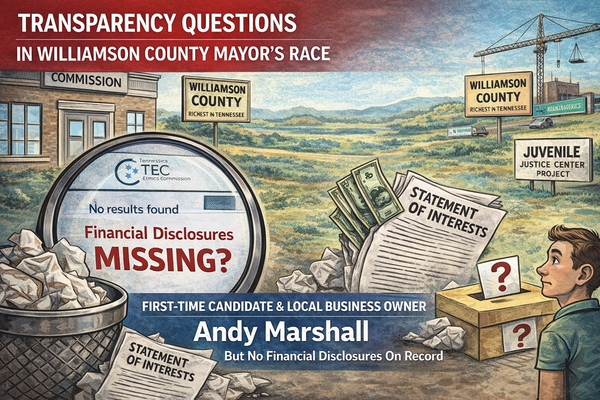
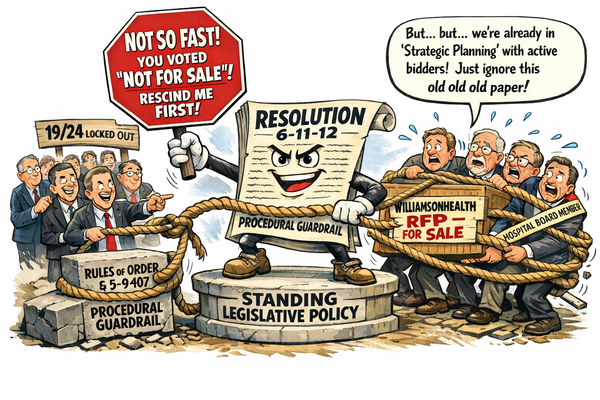
That same instinct surfaced again when Marshall discussed the potential sale of Williamson County Medical Center, saying, “It’s really important… that all this is done quietly… and then it will become public… and then the conversations will start.” In a private business context, that approach is familiar. But the hospital is not a private asset. It is publicly owned. The taxpayers are the stakeholders. Which raises a straightforward question: why should the process be quiet until after it is already underway? Why should the public conversation begin after decisions are already taking shape?
Smith’s response reflected a different starting point: “Let’s not rush this… we need more transparency… we need to make sure our citizens are being heard.” Again, the difference is not stylistic. It is philosophical. One approach reflects private-sector dealmaking. The other reflects public stewardship.
Even in areas where the policy details were less defined, the instinct gap remained visible. Marshall reframed “smart city” concepts in practical terms, saying, “Smart city, for me, is getting people out of their cars… where they can walk to their parks,” and added that “it absolutely can be done in Williamson County.” He also referenced the need for “affordable housing” multiple times. Those phrases may sound neutral, but they carry broader implications, density, planning frameworks, and long-term changes to community character. Marshall did not define those terms, leaving their meaning open to interpretation.
Smith engaged more directly with how those ideas are perceived, warning, “Before you know it… you’ve got surveillance everywhere… and then you’ve got control,” and emphasizing the importance of preserving choice and local identity.
By the end of the debate, the divide was not about who understands the challenges facing Williamson County. Both candidates clearly do. It was about how they interpret their role in addressing them, and how accurately they describe the conditions they are stepping into.
Marshall presented himself as a steady executive, comfortable with leverage, comfortable with relationships, and confident that problems can be managed through coordination, even if that includes extending debt timelines and relying on informal alignment between jurisdictions. But in doing so, he also made claims about the county’s financial position that do not align with the available data, and dismissed structural tools that would have given the county more control over the very growth pressures he acknowledged.
Smith presented herself as a corrective force, focused on discipline, transparency, and the idea that government must be continuously examined, especially in a county carrying a substantial per-capita debt burden and facing sustained growth pressure.
That difference is not about tone. It is about foundation.
It is the difference between managing a system as it exists…
and ensuring that system is aligned, accountable, and grounded in fact before asking the public to trust it.
And in a race where credibility matters as much as vision, the gap between what is claimed and what the facts show isn’t minor—it’s decisive.
If you want to support what we do, please consider donating a gift in order to sustain free, independent, and TRULY CONSERVATIVE media that is focused on Middle Tennessee and BEYOND!