Washington Demanded Election Reforms. A Federal Judge Blocked Them. Now What Happens in Tennessee?
Washington tied election security reforms to federal funding, but a judge struck down the conditions. From citizenship checks to paper ballots and manual audits, Tennessee still faces a question: Why wait for Washington to secure its own elections?

Tennessee Election Integrity: Part Three of Three
5 Key Takeaways
1. FEMA overstepped its authority. A federal judge blocked election security grant conditions, not the underlying reforms involving paper ballots, audits, citizenship checks, and reconciliation.
2. Trump expanded citizenship verification. His administration eliminated SAVE fees, enabled bulk voter checks, and expanded access to federal records.
3. Tennessee faces questions about voter verification. Election advocates want answers about counties' access to SAVE and the state's citizenship verification results.
4. Federal scrutiny extends beyond voting machines. New guidance addresses voting protections in nursing homes and eligibility verification for military and overseas voters.
5. Tennessee can act independently. State lawmakers already have authority to strengthen election audits, paper ballot verification, voter rolls, and transparency.
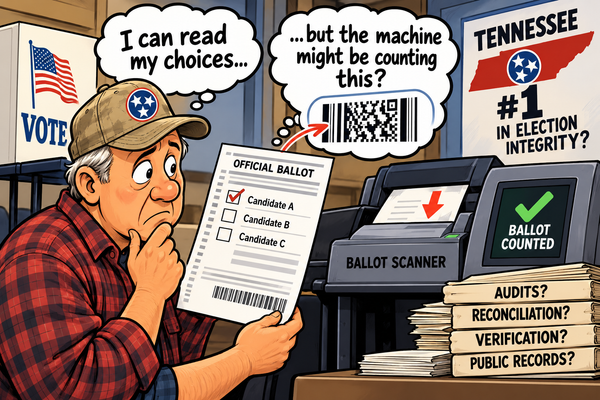
For years, Tennessee election integrity advocates have urged state officials to strengthen citizenship verification, replace voting systems that rely on machine-readable ballot codes, expand manual audits, and improve public access to election records. In August, the federal government issued guidance requiring states to address many of those same concerns as a condition of receiving certain homeland security grants. The requirements brought new attention to election procedures that Tennessee citizens had been questioning long before Washington became involved, but a federal court subsequently struck down the funding conditions.
At the same time, President Donald Trump's administration has expanded the capabilities of the federal Systematic Alien Verification for Entitlements program, known as SAVE, making it easier for election officials to check large voter registration databases against federal citizenship information. The changes have generated legal challenges and political opposition, while Tennessee election integrity advocates continue asking how the state is using the system and what its verification efforts have revealed.
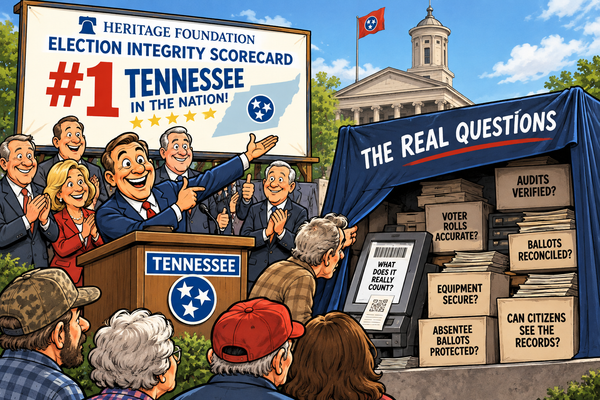
Together, these developments have renewed questions about whether Tennessee's election procedures are as transparent and independently verifiable as its national ranking suggests.
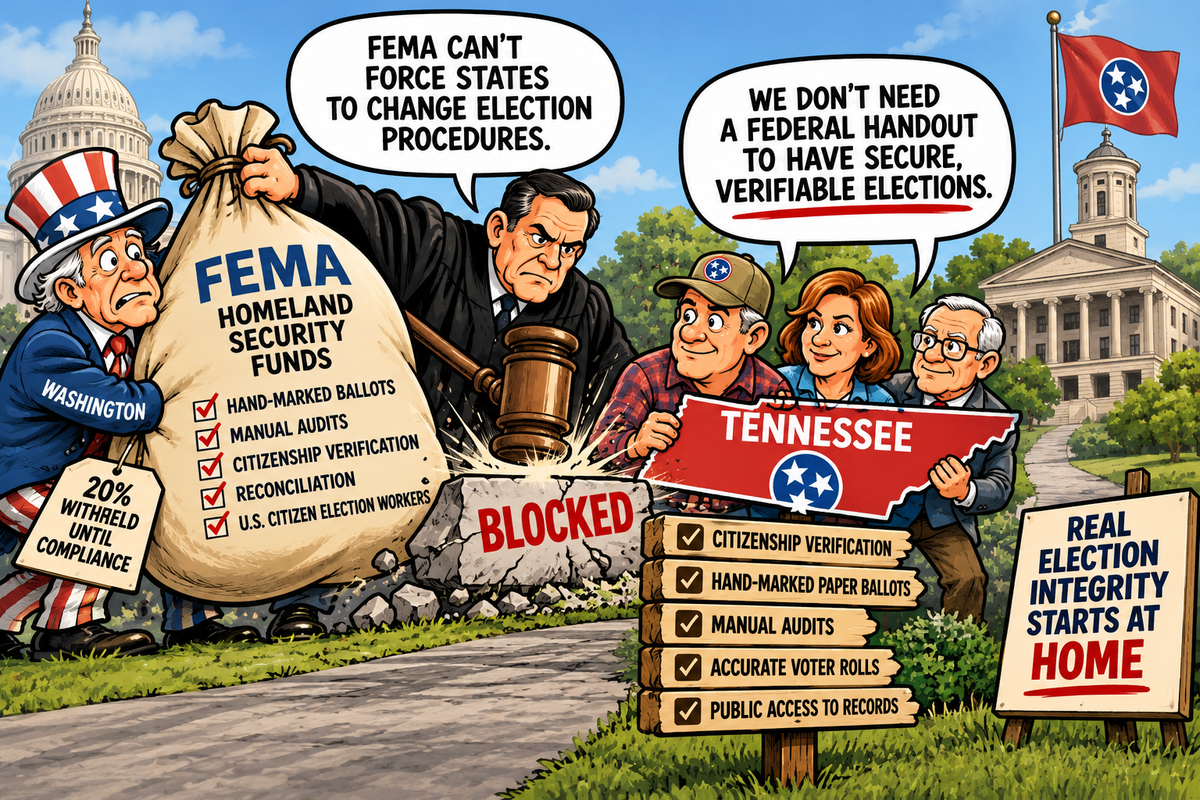
On August 10, 2026, the Federal Emergency Management Agency issued Grant Programs Directorate Information Bulletin No. 580, establishing five election-related requirements for states receiving fiscal year 2026 Homeland Security Grant Program funding. The bulletin required states to submit a plan to transition away from barcode and QR-code-based vote tabulation toward hand-marked paper ballots, conduct manual post-election audits, reconcile voter participation with ballots counted, verify registered voters' citizenship, and ensure that election administrators were United States citizens.
The audit requirement was specific. States were directed to conduct manual audits of at least five percent of paper ballots and compare the findings with electronic voting system results. The bulletin also required documentation of discrepancies between the number of voters and the number of ballots counted. For states already meeting particular requirements, FEMA allowed the chief election official to submit an explanation of the existing procedures rather than creating an entirely new process.
The funding mechanism was intended to encourage compliance. FEMA directed that 20 percent of the recipient's Homeland Security Grant Program award be withheld from drawdown until the Department of Homeland Security verified compliance. The holdback affected access to the money rather than permanently reducing the award, and the bulletin applied it to recipients rather than imposing separate withholding requirements on individual local subrecipients. The conditions affected programs intended to support homeland security preparedness, including funding relied upon by state and local governments.
The requirements closely resembled reforms Tennessee election integrity advocates had been promoting for years. However, the legal question was whether FEMA had the authority to attach election administration conditions to grants established for homeland security purposes. Nashville and other local governments challenged the requirements, arguing that the agency had exceeded the authority Congress granted it.
On September 28, U.S. District Judge Amir H. Ali ruled in Metropolitan Government of Nashville and Davidson County v. Department of Homeland Security that FEMA lacked the statutory authority to impose the challenged election conditions. The court vacated the requirements, the 20 percent holdback, and the implementing guidance while leaving the remaining homeland security grant provisions intact. The ruling addressed the agency's legal authority to impose those conditions; it did not determine whether hand-marked ballots, citizenship verification, or manual audits were worthwhile election safeguards.
For Tennessee, that distinction is important because the court's decision did not prevent the General Assembly from considering similar measures under state law. Lawmakers remain able to examine voting equipment, establish audit procedures, and determine how voter registration records should be verified. The federal funding dispute changed the means by which Washington attempted to encourage those reforms, but it did not resolve the questions Tennessee citizens have been raising about their own election system.
One of the most consequential federal developments concerns SAVE, a system administered by U.S. Citizenship and Immigration Services. The program existed long before Trump's return to office and was designed to help authorized government agencies verify immigration status and citizenship-related information. Changes introduced in 2025 eliminated transaction fees for voter verification, expanded bulk-processing capabilities, and incorporated additional federal information, including Social Security data, to assist election administrators.
Before those changes, states attempting to verify large voter registration databases faced a more cumbersome process. The improved system allows authorized officials to submit substantial numbers of records for comparison rather than checking every registration individually. That makes the program more practical for statewide voter roll reviews, although a potential discrepancy still requires careful examination before an election official can conclude that someone is ineligible to vote.
Conservative election attorney Cleta Mitchell discussed the changes during a September 25 appearance on Steve Bannon's War Room, beginning around the 36-minute mark. Mitchell explained that SAVE was not a newly created citizenship verification program, but that the Trump administration had made it considerably easier for election officials to use. She emphasized the elimination of fees, the ability to process voter records in batches, and access to additional federal information as changes that transformed its practical usefulness.
Mitchell also offered an explanation for the political opposition surrounding the expanded system. She argued that the left's anger was driven by the fact that Trump had made SAVE usable for large-scale voter registration verification, rather than merely creating another government requirement that would be difficult for states to implement. Her interpretation was that the administration had removed obstacles that previously limited election officials' ability to compare voter registration records with federal citizenship information.
Opponents of the expanded program have raised different concerns, including privacy, data accuracy, and the risk that eligible voters could be incorrectly identified as noncitizens. Government databases may contain outdated information, particularly when a person has become a naturalized citizen since an earlier interaction with an agency. These concerns make it important to distinguish an initial database discrepancy from a final determination of ineligibility, while also recognizing that the federal government has made substantial changes to the verification tools available to election officials.
The legal controversy over SAVE has proceeded separately from the FEMA grant litigation. Court proceedings have addressed the federal government's expanded use of information for voter verification and the conditions under which those checks may occur. Those cases involve questions about statutory authority, data sharing, and protections for eligible voters. They should not be confused with the September 28 decision concerning FEMA's authority to condition homeland security funding on election reforms.
In Tennessee, election integrity advocates have questioned how Secretary of State Tre Hargett and Coordinator of Elections Mark Goins have used the expanded verification capabilities. During an interview with TruthWire News, Kathy Harms of Tennessee Fair Elections described years of efforts to persuade state officials to strengthen citizenship checks and provide more information about their results. Harms, who has worked with election attorney Cleta Mitchell, said legislation requiring the use of SAVE was enacted before the Trump administration's 2025 improvements, but questioned whether the state had fully taken advantage of the expanded system.
Harms pointed to Tennessee's 2024 effort to contact approximately 17,000 registered voters whose citizenship status had been questioned using information from driver's license records. She argued that those records could be outdated, particularly for individuals who obtained identification before becoming naturalized citizens. According to her account, she personally knew individuals who had received such inquiries despite already being American citizens.
That example illustrates the limitations of relying on a single government database to determine current citizenship status. An individual may lawfully obtain certain state documents before naturalization, and those documents may not automatically be updated when citizenship changes. Verification procedures therefore need to distinguish between records that justify further investigation and evidence sufficient to establish that a person is actually ineligible.
Harms said Tennessee subsequently submitted voter registration information through the improved SAVE system, but questioned what happened after those records were processed. She wanted to know how many registrations were examined, how many were flagged for further review, whether any records were corrected, and how frequently the state repeated the checks. She also said requests for information about the results had not produced the transparency she believed citizens were entitled to expect.
These are questions about the administration of the verification program rather than evidence that a particular number of noncitizens voted in Tennessee. The state could potentially provide aggregate information about its verification activities while protecting sensitive personal data and complying with applicable privacy requirements. Such reporting would help voters understand the scale of the state's efforts and how discrepancies are investigated.
Harms also described a disagreement over whether Tennessee counties should be permitted to use SAVE independently. According to her account, Maury County sought access to the system but was told that county officials lacked the necessary authority under Tennessee law. She alleged that Goins instructed counties not to use SAVE independently and argued that federal access provisions should allow qualifying local election officials to perform checks without relying exclusively on the state.
That disagreement involves two separate questions: whether federal administrators permit qualifying county officials to request access and whether Tennessee law authorizes those officials to conduct the checks independently. Federal program eligibility does not automatically settle every question of state administrative authority. The correspondence and legal provisions underlying the dispute would need to be examined to determine precisely what counties requested and why state officials opposed or restricted their access.
Harms also criticized the cost of obtaining statewide voter registration records. She argued that Tennessee's pricing makes it difficult for citizen researchers and independent organizations to examine registration data, particularly when compared with jurisdictions that provide broader access at lower cost. She questioned whether the charges were necessary and why the state could not make more information available without compromising protected voter data.
The concern reflects a recurring theme throughout this series: whether Tennessee's election safeguards can be independently examined. Accurate voter registration records are important, but so are procedures that allow officials to correct outdated information and protect eligible citizens from improper removal. Public confidence depends in part on understanding how those procedures work, how often they are used, and what the results show.
The USCIS SAVE program is a verification resource, not an automatic voter removal system. State election officials remain responsible for reviewing the information returned and following applicable laws before making changes to voter registration records. A system that identifies potential discrepancies more efficiently may strengthen election administration, but its accuracy also depends on the quality of the underlying data and the procedures used to resolve uncertain results.
Another federal initiative addressed voting in nursing homes and other long-term care facilities. In July, the Centers for Medicare & Medicaid Services issued guidance concerning residents' voting rights, emphasizing that residents have the right to vote or decline to participate without coercion. The guidance addressed unauthorized registration, improper assistance with absentee ballots, and attempts to influence voting decisions by people responsible for residents' care.
The memorandum referenced voting-related criminal allegations involving long-term care settings, including a Texas case in which a social worker faced 134 felony charges. Such cases demonstrate why appropriate safeguards matter, although allegations in individual cases should not be treated as evidence that unlawful voting is widespread in nursing homes. Residents retain their voting rights, and legitimate assistance remains important for people who need help participating.
Tennessee law allows voters age 60 and older to request absentee ballots without having to establish another qualifying excuse. That provision provides greater access for older voters, including residents of long-term care facilities, but it also places importance on protecting their independence. Election officials and care facilities must ensure that residents can make their own voting decisions and that assistance is provided only as permitted by law.
A separate federal initiative involved military and overseas voting under the Uniformed and Overseas Citizens Absentee Voting Act, commonly known as UOCAVA. In August, the Department of War proposed changes to federal voting forms, including additional identification requirements and removal of an option used by individuals who had never resided in the United States. The proposal concerned the Federal Post Card Application and Federal Write-In Absentee Ballot, documents used to facilitate voting by eligible military personnel and Americans overseas.
The proposed changes raised questions about the relationship between federal overseas voting protections and state laws governing individuals whose connection to a state is based on a parent's residence. Eligibility rules can differ depending on the type of election and applicable law, making it important to distinguish federal requirements from state provisions. The proposal was not itself proof of widespread unlawful overseas voting, nor did proposing changes to the forms automatically change every state's eligibility rules.
Taken together, the FEMA guidance, SAVE expansion, CMS memorandum, and overseas voting proposals show the range of election administration issues receiving federal attention. They concern different populations, legal authorities, and administrative procedures, but each involves the question of how election officials verify eligibility, protect lawful participation, and maintain accurate records. The federal government's involvement does not relieve Tennessee officials of their own responsibilities under state and federal law.
The July 2026 election security findings also reinforced the importance of auditable paper ballots, cybersecurity protections, and independent verification. Those recommendations align with several proposals Tennessee advocates have presented to lawmakers, including more extensive manual audits and greater transparency concerning election technology. Whether the state adopts those proposals is a decision for Tennessee's elected officials, subject to applicable federal requirements and the practical responsibilities of administering elections.
Tennessee's Republican-controlled General Assembly can consider those reforms without waiting for another federal grant condition or court ruling. Lawmakers can examine whether the state's voting equipment provides sufficient independent verification, whether its audits are adequate, and whether county election officials have appropriate tools to maintain accurate voter rolls. They can also evaluate the costs of proposed changes, protect accessibility for voters with disabilities, and establish clearer standards for public reporting.
Secretary Hargett and Coordinator Goins likewise have an opportunity to provide more detailed information about existing safeguards. Citizens have raised specific questions about SAVE verification, voter registration records, ballot accounting, and access to election documentation. Those questions can be addressed through explanations of applicable procedures, aggregate results, and the records state law permits officials to release.
Throughout this series, TruthWire News has examined the difference between having strong election laws and independently demonstrating that those laws produce accurate, verifiable results. Tennessee's national ranking recognizes its legal safeguards, but it does not eliminate the need to examine election equipment, verify voter registration records, or investigate discrepancies when they arise. The public's ability to evaluate those processes remains an essential part of election accountability.
The September 28 court ruling removed FEMA's attempt to impose election reforms through homeland security funding, but it did not settle the questions that prompted the requirements. Trump's administration has expanded federal citizenship verification capabilities, while Tennessee advocates continue asking how those capabilities are being used and what the results reveal. Those are matters Tennessee officials can address regardless of what happens in Washington.
The state has spent years telling voters it leads the nation in election integrity. Now it is time to demonstrate exactly what that means.
TruthWire exists to provide independent investigative journalism that holds Tennessee’s political establishment accountable.
Independent journalism depends on the support of readers who believe in that mission.
Your contributions help us continue investigating the issues, asking difficult questions, and reporting the stories that matter to Tennesseans. If you value our work, please consider becoming a monthly supporter. Every contribution makes a difference.