
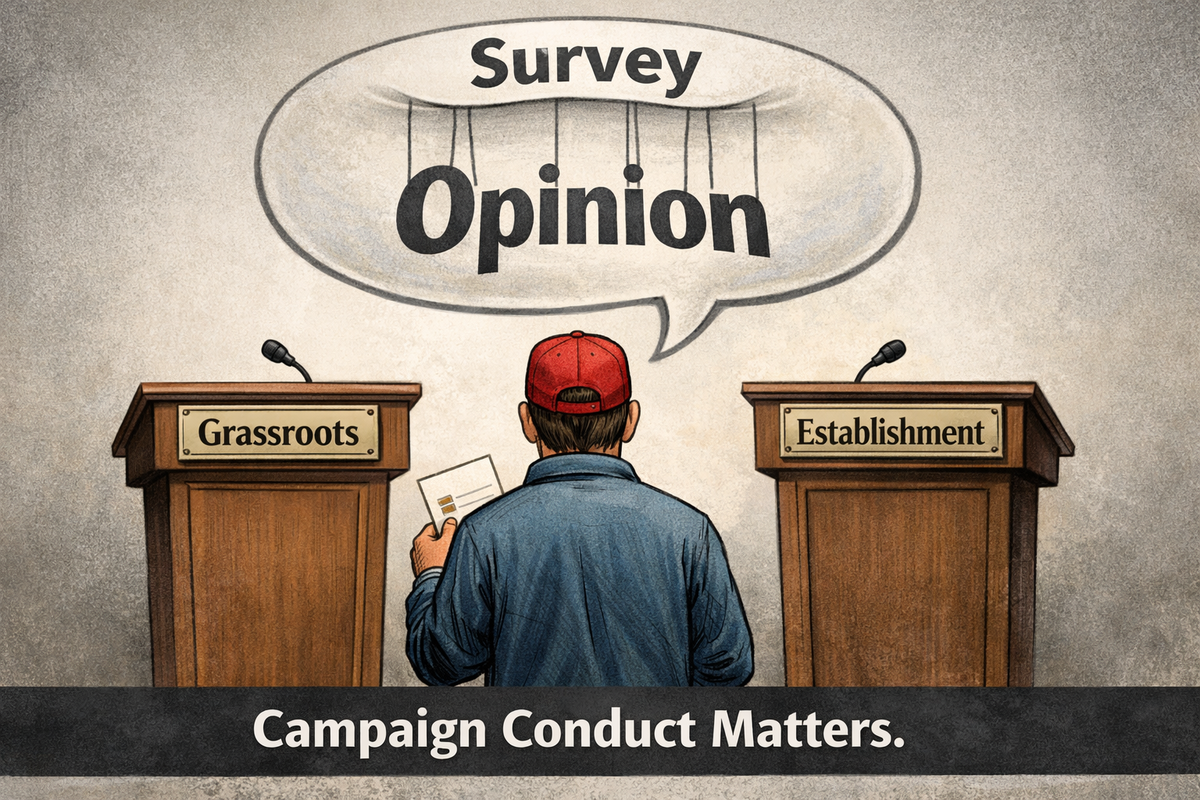
A recent push poll in the Williamson County mayor’s race highlights a growing divide within the local GOP and raises questions about campaign integrity, political culture, and whether voters will continue tolerating smear-style persuasion tactics.
In the years since Donald Trump reshaped the Republican Party’s political identity, Williamson County has quietly undergone a transformation of its own. For decades, local Republican politics operated within a largely predictable framework — business-friendly governance, managed growth, and institutional continuity supported by an interconnected network of civic leaders, donors, and elected officials. Disagreements existed, but they rarely threatened the broader consensus about how politics should function.
That consensus no longer exists.
The anonymous push poll circulating during the Williamson County mayoral race between County Commissioner Mary Smith and candidate Andy Marshall is not an isolated campaign tactic. Nor is it particularly shocking to voters who have watched local politics evolve over the past several election cycles. Instead, it serves as another example of a political culture increasingly defined by distrust between a growing grassroots populist movement and an establishment Republican structure that many voters believe has resisted meaningful change.
The controversy surrounding the survey is not merely about tone or messaging. It is about intent.
Push polls are not designed primarily to measure opinion. They are designed to shape it.
Screenshots provided to TruthWire show that voters accessing the survey link encountered a sequence of questions framed around selectively presented claims about Smith’s voting record as a county commissioner. Complex policy votes were reduced to simplified characterizations presented without broader legislative context. Questions emphasizing alleged shortcomings appeared early and repeatedly, while subsequent prompts introduced favorable framing about Marshall’s leadership and vision.
The survey ultimately concluded by asking participants which candidate they were most likely to support.
In other words, the instrument functioned less as research and more as persuasion disguised as inquiry.
Mary Smith addressed the controversy directly in a public statement posted Sunday evening, invoking Ronald Reagan’s famous debate response: “There you go again.”
“A push poll is not designed to measure opinion,” Smith wrote. “It is designed to manipulate it. It presents misleading or distorted claims disguised as questions in order to plant doubt and damage reputations.”
She further stated that recent communications contained “deceptive claims and outright lies” regarding her record supporting sheriff’s deputies and public safety funding.
“I have supported competitive pay for our deputies and first responders because keeping Williamson County safe is not optional,” Smith wrote. “Supporting public safety while demanding fiscal discipline is not a contradiction — it is stewardship.”
Whether voters ultimately agree with Smith’s policy positions is not the central question raised by the survey’s existence. Campaigns routinely criticize opponents.
The deeper concern is how political communication itself has changed.
For many longtime residents, Williamson County politics once revolved around debates held in churches, civic halls, and neighborhood meetings. Candidates argued budgets, zoning decisions, and infrastructure priorities face-to-face with voters. Campaign disagreements could be sharp, but they generally remained visible and accountable.
That model began to fracture after 2016.
During President Trump’s first term, Republican unity largely held at the local level despite significant ideological differences beneath the surface. With national Democrats launching investigations, impeachment proceedings, and sustained legal challenges against the administration, Republicans across factions found common cause in opposition.
Those years created the illusion of ideological alignment.
Many grassroots conservatives assumed establishment Republicans shared their emerging populist skepticism toward bureaucratic authority, media narratives, and centralized decision-making.
COVID shattered that assumption.
Beginning in 2020, policy decisions moved rapidly from abstract national debate into daily local consequence. Businesses across Tennessee were shuttered after being deemed “non-essential,” and many never reopened. Families watched educational policies shift dramatically as school systems navigated emergency directives. Parents filled school board meetings objecting to curriculum materials and transparency issues. County commissions faced explosive population growth, rising infrastructure demands, and escalating tax concerns.
The laws governing many of those issues originated not in Washington but in Nashville.
State executive decisions regarding emergency authority, economic shutdowns, and disputes over localized mandates revealed stark differences in governing philosophy among Republicans themselves. A grassroots movement that had grown during the Trump years expected confrontation with federal pressure and bureaucratic expansion. What they often perceived instead was institutional caution.
For many voters, the distinction became unavoidable.
Officials who had campaigned as populist conservatives appeared, in the eyes of critics, to revert toward a more traditional managerial politics once confronted with real institutional risk. Whether fair or not, that perception hardened into skepticism about motives and accountability.
The political environment changed accordingly.
Grassroots activism expanded rapidly across Tennessee. Parents organized through social media networks. Lawsuits challenged longstanding statutes. Citizens filled public comment periods at school board and county commission meetings demanding transparency about growth, spending, and education policy. The battleground for Republican politics shifted from quiet donor circles into public forums fueled by online engagement.
The unity once assumed within the party dissolved.
Against that backdrop, the mayoral race’s push poll feels less like a surprise than a continuation of familiar tactics.
For many grassroots voters, anonymous messaging designed to frame opponents negatively has become almost expected — political wallpaper rather than scandal.
That normalization may be the most troubling development of all.
When voters cease to be shocked by smear tactics, campaigns risk abandoning persuasion altogether in favor of psychological influence. The danger is not simply unfair treatment of a candidate. It is erosion of trust between voters and the political process itself.
Smith’s statement emphasized that distinction.
“Disagreement is part of democracy,” she wrote. “Honest debate is healthy. But deception and lies are not.”
Her campaign has emphasized fiscal restraint, debt management, and infrastructure planning amid rapid county growth. Supporters argue that approach reflects stewardship rather than ambition.
Marshall, meanwhile, has assembled an extensive coalition of supporters whose kickoff event read like a directory of Williamson County influence. Publicly associated backers include Governor Bill Lee, financial personality Dave Ramsey, musician Michael W. Smith, business executives, developers, and prominent civic figures connected to state commerce and legislative networks.
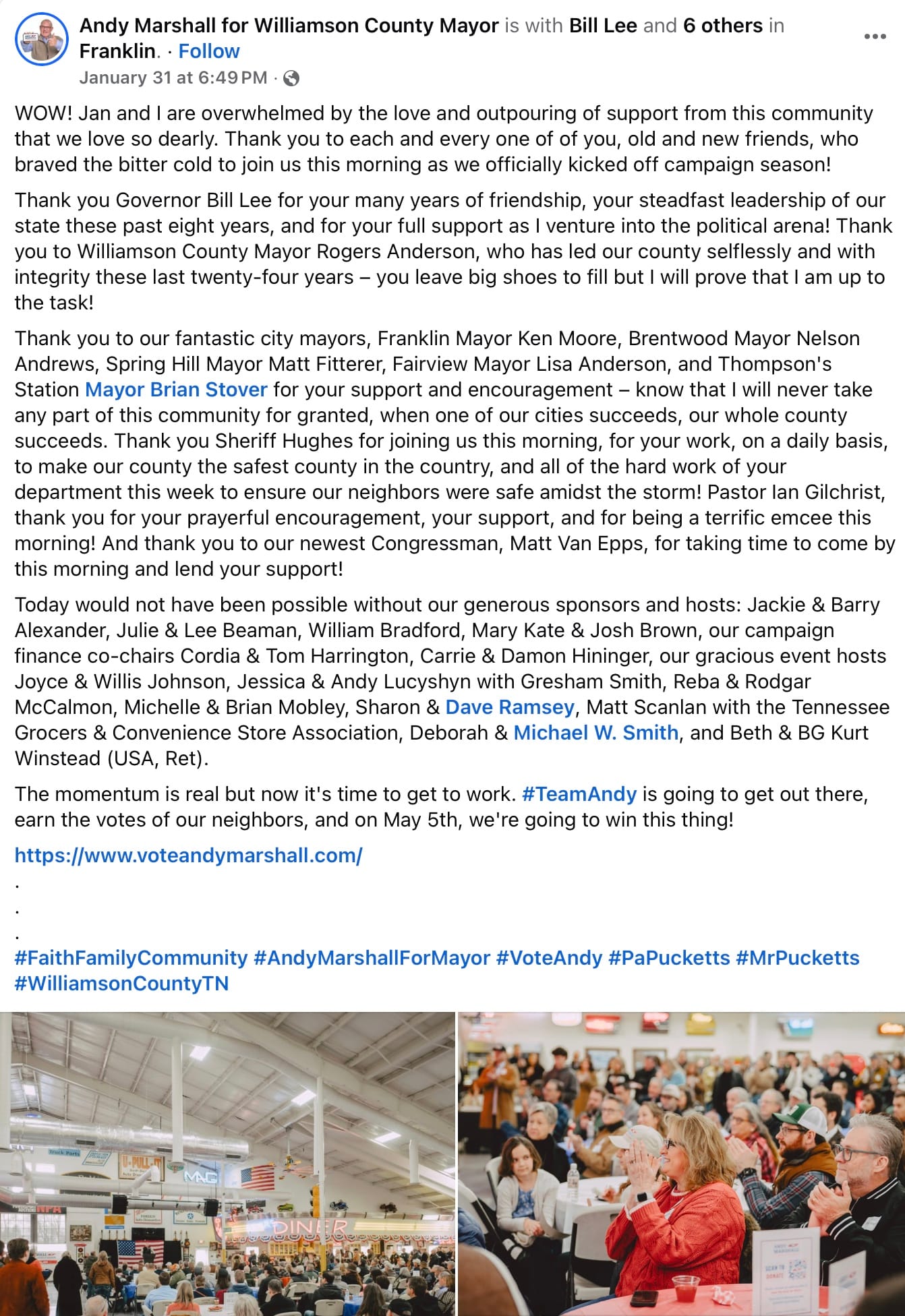
Endorsements alone do not determine campaign conduct.
But they do raise questions.
Many of those supporters are widely recognized for emphasizing faith, integrity, and public service in their own professional lives. Voters may reasonably ask whether they anticipated anonymous push polling tactics becoming part of the campaign environment attached to their endorsements.
Equally important is what voters themselves now expect.
Over the past four years, grassroots conservatives have increasingly rejected politics that appears insulated from accountability. They have shown willingness to challenge school boards, county commissions, and even state leadership when decisions appear disconnected from community priorities.
The push poll controversy therefore reflects more than campaign rivalry.
It highlights a deeper question about political character.
If candidates ask voters to trust them with budgets, growth decisions, and public authority, voters may reasonably expect campaigns themselves to model transparency and fairness. Messaging designed to shame, embarrass, or manipulate opponents risks undermining those claims before a candidate ever takes office.
Williamson County voters have demonstrated repeatedly that they are paying attention.
They have shown up at meetings. Organized online. Filed lawsuits. Demanded explanations.
They are unlikely to stop now.
The question facing this election may not simply be which candidate wins.
It may be whether voters decide that tactics once tolerated as politics-as-usual have finally crossed a line.
Integrity, after all, is not measured by campaign slogans.
It is measured by conduct when no one is supposed to be watching.
If you want to support what we do, please consider donating a gift in order to sustain free, independent, and TRULY CONSERVATIVE media that is focused on Middle Tennessee and BEYOND!
Comments ()