When Government Shields Itself from the People
Tennessee lawmakers move to limit citizens’ ability to challenge state laws—raising serious constitutional concerns. If government can’t be questioned, who holds it accountable? #TNGA #Constitution #RuleOfLaw

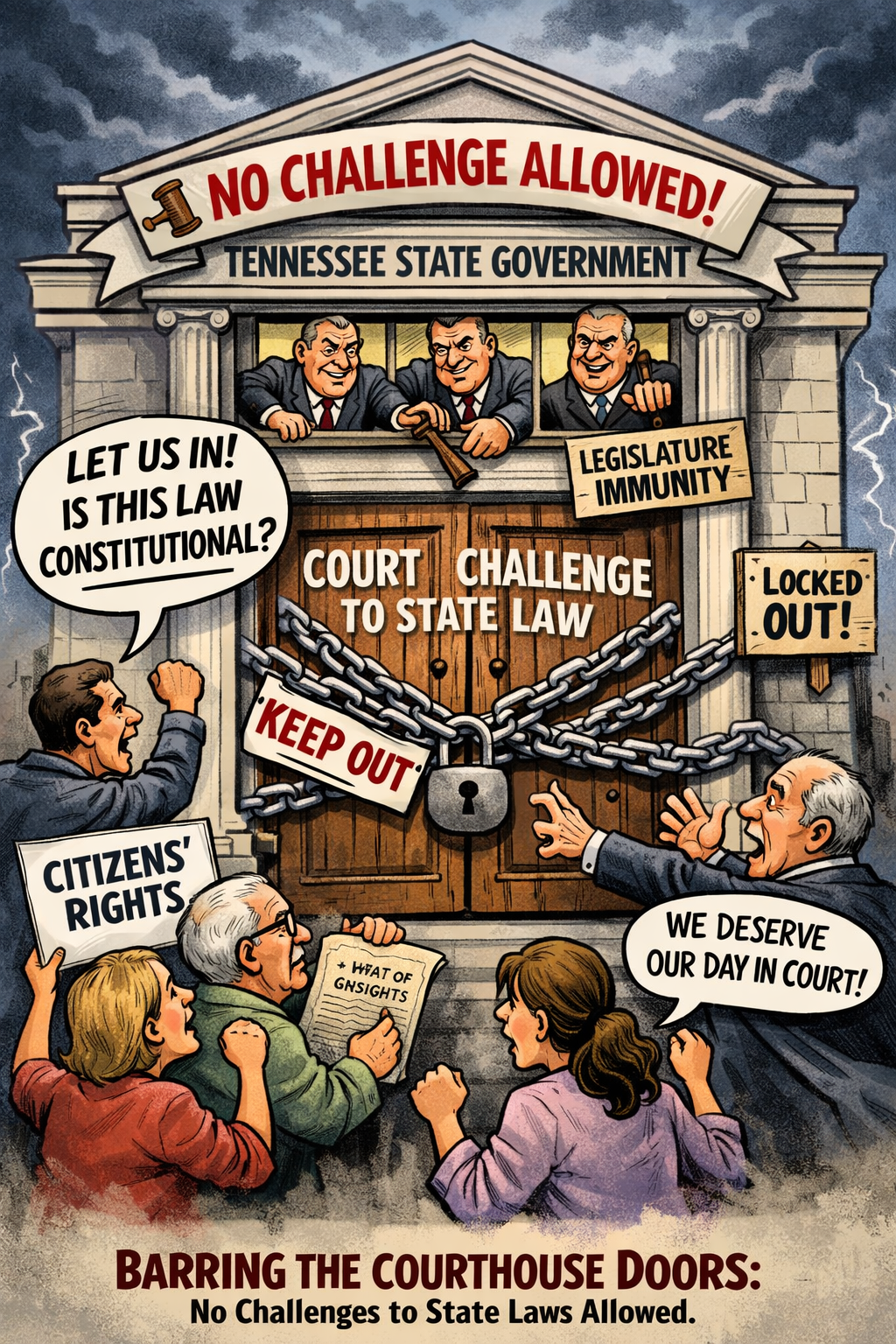
There are moments in public policy when the real issue is not the headline itself, but what sits just beneath it. Tennessee now finds itself in one of those moments. What is being presented in Nashville as a procedural correction—a closing of what some lawmakers call a “loophole”—carries implications that reach far beyond any single policy debate. At its core, this legislation asks a far more consequential question: should citizens retain the ability to challenge the constitutionality of state laws before they are enforced, or should that pathway be limited by the very government being challenged?
The legislation at issue, HB1971 / SB1958, seeks to significantly narrow a legal mechanism established in 2018 under Tennessee Code § 1-3-121. That statute created a cause of action allowing any affected person to seek declaratory or injunctive relief when they believe a governmental action is unconstitutional. It is important to understand what that means—and what it does not.
The law does not allow for monetary damages. It does not incentivize litigation for profit. It simply allows a court to answer a fundamental question: whether a law, as written, is constitutional before it is enforced and before harm occurs.
That framework reflects a longstanding principle in American law. Constitutional protections are not meant to be tested only after damage has been done. They are meant to act as a safeguard in advance. Without that ability, citizens are often left with only one option: to wait until a law is enforced against them and then bear the cost—financial, legal, or personal—of challenging it after the fact. The 2018 law recognized that reality and provided a narrow pathway for judicial review at the front end of government action.
HB1971 / SB1958 would alter that balance in a meaningful way. Under the proposed change, Tennesseans would still be able to challenge the actions of local governments such as cities and counties, but the same cause of action would no longer apply in the same way to state laws passed by the General Assembly. In practical terms, this creates a distinction in accountability: citizens could question the legality of their local officials, but their ability to bring similar challenges against the state itself would be significantly reduced.
The timing of this legislation is not incidental. It comes as courts are actively being asked to evaluate the constitutionality of state actions, most notably in cases such as Hughes v. Lee. That case reflects how the 2018 statute has been used in practice—allowing citizens to bring constitutional questions before the courts without waiting for enforcement. From the perspective of state leadership, this represents more than a legal dispute; it represents exposure. It requires the state to defend its laws in real time, on constitutional grounds, rather than relying on procedural barriers to delay or avoid review altogether.
Supporters of the bill argue that this change is necessary to prevent abuse of the courts. They point to litigation surrounding abortion laws and contend that activist organizations are using the current statute to obstruct policies they could not defeat through the legislative process. They argue that the law has been interpreted more broadly than originally intended and that this legislation simply restores appropriate boundaries.
However, there is another way to understand what is happening. When a law is challenged in court, the government is not powerless. It has the opportunity to defend the law, to justify it, and to demonstrate that it is consistent with the Constitution. That is how the system is designed to work. Limiting the ability to bring those challenges does not strengthen the law—it reduces the scrutiny applied to it.
This is where the tension becomes particularly difficult to reconcile in a state that consistently identifies itself as committed to limited government and constitutional fidelity. The conservative legal tradition has long emphasized the importance of checks and balances, judicial review, and the right of individuals to challenge government overreach. Yet this legislation moves in the opposite direction. It does not constrain the power of government; it constrains the ability of citizens to question it.
The political alignment surrounding the bill only deepens that tension. Establishment Republican leadership is advancing the legislation, while some organizations that identify as grassroots conservative are supporting it, largely because of the specific policy outcomes they hope to protect. But outcomes and principles are not the same. The question is not whether a particular law should stand or fall. The question is whether citizens should retain the ability to ask that question in a court of law.
Precedent, once established, does not remain confined to a single issue. If the state can limit how its laws are challenged in one context, that same limitation exists for all others. Today, the focus may be on abortion-related litigation. Tomorrow, it could involve property rights, free speech, religious liberty, or economic regulation. The mechanism does not distinguish between causes. It simply determines whether a citizen has access to judicial review.
That is what is at stake in this moment. Not a single policy outcome, but the structure through which government accountability is maintained. The ability to challenge the constitutionality of a law is not a procedural convenience. It is a cornerstone of a system designed to ensure that power remains subject to limits.
The urgency of this issue is immediate. HB1971 is scheduled for a vote on the House floor today, Monday, March 30th at 3:00 PM. The window for public input is narrow, but the implications are not.
If you believe that constitutional questions should be answered in a courtroom rather than avoided through legislative restriction, now is the time to act. Citizens should contact their State Representatives and urge them to vote NO on HB1971. This is not about aligning with one policy position or another. It is about preserving the ability of the people to hold their government accountable to the Constitution it is sworn to uphold.
Because once that ability is limited, the balance of power does not remain where it was. It shifts—subtly at first, but meaningfully over time—away from the people and toward the institutions meant to serve them.
If you want to support what we do, please consider donating a gift in order to sustain free, independent, and TRULY CONSERVATIVE media that is focused on Middle Tennessee and BEYOND!