
Why Is Blackburn Blocking Trump's Judge? A Preferred Pick, Political Power, or Payback?
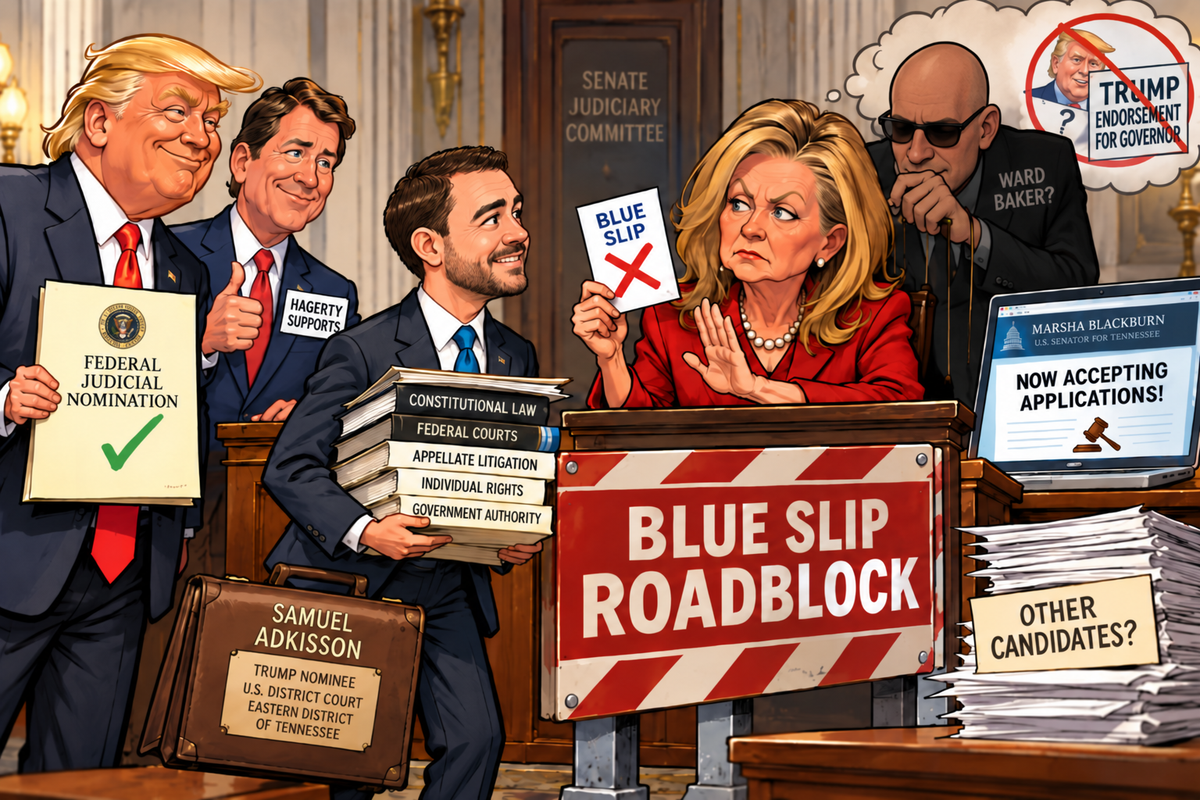
Trump picked Samuel Adkisson for a lifetime federal judgeship, and Hagerty supports him. So why is Blackburn blocking his nomination? Is this about qualifications, political influence, a preferred candidate, or payback for Trump's withheld endorsement?
Five Key Takeaways
- Blackburn has stalled Trump's judicial nominee. Her refusal to return a blue slip has prevented Samuel Adkisson's nomination from advancing despite support from Trump and Hagerty.
- Trump values Adkisson's constitutional litigation background. His experience in constitutional disputes, White House legal work, and judicial clerkships features prominently in the president's selection.
- Blackburn personally interviewed Adkisson in March. Both Tennessee senators evaluated him, but only Hagerty has publicly endorsed his confirmation.
- Blackburn's Senate website still advertises the vacancy. The continuing application notice raises questions about whether she prefers another candidate, although the page may simply be outdated.
- Political motivations remain unanswered questions. Ward Baker's documented political influence and Trump's withheld gubernatorial endorsement provide context, but neither establishes why Blackburn is opposing the nomination.
President Donald Trump has selected an attorney from his own White House Counsel's Office for a lifetime appointment to Tennessee's federal judiciary. The nominee has experience in significant constitutional litigation, clerked for Supreme Court Chief Justice John Roberts, and has worked on cases involving government authority and individual rights. Tennessee Senator Bill Hagerty supports the selection, but the state's other Republican senator, Marsha Blackburn, is standing in the way.
According to Reuters and Bloomberg Law, Blackburn has withheld her blue slip, preventing Samuel D. Adkisson's nomination to the U.S. District Court for the Eastern District of Tennessee from advancing to a Senate Judiciary Committee hearing. The blue-slip process is a Senate tradition allowing home-state senators to register their approval or opposition to judicial nominees. Under the committee's current practice, withholding that approval can effectively prevent a district court nominee from receiving a hearing.
Blackburn has offered no public explanation, despite personally interviewing Adkisson months before Trump announced his selection. Meanwhile, her Senate website continues to solicit applications for the same judgeship. Those circumstances raise questions about whether Blackburn objects to his qualifications, prefers another candidate, or is exercising political leverage over the appointment.
Why Trump Wants Adkisson on the Federal Bench
Trump's August 14 announcement provides insight into his selection. In his Truth Social statement, Trump highlighted Adkisson's work in the White House Counsel's Office, particularly his involvement in Trump v. Slaughter, litigation concerning presidential authority over independent federal agencies. He also cited Adkisson's role during Brett Kavanaugh's Supreme Court confirmation and his clerkships for Chief Justice Roberts and federal appellate judges Gregory Katsas and Amul Thapar.
According to his Federalist Society biography, Adkisson previously practiced at Cooper & Kirk PLLC, handling high-stakes constitutional, political, and civil-rights litigation. His work included challenges to federal hiring practices, allegedly discriminatory university financial aid policies, and government actions involving constitutional rights. He also worked on litigation challenging Harvard University's race-conscious admissions practices and a constitutional dispute involving the State Bar of Texas.
His experience involves legal questions that often determine whether constitutional challenges proceed through federal courts, including jurisdiction, standing, statutory authority, and the sufficiency of claims. That background may be particularly relevant to Trump given his experiences with the judiciary following the 2020 presidential election.
Numerous post-election lawsuits encountered procedural obstacles, including standing and timeliness requirements. Some were dismissed without courts reaching the underlying factual allegations, while others received substantive review and were rejected. Federal judges must enforce jurisdictional requirements, but they must also determine when properly presented constitutional claims warrant consideration on their merits. Trump's experience may have influenced his preference for judges familiar with complex constitutional litigation, although he has not publicly connected Adkisson's nomination specifically to the 2020 election disputes.
Adkisson's age makes the appointment particularly consequential. At approximately 33, he could potentially serve another four decades or longer. Federal judges receive lifetime appointments during good behavior, meaning Trump is selecting someone whose influence could extend well beyond his presidency. Given the qualifications the president has publicly emphasized, what precisely does Blackburn find objectionable?
Blackburn Interviewed Him Months Before Blocking Him
Adkisson's Senate Judiciary Committee questionnaire establishes that Blackburn personally participated in evaluating him before Trump's selection. Adkisson applied through both Tennessee senators' offices on January 9, 2026. Blackburn's chief counsel interviewed him on January 16, followed by an interview with Hagerty's general counsel on January 30. Hagerty personally interviewed him on February 26, and Blackburn interviewed him on March 11. Adkisson subsequently interviewed with White House attorneys on March 30, before Trump informed him of his selection on August 14.
Blackburn therefore had ample opportunity to evaluate his education, litigation experience, and judicial philosophy. If she had serious reservations, did she communicate them to the White House before Trump announced the nomination? Did the administration proceed despite knowing she might withhold approval, or did her objections emerge afterward?
Adkisson's questionnaire also reveals that approximately 95 percent of his private practice involved litigation, with about 85 percent involving federal courts. His experience concentrated on complex motions, constitutional arguments, and appellate work, although he personally tried only one case to judgment and reported no jury trials to verdict. Limited trial experience could be a legitimate consideration in evaluating a district court nominee, but Blackburn has not identified it as an objection.
Hagerty reviewed the same candidate and reached a publicly different conclusion. As reports indicate, Hagerty praised Adkisson and pledged to work toward his confirmation. Both senators interviewed him, yet one supports the nomination while the other is preventing it from advancing. If Blackburn has identified a deficiency Hagerty apparently did not, what is it?
Why Is Blackburn Still Accepting Applications?
Another detail raises questions about whether Blackburn prefers someone else. As of October 8, her official Senate website continues advertising that her office is accepting applications for the position of United States District Judge for the Eastern District of Tennessee, the same position Trump nominated Adkisson to fill.
The notice may simply be outdated, but its continued presence is noteworthy alongside Blackburn's refusal to advance the nomination. Home-state senators traditionally exercise considerable influence over federal judicial selections, including recommending candidates and participating in the vetting process. If Blackburn recommended another individual whom Trump passed over, withholding her blue slip could provide leverage to encourage reconsideration.
Did Blackburn recommend someone else? If so, who was that candidate, and what qualifications made that individual preferable to Adkisson? A lifetime federal appointment could shape constitutional law in Tennessee for decades, making the question of who influences the selection particularly consequential.
Ward Baker and Tennessee's Republican Political Establishment
The question of political influence brings attention to Blackburn's longtime strategist, Ward Baker, whose involvement in her political operation is well documented.
A March 2025 investigation reported that Baker's consulting firm and three colleagues received nearly $50,000 per month from Blackburn's Senate campaign in 2025 as she prepared for the governor's race. The investigation also documented the extensive political network Blackburn developed through campaign contributions, including more than $800,000 distributed through her Marsha PAC to Tennessee Republican organizations and state and local candidates between 2019 and 2025.
Those relationships illustrate the political infrastructure surrounding Blackburn and invite questions about whether campaign influence extends into government appointments. Baker has longstanding relationships within Republican politics, and his role in Blackburn's political operation extends beyond a single election.
Has Baker or anyone associated with Blackburn's political network advocated for another candidate for the Eastern District judgeship? Have those relationships influenced her decision to withhold approval from Trump's nominee? No publicly verified evidence currently connects Baker directly to the Adkisson dispute, but establishing whether Blackburn's political advisers participated in recommendations for the vacancy would help clarify whether competing preferences are involved.
Could This Be Payback for Trump's Withheld Endorsement?
Another possible explanation involves Blackburn's relationship with Trump and the gubernatorial endorsement she never received.
Despite Blackburn's longstanding political alliance with the president, Trump declined to endorse her during Tennessee's 2026 Republican gubernatorial primary. He had supported her previous Senate campaigns, but when she faced Congressman John Rose and state Representative Monty Fritts, Trump remained neutral.
As reported, Blackburn continued emphasizing her relationship with Trump throughout the campaign despite his decision not to endorse a candidate. She won the August 6 primary without his endorsement, and eight days later Trump announced Adkisson's selection.
Could Blackburn's disappointment over that decision have influenced her willingness to support his nominee? Or could a broader disagreement exist between Blackburn's political advisers and the White House about who should influence federal appointments in Tennessee?
The timeline does not establish retaliation, and no documented communication connects Blackburn's blue-slip decision to the gubernatorial campaign. Nevertheless, the circumstances raise questions about whether the disagreement is limited to judicial qualifications or reflects competing political interests. Blackburn's public explanation would help distinguish between those possibilities.
Five Questions Blackburn Should Answer
Blackburn's involvement in evaluating Adkisson, her unexplained opposition, and the political circumstances surrounding the nomination leave five questions requiring answers.
- What specifically does Blackburn find objectionable about Adkisson? Does she question his courtroom experience, judicial philosophy, or suitability for the Eastern District?
- Did Blackburn recommend another candidate? If so, whom did she recommend, and did Trump select Adkisson over her preferred nominee?
- Why is her Senate website still accepting applications? Is the notice outdated, or is her office considering alternatives?
- Did Ward Baker or anyone associated with Blackburn's political operation participate in discussions about potential nominees? If so, what role did they play?
- Did Trump's refusal to endorse Blackburn for governor contribute to a disagreement with the White House? Has she privately explained her objections to the president?
A Lifetime Appointment and an Unanswered Question
The Constitution assigns the president responsibility for nominating federal judges and the Senate responsibility for providing advice and consent. Senators are entitled to evaluate nominees independently, but when procedural authority prevents a nomination from advancing, the public has a legitimate interest in understanding why.
Trump has identified the qualifications he values in Adkisson, and Hagerty has publicly supported his nomination after participating in the same selection process as Blackburn. Blackburn personally interviewed Adkisson months before his selection but has offered no public explanation for withholding the approval necessary to advance his confirmation. Her Senate website continues to advertise the vacancy, while questions remain about whether another candidate or political considerations have influenced her decision.
Blackburn is now asking voters to entrust her with Tennessee's governorship, making her exercise of existing federal authority an important part of her public record. This appointment could shape Tennessee's federal judiciary for generations, and the question of who exercises influence over that selection deserves scrutiny.
President Trump has explained why he selected Samuel Adkisson, and Senator Bill Hagerty has explained why he supports him. Blackburn has yet to explain why she is standing in his way, leaving Tennesseans to ask whether this is a legitimate disagreement over judicial qualifications or something considerably more political.
TruthWire exists to provide independent investigative journalism that holds Tennessee's political establishment accountable.
We aren't funded by corporations, political parties, or large media companies.
We're funded by readers who believe the truth is worth defending.


Comments ()