Why Tennessee Still Can’t Recall Its Politicians — And What Must Change in 2026
Tennessee’s decade-long battle for real recall power continues as lawmakers propose another restrictive bill that excludes state officials. After years of failed attempts, the question remains: will 2026 bring true accountability—or another stall?

As Tennessee’s new legislative session begins next month, lawmakers have already filed several early bills, and one of the first that TruthWire is examining is a renewed attempt at recall legislation. The grassroots have pushed for this kind of law for a decade, and yet year after year, the General Assembly has either sidestepped the issue, watered it down, or drafted it so poorly that it collapses under its own weight. This has happened despite the fact that Tennessee has enjoyed a Republican supermajority for thirteen years—more than enough political power to pass a functional recall law without a single Democrat vote. The recurring failure to do so has become its own pattern, and 2026 may reveal whether lawmakers are serious about accountability or simply performing it.
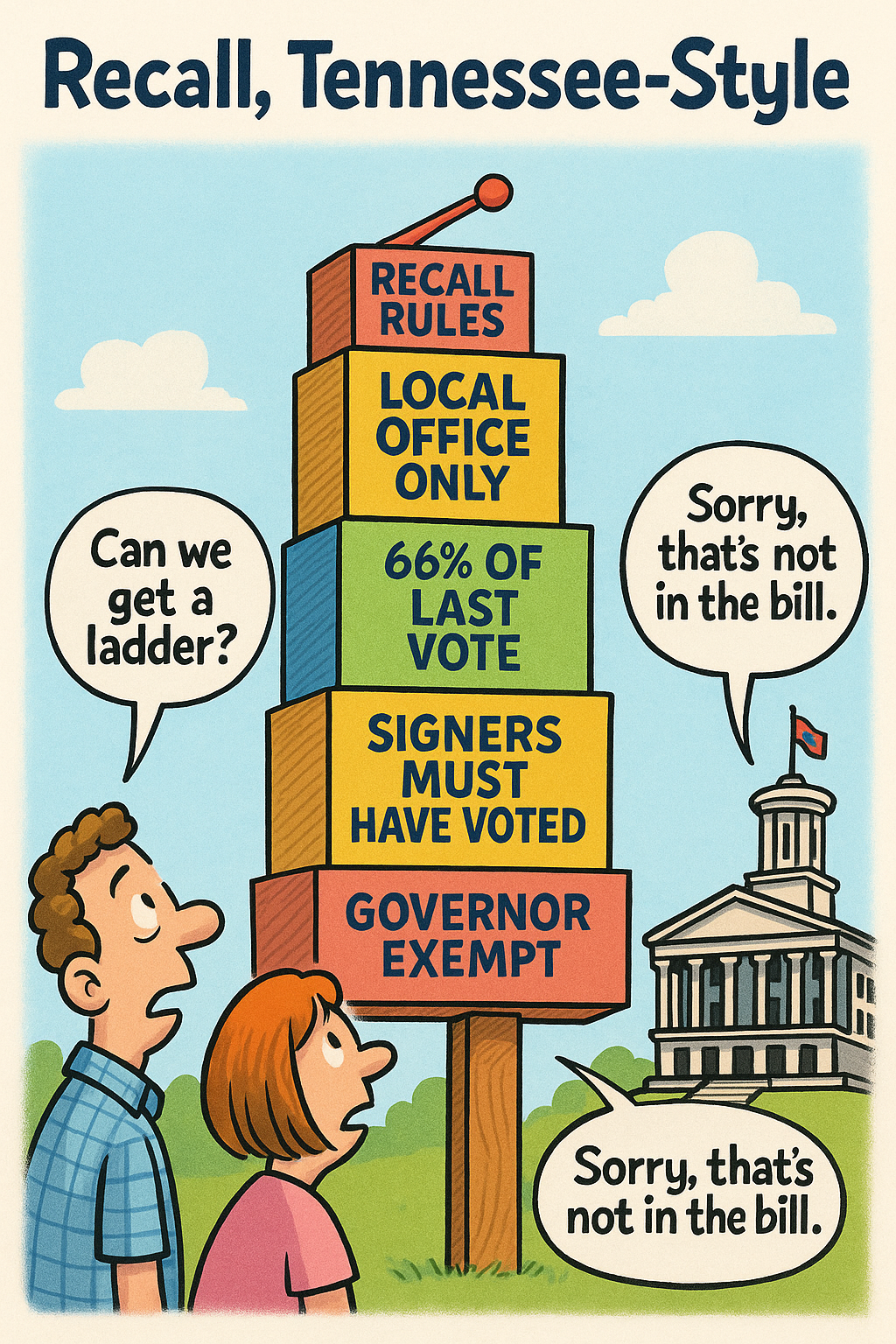
This year's bi-partisan proposal, SB1466/HB1448, carried by Sen. Brent Taylor (R-D31-Memphis) and Rep. Torrey Harris (D-D91-Memphis), attempts to create a recall process for local officials, but before even assessing its structure, the most glaring flaw is its scope: the bill excludes state-level elected officials entirely. The governor cannot be recalled. State senators cannot be recalled. State representatives cannot be recalled. The offices in Tennessee with the most power—and the most potential to do harm—remain protected from any mid-term accountability.
This omission is striking when compared to other states. Even California, the favorite punchline for conservatives who deride “Commiefornia,” allows voters to recall their governor and their state legislators. California successfully recalled a governor in 2003 and attempted to again in 2021. Both Democrats. Meanwhile, Tennessee—supposedly the deepest shade of red, if you believe what you hear on Fox News—leaves its citizens with fewer tools for accountability than voters in one of the most progressive states in the nation.
This contradiction becomes more obvious when examining the mechanics of the Taylor–Harris bill. It requires signatures equal to 66 percent of turnout from the last election for that office—an extraordinarily high standard that no other recall system in the United States uses. Most states set thresholds between 12 and 30 percent. A 66 percent requirement ensures that recall is theoretically possible, but practically unreachable. The bill also requires petition circulators to swear that they personally voted for the official they are now seeking to recall, a condition that exists nowhere else in the country and excludes new residents, those who abstained, those who voted for another candidate, and even newly eligible young voters. The practical effect of these provisions does not necessarily ensure integrity, but in practice, suppress participation.
It is important to note, however, that Senator Taylor appears genuinely interested in crafting a recall system that lawmakers will actually pass. The challenge is not necessarily apathy—it is fear. Many in the General Assembly believe that if the threshold is perceived as too low, organized activist groups with outside funding could weaponize recall efforts against conservative officials, creating chaos and destabilizing governance. This would practically include not just progressive activist groups, but also dark money republican establishment organizations like Club For Growth or Americans For Prosperity, who have endless streams of money almost always used to knee cap populist conservative grassroots efforts at capturing any amount of power for their voters.
But the solution to potential abuse, is not to make recall impossible. Other states have found reasonable middle-ground thresholds—such as 25 percent of prior turnout or 15 percent of registered voters—that have the ability to prevent political mischief, while still allowing communities to act when an elected official has clearly lost public trust.
To understand how Tennessee arrived at this moment, one must revisit the ten-year saga of failed recall efforts. The first modern push began in 2016, nearly from the genesis of the existence of a Tennessee Republican Supermajority, when voters in several communities began asking lawmakers for a statewide recall mechanism. The idea gained momentum among conservative grassroots groups, but lawmakers declined to move any bills forward, claiming the proposals were too broad or not sufficiently vetted. The issue quietly died, despite the political feasibility created by the newly solidified supermajority.
Then came 2019. Lawmakers finally passed a recall provision, but drafted it so narrowly that it applied only to Madison County. Legislators refused to support it unless it was confined to a single county, and as it turned out, a local controversy involving a school board member the community wanted removed. This turned the bill into unconstitutional special legislation. When the county attempted to use the law, the targeted board member sued and successfully argued that the law had been crafted specifically to remove her. A judge struck it down entirely, and although the bill contained a severability clause that could have preserved the statewide portions, applying it would have instantly activated recall authority across Tennessee—something lawmakers had not intended. To avoid that political explosion, the judge struck down the entire statute.
In 2020 and again in 2022, Rep. Chris Todd attempted to fix the law with simple amendments that would remove the unconstitutional language and restore statewide applicability. Both attempts failed in committee, each receiving only one vote. The political hesitation was clear: lawmakers wanted recall power on paper, but not in practice. A theme that has since become very familiar to conservative grassroots.
In 2023, freshman legislator Bryan Richey filed HB595, which passed the House Education Administration Committee with every Republican aside from Democrats voting no. Yet in the Senate, its companion bill by Sen. Adam Lowe was quietly sent to General Subcommittee—the legislative graveyard where bills go to die. In 2024, Sen. Lowe returned with SB1580, a differently structured recall system designed to avoid the constitutional pitfalls of the 2019 law. It passed committee in the House, but in the Senate, it was pulled off notice due to concerns about conflicts with existing municipal recall provisions. Once again, Tennessee arrived at the brink of recall legislation only to step back.
Now, a decade after the first modern attempt, the state still lacks a functional recall process. This consistent pattern—initial enthusiasm, then legislative slowdown, then procedural death—cannot be ignored. It is objectively observable that Tennessee lawmakers have had both the time and the political power to implement recall, and yet they have not done so.
This is why the Taylor–Harris bill, despite good intentions, feels familiar. It gestures toward accountability but does not provide it. It introduces recall but in a form Tennesseans will never realistically be able to use. Any legislation that attempts to create a meaningful recall process must include state-level officials, establish thresholds that prevent weaponization without making recall impossible, and avoid barriers like the “must have voted for the official” rule. Tennessee can and should structure a recall system that is both responsible and functional, one that protects communities from political instability while also ensuring that elected officials are not shielded from consequences when they violate public trust.
After ten years, the question is no longer whether recall legislation is possible. It is whether state lawmakers are willing to relinquish even a small measure of their own insulation from accountability. As the new session begins, Tennesseans will see whether 2026 becomes the year their legislature finally enacts real recall power—or simply the latest chapter in a decade-long pattern of preserving the political class instead of empowering the people.
If you want to support what we do, please consider donating a gift in order to sustain free, independent, and TRULY CONSERVATIVE media that is focused on Middle Tennessee and BEYOND!