A Theological Audit of The After Party — Part I
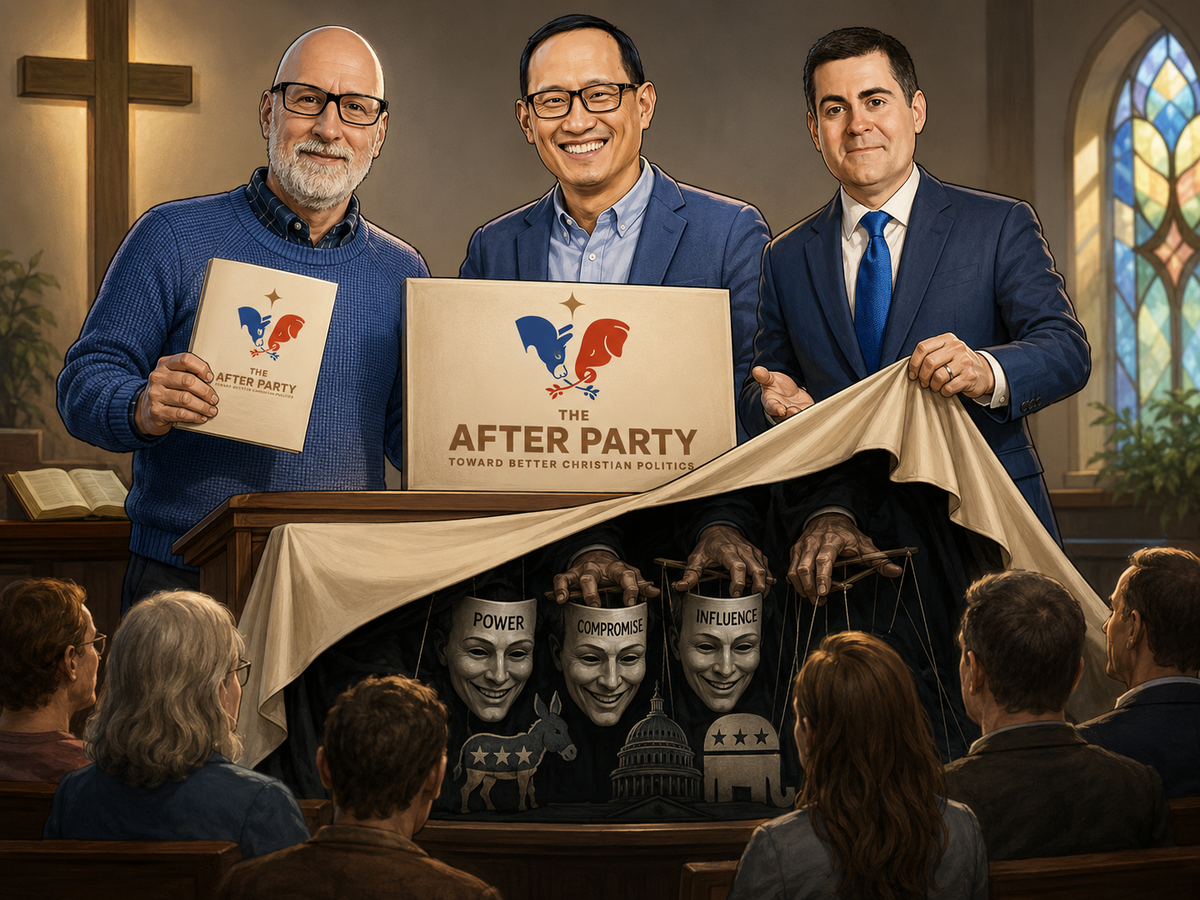
A political ad for The After Party resurfaced a question worth asking: Why are churches using a curriculum that says its focus is politics—not Bible study—to define “Christlike” political engagement for Christians?

They Say It Isn’t a Bible Study. So Why Is It Being Used to Define “Christlike” Politics?
5 Key Takeaways:
- Why The After Party is back on my radar.
A clearly labeled political ad appeared in my Facebook feed in Williamson County, prompting me to revisit a curriculum I had studied closely before. - Why Williamson County is a useful case study.
The county votes heavily Republican, but local politics reveal a deeper tension between establishment power and grassroots conservatives demanding more substantive conservative governance. - Why David French’s worldview matters.
As a principal creator, French’s Never Trump, pluralist and establishment-oriented political philosophy provides important context for the way the curriculum frames Christian political engagement. - Why churches should look closely at what they are using.
The After Party explicitly says it is not a Bible study and that its focus is politics, yet it is designed for churches, pastors and small groups as a tool for shaping Christian political behavior. - The theological question at the center of Part I.
The curriculum emphasizes the “how” of politics over the “what.” The question is whether that emphasis faithfully reflects Scripture or risks weakening the importance of moral clarity, confrontation and substantive biblical outcomes.
There I was yesterday, scrolling through my Facebook feed, when there it was: a political ad for The After Party. Not “political” because I had decided to characterize it that way. The advertisement itself was clearly labeled as political, and seeing it appear in my feed here in Williamson County, Tennessee, immediately got my attention.
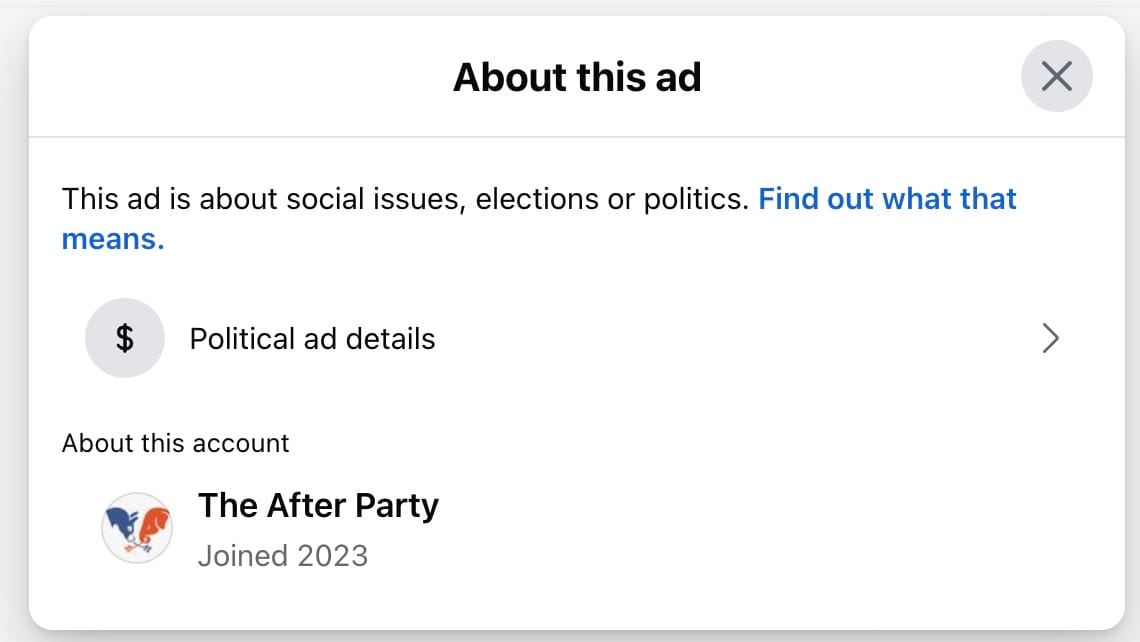
I had studied The After Party with considerable interest when it first surfaced. One reason was its connection to where I live. One of the curriculum’s principal creators, David French, was not some distant national political figure with no connection to Middle Tennessee. French and his wife, Nancy, previously lived in Williamson County before moving to neighboring Maury County. As near as I can determine, they have since left Tennessee, but their family and political connections here remain.
Nancy French’s sister, Mary Kate Brown, was recently elected to represent my district on the Tennessee Republican Party State Executive Committee. Mary Kate’s husband, Josh Brown, represents District 4 on the Williamson County Board of Education and currently serves as chairman. I know those family relationships firsthand. I am not suggesting that either Brown is responsible for The After Party or necessarily shares French’s political views. The connection simply explains why the project held a particular interest for me from the beginning.
French himself deserves a little context because his political philosophy matters to understanding the curriculum he helped create. He is a lawyer, former National Review writer, co-founder of The Dispatch and now a New York Times opinion columnist. Politically, he is best known as a Never Trump Republican and vocal critic of the MAGA movement. Among grassroots conservatives, French is generally associated with the neoconservative, establishment and classical-liberal wing of Republican politics than with the populist conservative movement that has reshaped the party over the last decade.
That distinction extends into cultural questions. During the 2019 debate over Drag Queen Story Hour in public libraries, French defended equal access to public facilities as a matter of viewpoint neutrality and constitutional liberty. In making that case, he described the ability to reserve a room for Drag Queen Story Hour and draw an audience as “one of the blessings of liberty.” To be precise, French was making a free-speech and pluralism argument rather than explicitly endorsing drag performances. But that distinction is important in its own right: his political philosophy places significant weight on pluralist liberty (which to me is a bit of an oxymoron, but I digress) even when the activity being protected is one many biblical Christians regard as morally destructive.
So when a political advertisement for The After Party suddenly appeared in my feed again—here, in Williamson County, right now—I stopped scrolling. The timing interested me almost as much as the ad itself.
Why Now?
Tennessee Republicans recently did something extraordinary: they redrew the state’s congressional districts in the middle of the decade. During a May special session, lawmakers changed state law to permit mid-cycle congressional redistricting and adopted new boundaries intended to improve Republican prospects across all nine districts.
Democrats, however, plainly do not believe Tennessee is hopeless territory. The Democratic Congressional Campaign Committee placed TN-05 candidate Chaz Molder in its Red to Blue program, explicitly identifying the race as a potential Republican pickup opportunity. Democratic organizations have also targeted the newly configured TN-09, while Tennessee Democrats have repeatedly pointed to their stronger-than-expected performance in the 2025 TN-07 special election as evidence that districts long assumed to be safely Republican may be more competitive than conventional wisdom suggests.
Whether Democrats can actually win those districts in November is fodder for another article. What matters here is that they believe an opening exists, and political organizations behave differently when they believe an opening exists.
There is another complication in Tennessee’s current political environment. Republicans have selected Marsha Blackburn as their gubernatorial nominee, a candidate many grassroots conservatives see as emblematic of the Republican establishment—what I have jokingly referred to as the Republican version of Hillary Clinton: enormously connected, institutionally powerful and treated within the establishment as nearly inevitable. That characterization is mine, but it reflects a very real divide between Republicans primarily concerned with maintaining Republican control and grassroots conservatives asking whether Republican power is actually producing conservative policy.
Do I have a memo from The After Party saying, “Target Williamson County because Tennessee Democrats think they have an opening”? No. But editorials are not written in a vacuum. I follow this county and this state closely enough to recognize political conditions when I see them. The timing, the audience and the message all matter. In a moment when Democrats believe they may reclaim some ground, establishment Republicans are fighting to retain theirs, and voters are exhausted by constant political conflict, a curriculum promising a gentler, more “Christlike” approach to politics could hardly arrive at a more useful time.
If I were the opposition looking at those conditions, I would recognize the opportunity too. You strike while the iron is hot.
Williamson County Is Republican. That Is Not the Same as Conservative.
Williamson County has long been described as one of Tennessee’s deepest-red counties, and Republicans unquestionably dominate elections here. But I have learned through years of following local politics that electing a lot of Republicans does not automatically make a county substantively conservative.
In a place where carrying the Republican label is practically a requirement for political viability, politicians can adopt conservative—and increasingly Trump-aligned—language while maintaining relationships, policies and governing practices that many grassroots conservatives believe bear little resemblance to the principles being advertised. Most voters understandably do not have time to research every vote, donor relationship, appointment, contract, policy decision and political alliance. They hear “Republican,” they hear “conservative,” they see the right endorsements and assume the conservative work is being done.
Recent election results should at least complicate that assumption. Across the May and August 2026 county election cycle, Democrats were elected to local positions in places where candidates openly carrying a “D” beside their names had either not won in decades or, depending upon the office, had never had that opportunity under the current partisan structure.
There is important historical context here, however, because school-board races and County Commission races have very different partisan histories in Williamson County.
School-board elections were nonpartisan until Tennessee lawmakers changed state law in 2021, allowing counties to conduct partisan school-board elections beginning with the 2022 cycle. So the absence of a “D” or “R” beside older school-board candidates tells us nothing about party affiliation because those races were not partisan in the first place.
County Commission races are a separate story. The Williamson County Democratic Party did not call county primaries for a long stretch between 1994 and 2018. Without a Democratic primary, left-leaning or Democratic-aligned candidates challenging Republicans could not simply appear on the general-election ballot as the Democratic nominee through the normal primary process. They often had to run without a party label unless another authorized nomination method was used.
That distinction matters. The historical absence of Democratic labels on County Commission ballots and the historical absence of any party labels on school-board ballots happened for completely different reasons. Neither should be used carelessly to argue that Williamson County lacked ideological diversity in earlier years.
In fact, that history reinforces the larger point: party designation is an imperfect substitute for governing philosophy. Williamson County can remain heavily Republican at the ballot box while having a much more complicated ideological reality underneath. Increasingly, the friction here is not simply Republican versus Democrat. It is also grassroots conservatives asking whether Republican officeholders are actually governing according to conservative principles while an entrenched political establishment insists the county must already be deeply conservative because Republicans control it.
The people asking whether the record matches the label can then become the perceived problem. Why are you attacking another Republican? Why are you creating division? Why can’t everyone work together? Translate those questions into Christian terminology and they become even more powerful: Is all this confrontation really Christlike? Have you made politics an idol? Shouldn’t unity matter more? Why are you so focused on winning?
That is where The After Party becomes particularly interesting.
When Churches Become Politically Consequential
During our May and August election cycles, pastors connected to two of Williamson County’s larger churches publicly advocated strongly for establishment-aligned candidates. I am not arguing that those interventions single-handedly determined election outcomes; there is no evidence that would support such a sweeping conclusion. But pretending that trusted pastors speaking to thousands of people in a highly churched community have no political influence would be equally unserious.
A curriculum does not have to turn conservative evangelicals into Democrats to affect political behavior. It only needs to influence how Christians understand the obligation created by their convictions: how hard they should fight for an outcome, when confrontation becomes inappropriate, whether political urgency reflects idolatry and whether preserving relationships should take precedence over achieving substantive political objectives.
That Facebook advertisement sent me back down the rabbit hole.
Megan Basham Followed the Money
Megan Basham has already done extensive reporting on The After Party’s creators, funding and ideological ecosystem. Her January 2024 First Things investigation, “Follow the Money to the After Party,” examined the outside philanthropic support behind the project, the political records of its creators and why large foundations were interested in financing a Christian political curriculum directed heavily toward evangelical audiences. Her reporting is foundational to this examination, and I have no intention of repackaging discoveries she already made and pretending they are new.
But here we are, just a few years later, and another question deserves just as much attention: What exactly did all of that money help put inside American churches?
Basham followed the money to The After Party. I want to follow it through the church doors and more closely examine the theology that came with it.
They Say It Isn’t a Bible Study
The After Party was created by Curtis Chang, David French and Russell Moore through Redeeming Babel, now operating as Good Faith. According to its own FAQ, it is a six-part digital course designed to “reorient Christian thinking about politics,” heal political divisions in churches and cultivate virtues such as humility, kindness and hopefulness. It is explicitly designed for pastors, small-group leaders and lay Christians, and the course is offered free of charge.
Then comes one of the statements that most interested me. The FAQ asks whether The After Party is a Bible study, and Good Faith says no. Its explanation is that a Bible study makes Scripture its primary subject, whereas The After Party supports its teaching with biblical references but acknowledges that “the focus is on politics.” In the same FAQ, however, the organization says pastors should spiritually form their people politically and recommends the curriculum as one tool for doing so.
Interestingly, Good Faith itself published a January 2025 article titled “5 of the Best Small Group Bible Studies” and placed The After Party first on the list, describing it as a free six-session study for small groups grappling with faith and politics.
That tension is worth noting. Formally, we are told this is not a Bible study because its focus is politics. Functionally, the organization markets it inside the same church small-group ecosystem and treats it as a resource for Christian formation.
There is nothing inherently improper about churches offering topical material. Churches teach marriage, parenting, finances and apologetics all the time. But The After Party is different in one important respect: it is a political-formation curriculum invoking biblical authority to tell Christians what faithful political engagement should look like.
If a church is going to devote days or even weeks of congregational discipleship time to that instruction, its theology deserves at least as much scrutiny as its politics.
The “How” Versus the “What”
The organizing idea of The After Party appears throughout its materials. The course repeatedly asks Christians to move away from the political “what”—party, candidate and policy—and toward the “how” of political engagement. Its course overview explicitly shifts attention away from parties, candidates and policy and toward virtues drawn from Micah 6:8. A later pastors’ guide describes this as “The Big Shift,” moving “from what we believe to how we engage.”
There is plenty in that premise with which biblical Christians should agree. Politics does not give believers permission to become hateful, dishonest, arrogant or cruel. Christian identity should never be subordinated to partisan identity, and our ultimate hope unquestionably rests in Christ rather than an election. The problem is that, biblically, the “how” and the “what” cannot always be separated.
I used the magic of AI to create a visual comparison highlighting how The After Party frames several foundational Christian principles alongside the broader biblical standard by which those concepts should be understood.
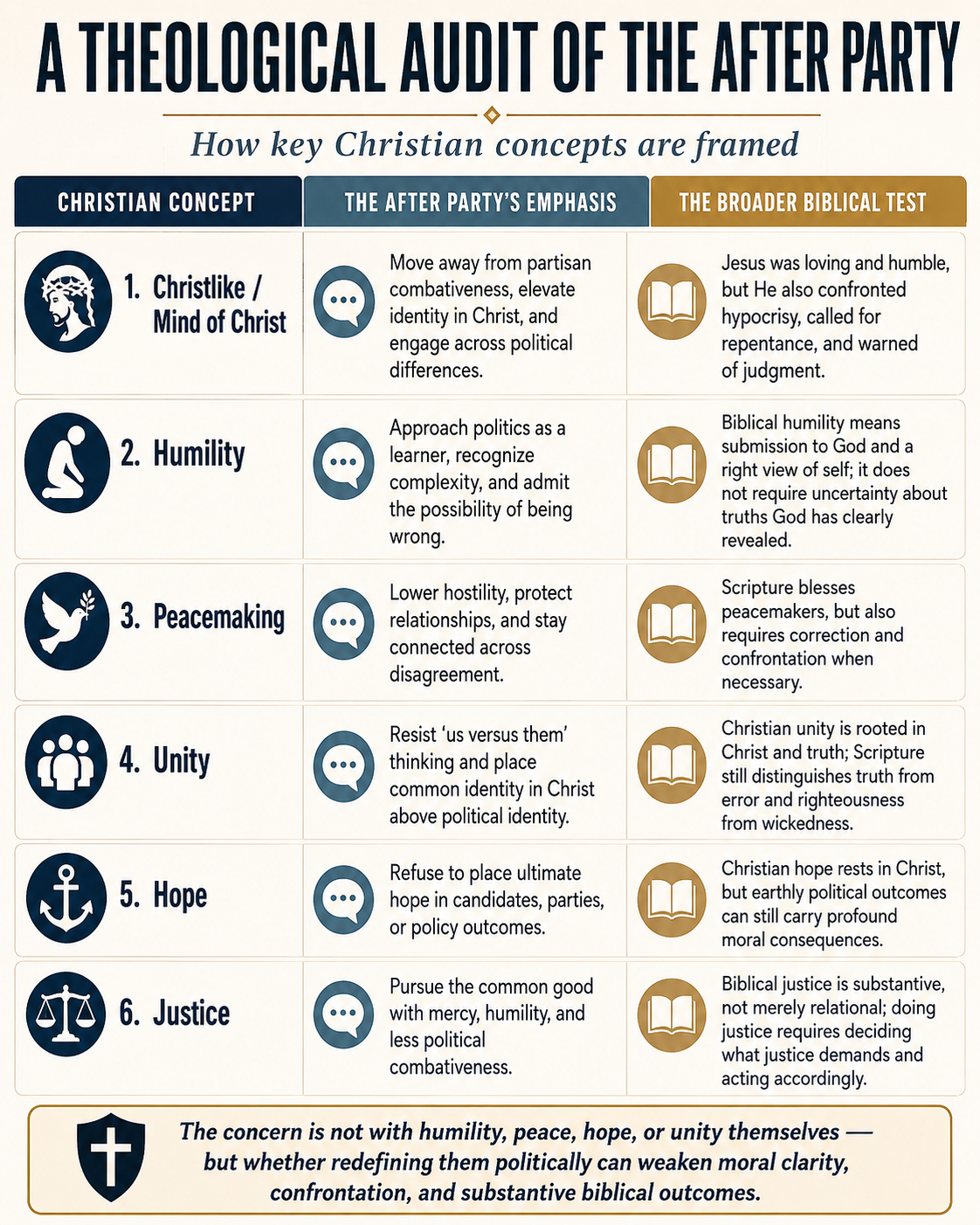
The problem is not humility, mercy, hope, peace or unity. Those are biblical virtues. The concern arises when their political definitions are expanded until moral certainty, confrontation or insistence on a substantive outcome begins to appear inherently less Christlike.
Jesus overturned tables. Nathan confronted David. John the Baptist confronted Herod. Paul publicly confronted Peter because truth was at stake. Those actions created conflict, but the existence of conflict did not make them unbiblical. Conversely, maintaining a pleasant relationship does not automatically make a position righteous.
Biblical Christianity demands something considerably more difficult than either political rage or political accommodation. It demands grace and truth, humility and courage, peace when peace is possible and confrontation when faithfulness requires it.
Once I began digging back through The After Party’s newer materials, I found an example that puts this entire “how versus what” framework into practice in a way that deserves much closer scrutiny. The subject is abortion, and the curriculum’s facilitator guide actually tells church leaders what to do when a discussion involving abortion begins turning into a substantive conversation about abortion.
That is where Part II begins.
Tomorrow, we will move from theory to application and examine what happens when The After Party’s “how over what” approach collides with an issue like abortion—where the substance of the disagreement cannot simply be separated from its moral consequences.
TruthWire exists to provide independent investigative journalism that holds Tennessee's political establishment accountable. We aren't funded by corporations, political parties, or large media companies. We're funded by readers who believe the truth is worth defending.
If this reporting has informed you or helped your community, please consider becoming a monthly supporter.