Accommodation or Imposition? Tennessee’s Uneven Line on Religion in Schools
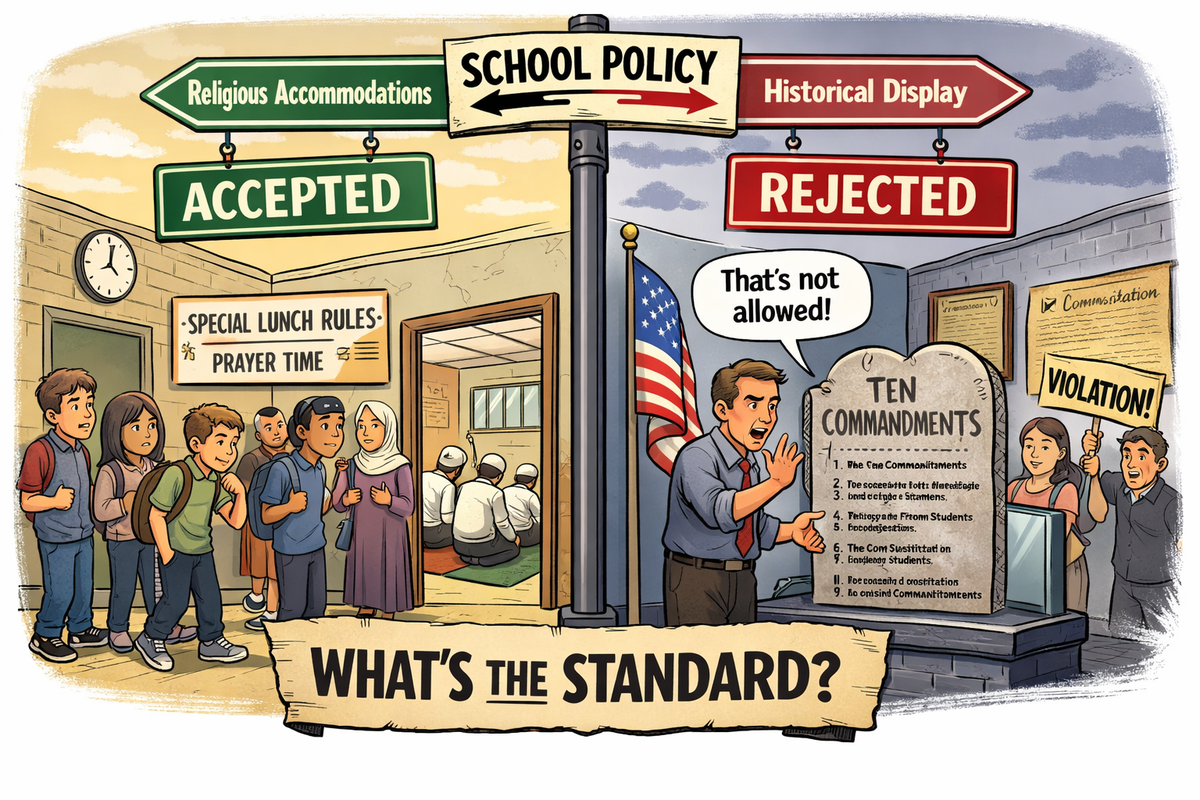
Two debates, one inconsistency. As Tennessee schools adjust schedules and policies to accommodate Ramadan, critics call even optional Ten Commandments displays unconstitutional. The real issue isn’t religion—it’s whether principles are applied consistently.

5 key highlights:
- Public schools accommodating Ramadan at a system-wide level raise questions about where accommodation ends and structural change begins.
- Multiple adjustments—not just the bell schedule—collectively reshape the school day for all students, not just those observing the religious practice.
- Tennessee’s Ten Commandments bill is optional and passive, yet faces constitutional criticism, while more active religious accommodations receive praise.
- The concept of “separation of church and state” is often misapplied; the Constitution protects religious freedom, not the removal of religion from public spaces.
- The core issue is consistency: principles around religion in public schools should be applied evenly, not selectively based on cultural framing.
- READ ENTIRE ARTICLE BELOW 👇
In Tennessee right now, two very different conversations are happening about religion in public schools, and what stands out isn’t just the contrast, it’s the inconsistency in how each is being judged.
At John Overton High School in Davidson County, administrators have taken significant steps to accommodate Muslim students observing Ramadan. Prayer spaces have been set aside, students can leave class with passes to participate in daily prayer, and teachers have volunteered their classrooms as food-free zones during lunch so fasting students don’t have to sit in the cafeteria surrounded by food. The school has even adjusted its bell schedule so students can more easily participate in religious observances during the day.
At an individual level, this is not controversial. Students have a constitutional right to practice their religion, and public schools can make reasonable allowances to protect that right. No one should be penalized for observing their faith.
But the question isn’t whether accommodation is appropriate. It’s where the line is drawn.
Because when you look at the full scope of what’s happening, the bell schedule is only one part of a broader pattern. Students are leaving class daily for prayer, classroom environments are being repurposed, and the normal flow of instruction is being adjusted in ways that affect more than just the students observing Ramadan. Each accommodation may seem reasonable on its own, but together they begin to alter the structure of the school day itself.
That’s where the distinction matters.
When a student steps out of class to pray, that’s an exercise of personal freedom. When a school provides space for that prayer, that’s a reasonable accommodation. But when schedules, movement, and classroom flow begin to shift to accommodate a specific religious practice, the impact is no longer limited to those participating in it. Every student is now operating within a system shaped, at least in part, by that observance.
That’s not just accommodation. That’s structural change.
And that becomes even more significant when viewed alongside another debate unfolding in Tennessee.
Lawmakers have passed HB0047, which would allow schools to display the Ten Commandments alongside documents like the Declaration of Independence, the Constitution, and the Bill of Rights. The bill doesn’t require anything, it simply gives local districts the option. Yet critics argue that even allowing such displays could violate the Establishment Clause of the First Amendment. That argument is almost always framed around the phrase “separation of church and state,” a concept many treat as if it appears directly in the Constitution.
It does not.
The First Amendment says, “Congress shall make no law respecting an establishment of religion, or prohibiting the free exercise thereof.” It does not mandate the removal of religion from public life. The phrase “separation of church and state” comes from an 1802 letter by Thomas Jefferson to the Danbury Baptists, where he reassured them the federal government would not establish a national religion or interfere with their faith. It was meant as a protection against government control of religion, not a directive to remove religion from public spaces altogether.
That distinction matters.
Because once you understand that the Constitution protects freedom of religion rather than eliminating its presence, the contrast between these two situations becomes harder to ignore.
Displaying the Ten Commandments is passive. It does not require participation, alter behavior, or change the structure of the school day. A student can walk past it, ignore it, or disagree with it entirely.
Restructuring elements of the school day is not passive.
It changes how time is spent, how classrooms function, and how students move through their day. It affects everyone, not just those directly participating in the religious practice that prompted the change. So the question becomes unavoidable: if one is considered constitutionally suspect, why is the other widely praised?
Because the Constitution does not prohibit religion in public life. It prohibits the government from establishing or favoring a religion in a way that infringes on the rights of others. That requires balance, protecting individual freedom while ensuring the system itself remains neutral.
Allowing a student to leave class to pray respects that balance. Adjusting the broader structure of the school day to accommodate that practice begins to test it.
And even beyond that, the argument that the mere presence of the Ten Commandments in a public school is unconstitutional deserves closer scrutiny. Even if such displays were required, the issue is not as clear-cut as it is often portrayed. The Ten Commandments are historically tied to the moral and philosophical foundations that influenced many of the principles embedded in America’s founding documents, documents already taught in public schools. Recognizing that influence in an educational context is not the same as establishing a state religion.
More broadly, every nation’s public education system reflects its own cultural and historical identity. Just as other countries emphasize their foundational traditions, it is not inherently inappropriate for American schools to reflect the influences that shaped this country. That does not compel belief, it provides context.
At Overton, no one is being forced to participate in prayer, but everyone is being required to operate within a system that has been adjusted because of it. That may seem like a subtle distinction, but in a public institution, it’s an important one. Neutrality doesn’t mean hostility toward religion, but it does mean the system itself should not shift in a way that elevates one practice over others.
And that is where the inconsistency becomes difficult to defend.
If displaying a religious text, one that students can ignore, is considered a potential violation of church-state principles, then altering the structure and flow of the school day for a religious observance should raise similar questions.
None of this diminishes the discipline or sincerity of the students observing Ramadan. Their commitment deserves respect, and schools should ensure they are not penalized for exercising their beliefs. But respect for one group’s religious practice does not require restructuring the environment for everyone else.
That’s where accommodation becomes something more.
And in a state like Tennessee, where even optional displays of the Ten Commandments are being challenged on constitutional grounds, the lack of consistency in how these situations are evaluated raises a broader concern.
Not about religion itself, but about whether the principles governing it are being applied evenly. Because once those principles are applied selectively, they stop being principles at all. They become preferences.
And that is a far less stable foundation for public education, or for the rights it is supposed to protect.
If you want to support what we do, please consider donating a gift in order to sustain free, independent, and TRULY CONSERVATIVE media that is focused on Middle Tennessee and BEYOND!