Franklin BOMA Members Invoke “Rule of Law” While Approving Pride Event with Speech Restrictions
Franklin says it follows the law. So why does Pride still ban viewpoints that conflict with its mission in a park?
5 Key Points:
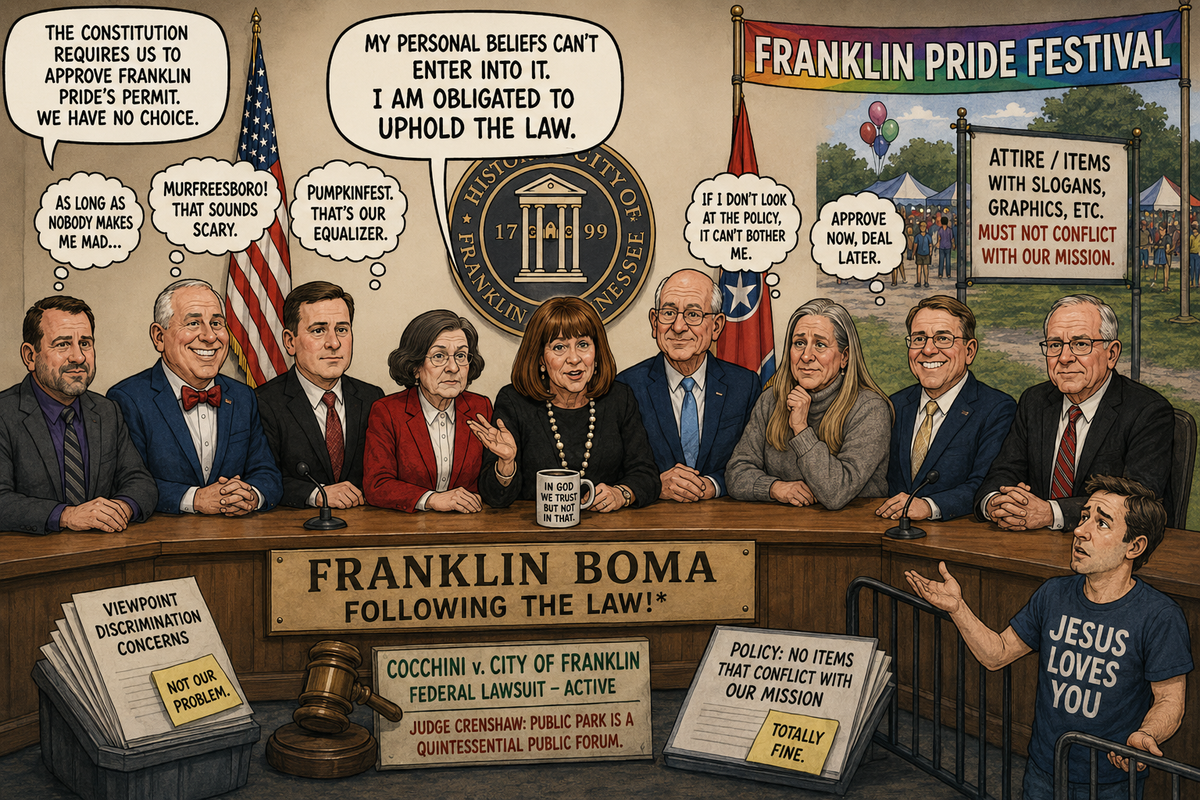
- BOMA Says Its Hands Are Tied
Officials claim the Constitution requires them to approve Franklin Pride's permit. - The Real Issue Isn't The Permit
The controversy is over speech restrictions imposed after the permit is granted. - Viewpoint Restrictions Remain In Place
Franklin Pride still prohibits messages that conflict with its mission. - The City Is Already Being Sued
The Cocchini lawsuit challenges how speech was handled at a previous Pride event. - Public Parks Don't Become Private Property
A permit does not eliminate First Amendment protections in a public forum.
During the January 2026 Franklin Board of Mayor and Aldermen work session, a young Christian conservative who had recently moved to the city from Georgia addressed the board. He asked them to show courage and stop allowing the Franklin Pride Festival to use Harlinsdale Farm, a public park. He was not seeking more legal excuses related to the First Amendment but wanted elected representatives to take a stand on behalf of their constituents.
Beverly Burger responded by stressing her duty as an elected official:
“As an elected official who is to abide by local, state, federal laws… I don’t necessarily have to agree and I do not agree with certain things… But I’m required to abide by the rule of law… I cannot allow my personal beliefs, my personal convictions as a Christian… I’m obligated to uphold that law.”
Vice Mayor Patrick Baggett described the board’s role as purely administrative, stating:
“This is no more a city sponsored event than Pumpkinfest… This is literally an administrative task… We are just deciding the use of a park, who can use it, when they can use it.”
Other BOMA members immediately contradicted Baggett, confirming that the city does in fact sponsor Pumpkinfest and several other major events. Despite this, he continued with the comparison.
The Franklin Pride Festival, taking place this weekend at Harlinsdale Farm, continues to list the following rule on its official website:

The same type of language was used in prior years, including 2023, when a man, Franklin resident Joe Cochini, was arrested at the event for wearing a shirt with a religious message.
Burger and Baggett both emphasized that their personal convictions must yield to their oath and the law. However, the board has continued to approve permits for the Pride event while its viewpoint-based speech restrictions remain in effect.
Legal precedent is clear on this matter. A permit for the use of a public park does not convert that space into private property or allow the permit holder to impose restrictions the government itself could not enforce. In Hague v. CIO (1939), the Supreme Court held that public parks are traditional public forums “held in trust for the use of the public” for assembly and expression. Government cannot delegate its First Amendment obligations to a private organizer.
Viewpoint discrimination in traditional public forums is presumptively unconstitutional, as established in cases such as Rosenberger v. Rector and Visitors of the University of Virginia (1995).
The board approved this year’s permit despite an ongoing federal lawsuit, Cocchini v. City of Franklin, stemming from the 2023 festival. U.S. District Judge Waverly Crenshaw ruled that Harlinsdale Farm is a quintessential public forum and allowed First Amendment claims to proceed. The court noted that police cannot simply defer constitutional decisions to private event organizers. The City itself did not seek dismissal of the claims against it at that stage.
One possible reason the board has not required Pride organizers to remove the restrictive rule is that doing so would amount to an admission that the policy at the center of the Cocchini lawsuit is unconstitutional. Forcing changes now could be seen as conceding weakness in the city’s legal position in the ongoing case.
Despite these developments and the continued presence of the restrictive rules on the Pride website, the event proceeds this weekend under the same framework the board has repeatedly approved. The board has stated that it reviews safety, costs, and compliance for all events. Yet the combination of their public statements about strictly following the law and their ongoing approval of permits containing explicit viewpoint restrictions continues to highlight a notable tension in how those principles are applied in practice.
In the end, claiming to be bound by law while repeatedly enabling viewpoint discrimination on public property is not neutrality — it is a quiet surrender of constitutional responsibility.
If you want to support what we do, please consider donating a gift in order to sustain free, independent, and TRULY CONSERVATIVE media that is focused on Middle Tennessee and BEYOND!