The Sale Recommendation Is In. The Transparency Debate Isn't Over.
Ascension is the Board's recommendation, not the final decision. The next chapter is transparency, oversight, and public accountability.

5 Key Takeaways
- The Board has made a recommendation—not a final decision.
The County Commission and other required approvals still lie ahead. - The process was further along than many realized.
By Monday's presentation, the Board confirmed months of active outreach, evaluations, and finalist selection. - The debate has always been about transparency.
Confidential negotiations may be appropriate, but the public is still asking whether the process was accurately represented as it unfolded. - Commissioners now have important questions to answer.
Why was Ascension chosen over the other finalists, and what criteria carried the greatest weight? - Accountability now shifts to the County Commission.
As the review moves forward, the public deserves clear answers about oversight, the use of proceeds, and transparency going forward.
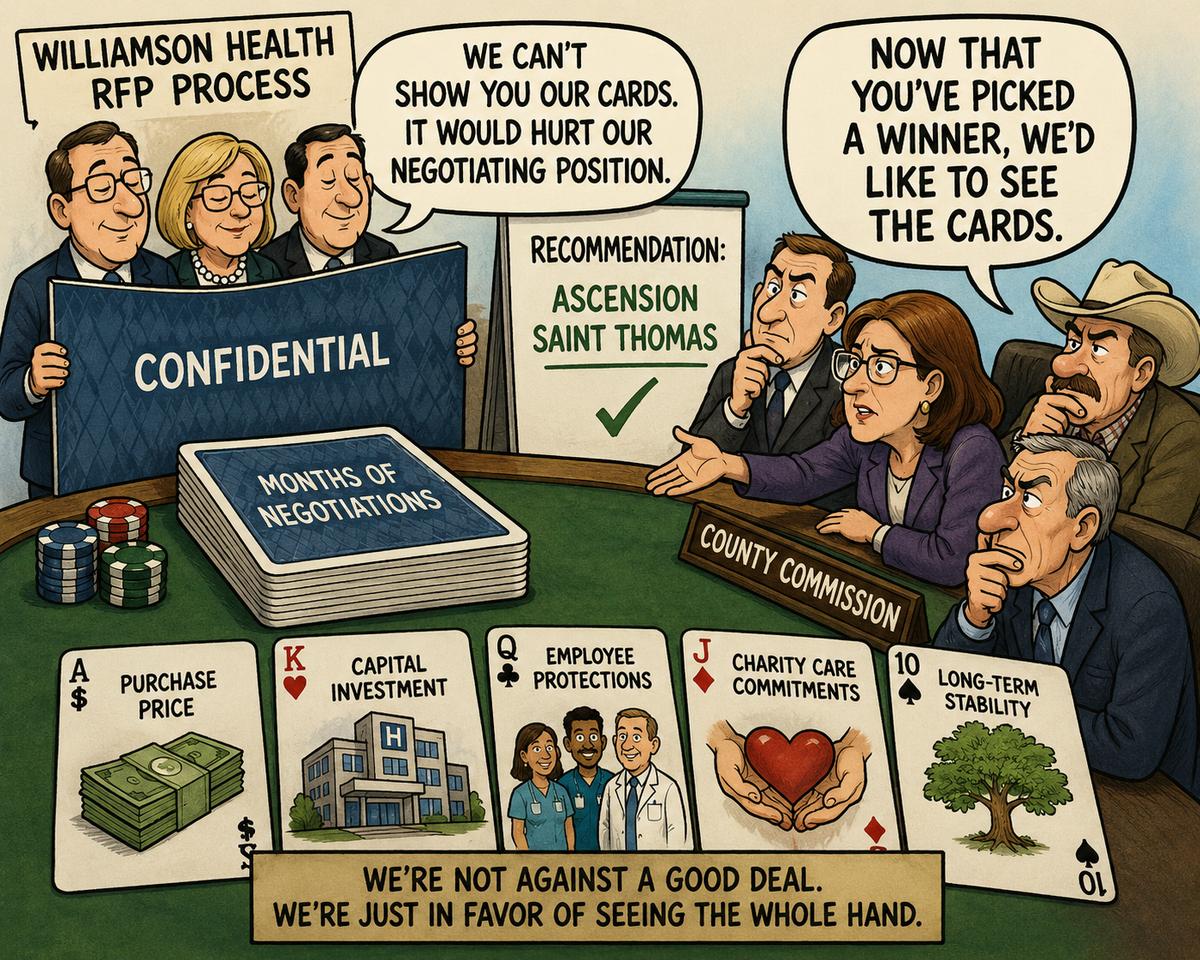
Monday night's Williamson Health Board of Trustees meeting answered many of the questions that have surrounded the proposed sale of Williamson Health over the past year. For the first time, the Board publicly explained why it unanimously recommended selling the county-owned health system to Ascension Saint Thomas, presenting comparisons of purchase price, capital commitments, employee protections, governance, charity care, and long-term financial projections.
The presentation provided substantially more information than the public had previously seen, making clear that the Board's recommendation was based on a detailed evaluation rather than a single financial figure.
It also changed the transparency conversation.
For nearly a year, commissioners, citizens, and members of the media sought additional information about Williamson Health's strategic planning process. The consistent response was that confidentiality was necessary while negotiations remained active. Hospital officials argued that public disclosure could weaken Williamson Health's negotiating position and ultimately reduce the value of one of the county's most significant public assets. Several county commissioners who also served on the Hospital Board defended that position, emphasizing that protecting the integrity of the procurement process required limiting what could be discussed publicly.
Monday night's presentation revealed just how far that process had progressed.
According to the Board, Kaufman Hall contacted twenty-eight healthcare organizations, eleven entered confidentiality agreements, four submitted formal proposals, and three advanced through management and Board presentations before Ascension was unanimously selected. That timeline confirms the hospital was conducting a comprehensive procurement process while much of the public discussion remained focused on whether a sale might occur at all.
There is nothing inherently improper about conducting a confidential procurement process for a transaction of this size. What Monday night's presentation confirmed, however, is that the process was significantly more advanced than many members of the public understood while requests for additional information were consistently met with explanations that negotiations were ongoing and no decision had been made. The question was never simply whether negotiations should remain confidential, but whether the public narrative accurately reflected where the process actually stood.
Now the circumstances have changed.
The Board has completed its evaluation and made its recommendation. Responsibility now shifts to the Williamson County Commission, whose role is not to negotiate the transaction but to independently determine whether the proposed sale serves the best interests of Williamson County.
That distinction is important because only a handful of commissioners participated directly in the Hospital Board's deliberations. The remaining commissioners must now evaluate months of work they did not personally witness before casting one of the most consequential votes of their time in office. That naturally raises the question of what information commissioners—and the public—should now receive as part of that review.
Monday's presentation explained why the Board selected Ascension. It provided less insight into how those conclusions were ultimately reached. The Board repeatedly cited Ascension's cultural fit, shared mission, and long-term vision, but many of the evaluation criteria remain largely unknown to the public. What factors carried the greatest weight? How were competing proposals measured against one another? Why did Ascension ultimately separate itself from the other finalists? Those are reasonable questions for commissioners to ask before approving one of the largest public transactions in county history.
The conversation also extends well beyond the sale itself.
If approved, the transaction is expected to generate hundreds of millions of dollars in net proceeds. That raises another series of questions that deserve public attention. Who will oversee those funds? How will investment decisions be made? What reporting requirements will exist? What role will the County Commission have after the sale closes, and what safeguards will ensure those proceeds continue serving the citizens of Williamson County for decades to come?
Those issues have received far less attention than the sale itself, yet they may ultimately have the greatest long-term impact on the county's future.
Throughout this process, TruthWire has focused less on whether Williamson Health should be sold than on whether the public was receiving an accurate understanding of where the process stood. Monday night's presentation answered many of the questions residents have been asking for months. It also confirmed that the procurement process had progressed much further than many citizens realized while discussions remained largely out of public view.
As the proposal now moves before the County Commission, the expectation should naturally shift from protecting negotiations to ensuring accountability. The recommendation has been made. The Commission's independent review now begins. With that review should come a greater understanding not only of why the Board reached its decision, but also of how the proceeds will ultimately be managed and what level of transparency the public can expect throughout the remainder of the process.
If you want to support what we do, please consider donating a gift in order to sustain free, independent, and TRULY CONSERVATIVE media that is focused on Middle Tennessee and BEYOND!