A Sober Reflection After the Primary: The Grassroots Didn’t Lose the Message — We Lost the Ground Game
Grassroots conservatives took a hard loss in Williamson County, but the deeper story is why. From early voting strategy to crossover voting and church influence, this commentary examines the structural failures reshaping local Republican politics.


5 Key Highlights:
- Grassroots conservatives may have weakened their greatest advantage by abandoning strong Election Day turnout in favor of early voting strategies better suited for establishment political machines.
- Local elections are being decided by shockingly small percentages of eligible voters, allowing organized political networks to dominate low-turnout races.
- Tennessee’s open primary system continues fueling frustration among Republican voters concerned about crossover voting and diluted primaries.
- Coordinated establishment candidates operated like a unified ticket while grassroots campaigns often functioned as isolated efforts sharing similar frustrations.
- Influential local pastors and community leaders played a major role mobilizing establishment-aligned voters, proving local relationships and long-term organization still matter deeply in county politics.
The Williamson County grassroots took a hard loss in the May 5th Republican County Primary Election, and there is no point pretending otherwise. The results were decisive, and for many voters who hoped to see a gain in our county government, the night was disappointing. But if there is anything worth taking from defeat, it is identifying some of the possible reasons why.
As a biased Election Day voter, one of the biggest strategic mistakes may have been abandoning what has traditionally been a grassroots strength: Election Day turnout. Grassroots voters are, by nature, highly engaged and deeply motivated. They are the voters willing to stand in line before work, after work, or in the rain because they desire to protect the sanctity of their ballot. That energy has historically been concentrated on Election Day itself. Still, due to the influence of national and local narratives that forecast the winner is determined in early voting, we have been watching the uptick over the past years. There was a significant push embraced by the grassroots this cycle to early vote, noticeably hampering the Election Day turnout. In 2022, the early vote was 48 -50% in the primaries. This election, May 2026, we hit 62% with a state average of 67%. For those of us at the polls, it was palpable.
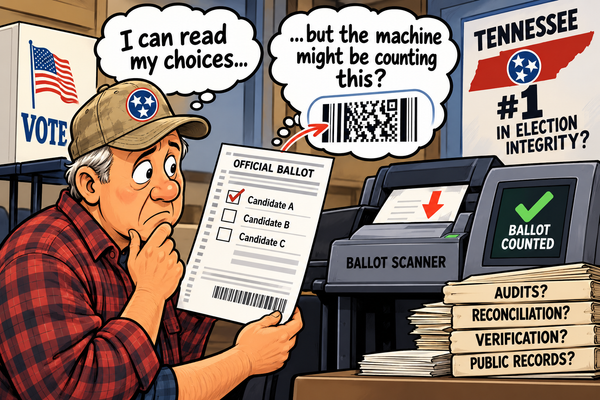
Understand, grassroots campaigns operate with finite resources. Time, volunteers, messaging, and voter contact all involve tradeoffs. By shifting focus toward early voting, the grassroots may have unintentionally weakened the very surge that traditionally gives outsider candidates momentum on Election Day by imitating the early vote strategy of the establishment, better equipped for long-term ballot banking operations. Additionally, there remains an important conversation surrounding election integrity. There are ongoing concerns about voting machines, as well as questions about who has access to the ballots cast, particularly during the early voting period. Critics argue that when voting trends or turnout data become visible over a two-week window, it can create opportunities for political operations to identify turnout targets and focus ballot collection or voter mobilization efforts around known numbers before Election Day arrives. Regardless of the reason, we are playing into their hands in a system where we can not win.
Low voter turnout also remains a major challenge and is the core issue. Local elections continue to be decided by approximately 13% of eligible voters, which naturally benefits organized political networks and entrenched insiders. To zero in, this number means that less than 7% of eligible voters likely just elected our next mayor. When we engage on the campaign trail, we find that grassroots support often exists broadly across communities, as we find most of our neighbors care about the same things we do, but broad support means very little if voters stay home. Frustration with the government does not translate into political change unless citizens consistently participate in local elections.
And then there is the issue of crossover voting. Tennessee’s open primary system continues to generate frustration among many Republican voters who believe partisan primaries should be decided strictly by committed Republican voters. Whether crossover voting ultimately changed the outcome in specific races or not, we know it happened, and our candidates work within a broken system that allows for it. Repeatedly, legislation to close the primaries has failed. It is up to the leadership of the Republican Party to do something about it, and the solution would be to caucus. We have allowed the state to infringe where they were not delegated power, and they should be held accountable.
Additionally, in county politics, down-ballot candidates often depend heavily on the energy and visibility created by the top race. Voters are influenced by momentum, consistency, and the perception of cohesion. When voters repeatedly see candidates standing together, endorsing one another, and operating as a coordinated movement, it reinforces confidence. The establishment teamed up from the top of the ticket and within the districts and won through coordinated turnout efforts. The grassroots, by comparison, often looked like separate campaigns sharing similar frustrations rather than a unified ticket moving toward a common goal.
And then there is the local church. We have been calling for the church to engage for years… and a few prominent pastors took to their pulpits and social media accounts, and they certainly did. The endorsements from a few influential local pastors of the establishment candidate/s made an impact far beyond a typical political endorsement. Recognize that in many communities, pastors are among the most trusted voices people hear each week, and their encouragement to participate in the election helped mobilize voters who may not otherwise have turned out. Their influence created an organized and motivated voting bloc that turned out against the grassroots. It is clear that these endorsements helped shape voter participation and demonstrated the powerful role community leaders can play in local elections. Unfortunately, they got it wrong.
What happens next matters more than what happened on Tuesday, May 5th. Political movements are tested more by defeat than by victory. The easy response is anger. The productive response is reflection and improvement. The grassroots movement is marked by passionate supporters, motivated volunteers, and voters who are hungry for change, which is evident in many of our recent elections.
A sustainable political movement cannot depend on a small group of advocates finding candidates each election cycle. Passion is important, but passion from the same small group of people is not enough to overcome a disciplined and well-funded political operation. It must invest in identifying, developing, and preparing future leaders long before campaigns begin. Organization, preparation, consistency, and experience all matter. Just as importantly, candidates who win office must continue building relationships and maintaining trust within the community after the election is over to build teams and a mechanism for re-election. Political movements are strengthened through continuous engagement with the people, not temporary enthusiasm during campaign season alone. Without building those structures, grassroots efforts will continue struggling against an establishment machine that understands turnout operations, maintains long-term networks, and has the financial resources to repeatedly outmatch and outlast its opposition.
The establishment did not win because the grassroots message lacked support. If the grassroots wants future victories, it must stop trying to imitate establishment strategies that do not fit our strengths and instead build a strategy that maximizes what makes grassroots movements powerful in the first place: motivated voters, building a bench of leaders and support, strong Election Day turnout, and authentic community engagement–not wasting time in rooms we have no business being in vying for the affection of those we will never win.
If you want to support what we do, please consider donating a gift in order to sustain free, independent, and TRULY CONSERVATIVE media that is focused on Middle Tennessee and BEYOND!