New Poll Puts Hatley Within Single Digits of Blackburn, Raising Questions About Tennessee’s Republican Vote
Tennessee's early-voting data and new polling challenge assumptions about Republican loyalty. With a well-funded conservative independent in the race, voters classified as Strong GOP may not automatically support the Republican nominee.

5 Key Takeaways
1. Hatley Within Single Digits: An October 27 campaign-sponsored poll places independent David Hatley at 26.47%, just 8.07 points behind Republican Marsha Blackburn at 34.54%. The survey used self-selected respondents, limiting its reliability.
2. Polling Reveals Different Pictures: Three October surveys place Hatley's support between 11.9% and 26.47%, highlighting significant differences in methodology and uncertainty about his actual statewide support.
3. Republican Voters Aren't Guaranteed Republican Votes: Voter-analysis data identifies 148,131 early voters as Republican-leaning, but those classifications cannot determine whether they voted for Blackburn, Hatley, or another candidate.
4. Hatley's Financing Changes the Dynamic: With $12 million reportedly loaned to his campaign by mid-October, Hatley has resources rarely available to independent gubernatorial candidates, allowing him to compete for statewide attention.
5. Conservative Principles Don't Equal Party Loyalty: The polling raises questions about assumptions of automatic Republican support. Voters can maintain conservative convictions while choosing candidates outside the Republican Party.
A new statewide survey released October 27 places independent gubernatorial candidate David Hatley within eight percentage points of Republican Marsha Blackburn, adding another dimension to an unusual Tennessee governor's race. The findings come as voter-analysis data obtained by TruthWire News raises a related question: How reliable are traditional Republican voting classifications when a conservative independent is competing for the same electorate?
The latest survey, conducted October 25–26 by GOTV Polling, reported Blackburn at 34.54%, Democrat Jerri Green at 30.12%, and Hatley at 26.47%. Independent Lauren Pinkston received 2.96%, with 5.91% undecided. The survey included 1,196 respondents and was sponsored by Hatley's campaign. Participants voluntarily responded to an automated text message, a methodological distinction relevant to evaluating the findings.
The new figures differ considerably from an October Spry Strategies survey, circulated by Blackburn's campaign, which placed Blackburn at 43.5%, Green at 32%, and Hatley at 11.9%. A separate Political Intelligence Polling survey conducted in mid-October reported Blackburn at 36%, Green at 34%, and Hatley at 19%. The three surveys present substantially different pictures of the same gubernatorial contest and raise questions about the assumptions underlying traditional partisan voting models.
What the Latest Poll Shows
The October 27 GOTV Polling release reported Blackburn leading Hatley by 8.07 percentage points and Green by 4.42 points. The weighted figures were calculated using county, age, and sex. Of those responding, 49% identified as Republican, 23% as Democrat, and 28% as nonpartisan.
GOTV Polling reported a conventional margin of sampling error of ±2.8 percentage points, increasing to ±3.6 points after accounting for weighting. The firm acknowledged that its survey relied on self-selected respondents rather than a representative probability sample, introducing potential self-selection and coverage bias beyond those margins. The survey was also sponsored and paid for by Hatley for Governor.
The geographic findings are particularly interesting. Among respondents living in counties where President Donald Trump received more than 75% of the vote, Hatley registered 33.24% support compared with Blackburn's 36.19%. In smaller and rural counties, Hatley received 29.78%, while Blackburn received 38.76%. These unweighted subgroup results show substantial independent support among respondents from counties that have historically voted heavily Republican.
The survey also recorded Hatley receiving 28.77% in East Tennessee, 23.93% in Middle Tennessee, and 25% in West Tennessee. His support among survey respondents extended across the state's three grand divisions, including regions with longstanding Republican voting patterns. These findings make the relationship between political affiliation and actual candidate preference an important part of understanding the race.
Three Polls, Three Different Pictures
The October polling presents substantially different measurements of the gubernatorial electorate, and those discrepancies deserve more scrutiny than simply accepting whichever survey produces the preferred outcome.
The Spry Strategies survey, released October 19, interviewed 635 likely Tennessee voters between October 10 and 16. Circulated by Blackburn's campaign, the poll placed Blackburn at 43.5%, Green at 32%, Hatley at 11.9%, and Pinkston at 1.4%, with approximately 10% undecided. Its reported margin of error was ±3.89 percentage points. According to Spry's published findings, Blackburn received support from 73.5% of self-identified Republicans and 84.7% of respondents identifying as MAGA Republicans.
A separate Political Intelligence Polling survey conducted October 13–16 reportedly interviewed 873 likely Tennessee voters with a stated margin of error of ±3.3 percentage points. That survey placed Blackburn at 36%, Green at 34%, and Hatley at 19%, with 11% undecided. The survey circulated publicly, including through Green's campaign. As WPLN News reported October 21, a spokesperson for Green said a trusted source had shared the polling with the campaign. Its commissioning and funding have not been publicly established.
The PI survey's reported partisan breakdown is especially relevant to the question of Republican voter loyalty. Among self-identified Republicans, 65% supported Blackburn, 19% Hatley, and 5% Green. Among respondents describing themselves as conservative, Blackburn received 55%, Hatley 22%, and Green 12%. Hatley also attracted 28% of respondents identifying as nonpartisan. Blackburn's reported favorability stood at 37%, compared with 53% unfavorable, including unfavorable ratings from 20% of Republicans and 31% of conservatives.
The latest GOTV survey places Hatley at 26.47%, compared with 19% in the Political Intelligence survey and 11.9% in Spry's findings. The Spry poll was circulated by Blackburn's campaign, while the GOTV survey was openly sponsored by Hatley's campaign. The results raise an increasingly important question about how accurately traditional polling captures support for a well-funded conservative independent in a state where Republican voting patterns have long been taken for granted.
Across all three surveys, Hatley registers measurable support, including among voters who identify as Republican or conservative. The differences between the surveys make their methodologies and partisan assumptions especially relevant as Tennessee approaches Election Day.
What Does "Strong GOP" Actually Mean?
Voter-analysis data recently provided to TruthWire News classified approximately 297,000 early voters according to their modeled partisan tendencies. Within that snapshot, 148,131 were identified as Republican-leaning, 113,782 as Democratic-leaning, and 35,574 as Swing. The classifications suggest a Republican advantage in early participation and provide a useful starting point for examining the partisan composition of Tennessee's electorate.
Information provided to TruthWire indicates that the voter-analysis system combines voting histories with consumer and behavioral information, including political contributions, social media interests, and purchasing patterns. These classifications are relatively stable, meaning someone identified as Strong Republican would ordinarily retain that classification even after supporting an independent candidate in one election. The model estimates political tendencies based on historical information, while voters make individual choices in each race.
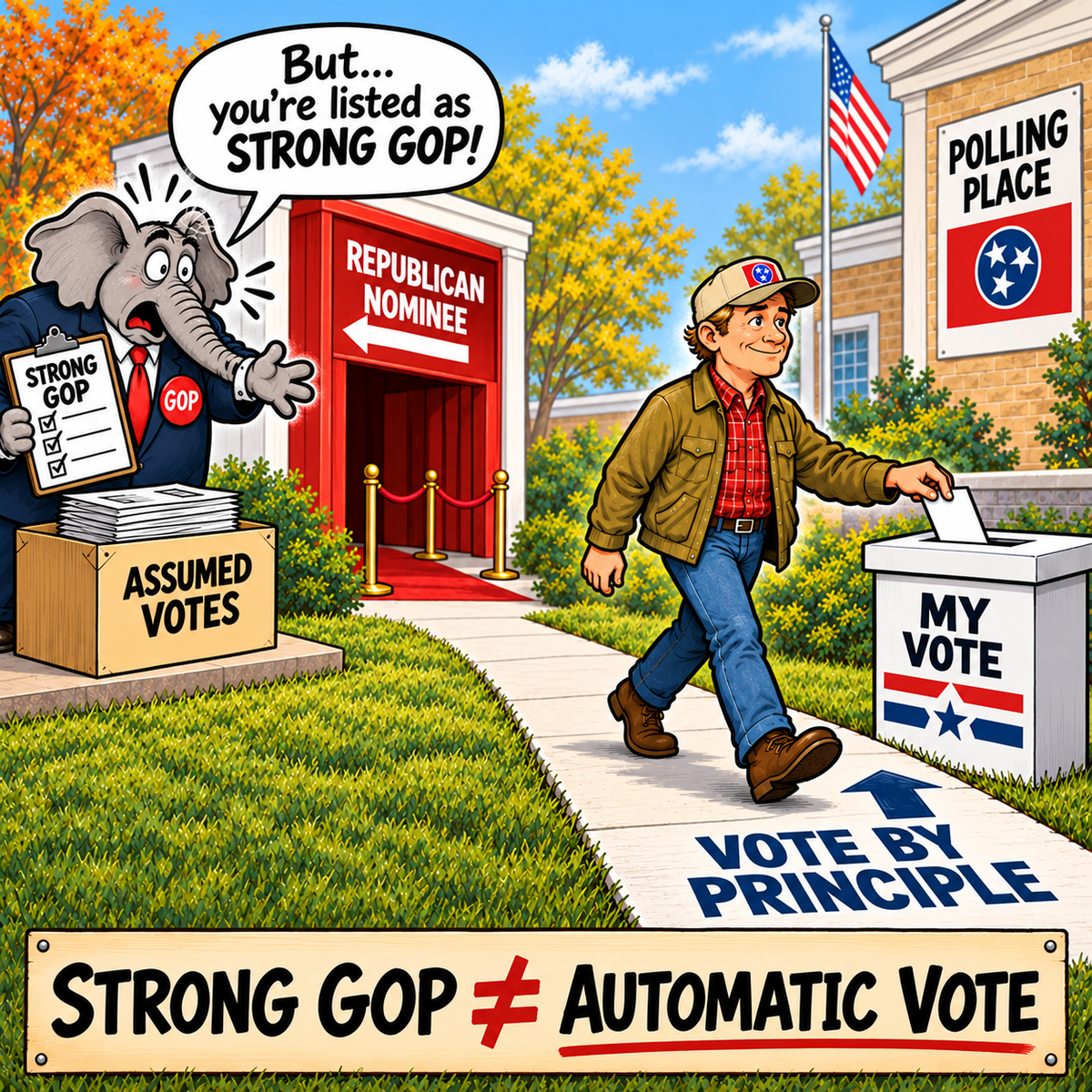
If I appeared in that database, I would almost certainly be classified as Strong GOP, accurately reflecting my political history and conservative convictions. I believe in limited government, fiscal responsibility, individual liberty, and constitutional principles. Yet I consider independent David Hatley the more conservative alternative to Republican nominee Marsha Blackburn. My principles haven't changed, but I've never believed a candidate is entitled to my vote simply because there's an R beside their name.
Tennessee's primary system adds another complication. Voters do not formally register by political party, although state law requires primary voters to be affiliated with the party or declare allegiance with the intent to affiliate. According to Think Tennessee's analysis of primary participation, August primary turnout has averaged 33.4 percentage points below November general-election turnout. Consequently, many voters participating in general elections have little recent primary history, even when their political convictions are firmly established.
The 35,574 voters classified as Swing also include younger and infrequent voters whose histories provide insufficient evidence of partisan preference. Meanwhile, voters with extensive Republican histories may support Hatley for governor while voting Republican in congressional races. The Pew Research Center documented the broader phenomenon of split-ticket voting in 2024, when four states supporting Donald Trump also elected Democratic U.S. senators.
This is where voter modeling becomes particularly important. A Republican classification can accurately identify someone's political philosophy and historical behavior while providing an incomplete picture of their preferences in a specific race. The distinction takes on greater significance when a well-financed independent candidate competes for voters who have traditionally supported Republicans.
What Has Changed Since 2020?
The past six years have changed how many Americans view political institutions. Election controversies, COVID-19 restrictions, school closures, vaccine mandates, and disputes over censorship and government authority prompted people to reconsider institutions they previously trusted. Political parties have faced that same scrutiny, particularly among voters who believe elected officials have failed to uphold the principles they publicly claim to support.
The Pew Research Center reported that only 17% of Americans trusted the federal government to do what is right most or all of the time in September 2025. That finding illustrates the broader environment of institutional distrust in which Tennessee's gubernatorial election is taking place, as voters scrutinize political leadership and demand greater accountability.
Someone who consistently supported Republicans in 2016 or 2018 may now view the Republican establishment differently while holding firmly to the same conservative principles. That dissatisfaction becomes especially relevant when wealthy donors, political organizations, and Super PACs spend enormous sums promoting preferred candidates. Federal election rules permit unlimited independent expenditures, subject to restrictions against coordination with campaigns. Advertising can expand a candidate's visibility, but voters ultimately decide whether that candidate represents their priorities.
Tennessee's Republican establishment has enjoyed a legislative supermajority for years, yet grassroots conservatives continue expressing frustration over spending, education policy, individual liberty, and government accountability. These disagreements reflect longstanding divisions over what conservative governance should look like and whether Republican officeholders have delivered on their stated commitments.
For many grassroots conservatives, those divisions have become central to evaluating Republican candidates. Their priorities remain rooted in limited government, constitutional protections, fiscal accountability, and the expectation that elected officials will honor their campaign commitments. The disagreement increasingly centers on which candidates will advance those priorities once in office.
A Different Kind of Independent Candidate
There is another factor that makes this election unusual. Historically, grassroots conservatives challenging establishment-backed Republicans have often lacked the resources to counter extensive advertising campaigns financed by wealthy donors and outside political organizations. Even candidates with substantial ideological support can struggle to communicate their positions when opponents possess overwhelming financial advantages.
Hatley changes that equation. He has publicly discussed his willingness to spend as much as $15 million, and according to the Tennessee Lookout's October 15 reporting, he had already loaned his campaign $12 million, with more than $6.8 million available entering the final stretch of the election. Tennessee now has a conservative independent with the resources to conduct extensive statewide advertising and outreach, something previous independent gubernatorial campaigns have rarely approached.
Hatley's financing distinguishes this race from previous contests in which independent candidates lacked the resources to compete with major-party advertising and political infrastructure. His campaign can communicate directly with voters statewide, including those who have historically participated in Republican primaries and supported Republican candidates in general elections.
In 2018, Republican Bill Lee received 59.56% against Democrat Karl Dean's 38.55%, while all other candidates combined received less than 2%. The 2026 election presents a markedly different electoral environment, with a well-financed conservative independent competing for voters who traditionally support Republicans.
The October polling reflects that unusual dynamic. Hatley's reported support ranges from 11.9% in Spry's survey to 26.47% in the latest GOTV release, with Political Intelligence placing him at 19%. The financial resources behind his campaign and the measurable support recorded across multiple surveys distinguish this contest from Tennessee's recent gubernatorial elections.
The Votes They Think They Have
Tennessee's Republican establishment has enjoyed a substantial electoral advantage for years, but conservative voters have increasingly expressed dissatisfaction with party leadership and the decisions of Republican officeholders. Winning a primary establishes who represents the party. Earning the support of conservative voters in November requires addressing the priorities and concerns that inform their political choices.
Too often, the response to conservative dissatisfaction is that voters must support the Republican nominee to prevent Democrats from gaining power. That argument emphasizes the consequences of a divided electorate, particularly in a plurality election where the winning candidate can receive less than 50% of the vote. The underlying disagreements over policy, accountability, and representation remain central to how voters evaluate the candidates.
The early-voting analysis identifies the partisan tendencies of participating voters, while the available polling measures candidate preferences among different groups of respondents. Together, the figures underscore the importance of examining Republican identification separately from support for Blackburn. Research into voters' second choices would provide further insight into how Hatley's candidacy affects the composition of the electorate.
The polling illustrates the distinction between identifying as Republican and actually supporting the Republican nominee, particularly when an independent alternative has meaningful financial resources and measurable support. Voters with longstanding Republican histories are evaluating candidates individually, and the available surveys reflect support for Hatley among some respondents who identify as Republican or conservative.
As Tennessee approaches November 3, attention naturally turns to the choices of voters historically counted in the Republican column. Their voting histories reflect years of political participation, but the governor's race presents a new set of candidates and circumstances. The presence of a well-financed conservative independent makes those individual choices especially consequential.
I haven't become less conservative because I disagree with Blackburn, nor have I abandoned the principles that have informed my political decisions for decades. I can support Republicans in one race and an independent in another without compromising those convictions. If a political database classifies me as Strong GOP, that's probably accurate, but it's not a promise that I'll support whoever the Republican Party puts on the ballot.
Political parties can model our voting histories and estimate our partisan preferences, but they don't own our votes, and they shouldn't mistake our commitment to conservative principles for unconditional loyalty to their candidates.
TruthWire exists to provide independent investigative journalism that holds Tennessee’s political establishment accountable.
Independent journalism depends on the support of readers who believe in that mission.
Your contributions help us continue investigating the issues, asking difficult questions, and reporting the stories that matter to Tennesseans. If you value our work, please consider becoming a monthly supporter. Every contribution makes a difference.