Ross Perot Didn't Cost Bush the Presidency. So Why Are Tennessee Republicans Still Blaming Independent Voters?
Did Ross Perot really cost Bush the presidency in 1992, or did broken promises cost him voters? Tennessee's governor race revives that debate, but the state's Constitution tells a different story about political power, party loyalty and accountability.

The 1992 election offers a lesson about broken promises, party loyalty, and political accountability. And Tennessee's Constitution tells us considerably more about what our next governor can actually do than the campaign scare stories we're being told.
5 Key Takeaways
1. Ross Perot didn't simply hand Bill Clinton the presidency. Exit polling showed Perot's supporters were nearly evenly divided between Bush and Clinton as their second choice. Bush's broken promises, economic troubles, and declining public confidence were already serious problems.
2. Party loyalty doesn't erase political accountability. The 1992 election illustrates how voter dissatisfaction can develop when elected officials fail to deliver on campaign promises. Independent candidates can attract voters whose concerns aren't being addressed by the major parties.
3. Tennessee's governor cannot govern by executive order alone. A governor cannot independently repeal abortion restrictions, enact new gun laws, or authorize spending that requires legislative approval. Those powers belong to the General Assembly.
4. Tennessee's Republican supermajority retains substantial constitutional authority. Unlike Congress, Tennessee's legislature can override a governor's veto with a simple majority of its elected members: 50 representatives and 17 senators.
5. Election warnings deserve the same scrutiny as campaign promises. Understanding what happened in 1992, what candidates are actually proposing, and what Tennessee's Constitution permits provides a more complete picture than arguments based solely on the possibility of a divided vote.
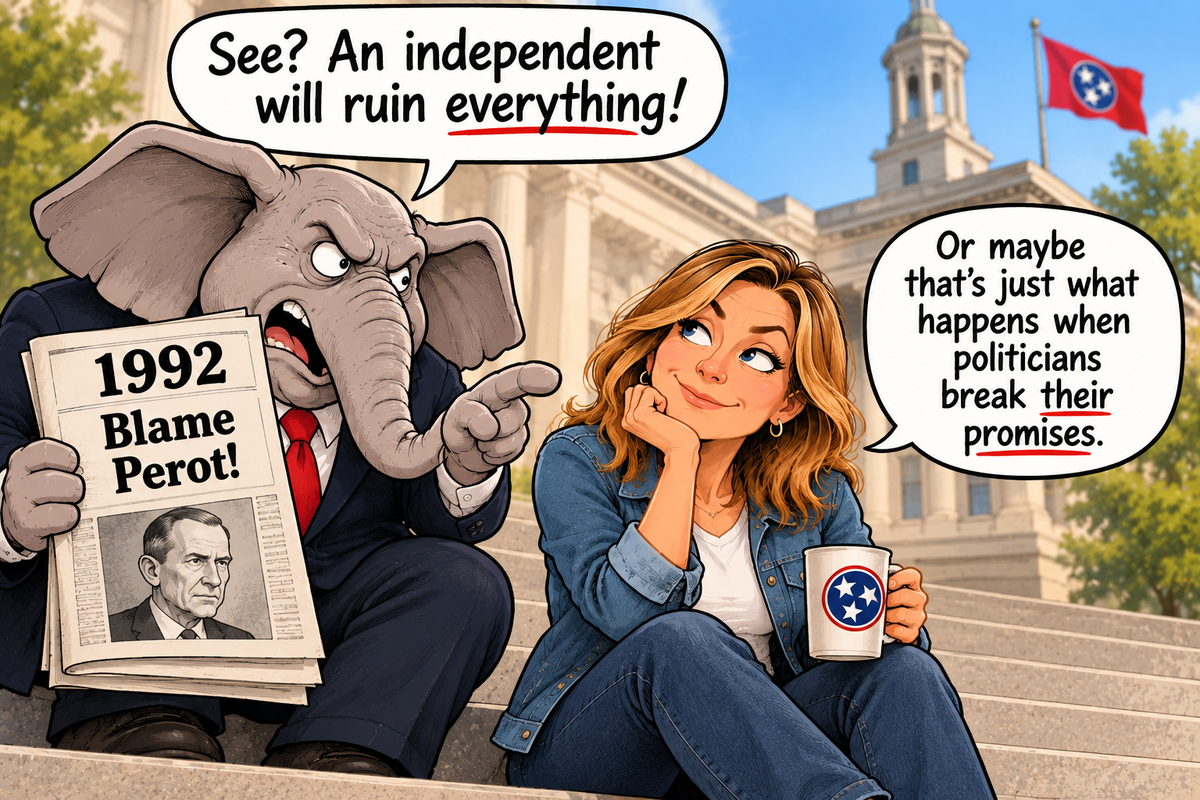
Every time an independent candidate gains traction in an election, someone inevitably dusts off Ross Perot and the 1992 presidential race. You've probably heard the story a hundred times. Perot split the Republican vote, handed the White House to Bill Clinton, and proved why voting for an independent is a terrible idea. It's a favorite cautionary tale among Republicans who would prefer their voters not wander off the reservation. The trouble is, the actual history doesn't quite support the story they've been telling.
In 1988, George H. W. Bush famously promised Americans, “Read my lips: no new taxes.” It was an unmistakable commitment that helped define his presidential campaign. Two years later, Bush agreed to a budget deal that raised taxes, breaking a promise that many conservatives considered fundamental. But that reversal was only part of a much larger problem. Bush had served eight years as vice president under the enormously popular Ronald Reagan, inherited a formidable Republican political coalition, and enjoyed an extraordinary 89 percent approval rating following the Gulf War in 1991. Yet by July 1992, his approval had collapsed to just 29 percent. That's quite a fall for a president who had practically been handed the keys to the Reagan coalition.
The economy was struggling, unemployment was rising, and Americans increasingly believed Bush was more interested in foreign affairs than the problems confronting families at home. Conservatives were also frustrated by his tax reversal and what they saw as a retreat from Reagan-era principles. That dissatisfaction became so pronounced that conservative commentator Pat Buchanan challenged Bush for the Republican nomination in 1992. Bush won the nomination, but Buchanan's challenge exposed serious divisions within his own party.
Those divisions should sound awfully familiar to Tennesseans. The frustration among grassroots conservatives isn't so much about disagreements over policy. It's about Republicans who campaign on the same conservative promises we believe in, only to get elected and deliver some watered-down, toothless version that accomplishes next to nothing. Then, when a principled conservative challenges them in a primary, the establishment pulls out its checkbook and goes to work making sure that challenger never sees the light of day.
And let's not forget the smear campaigns. For politicians who spend an awful lot of time convincing Christian voters that they worship the same Jesus we do, some of those attacks can get downright vicious. And people remember that. You don't get to spend months dragging someone's character through the mud and then expect their supporters to suddenly develop warm, fuzzy feelings for you because you won the primary. It's a little like a husband beating the crap out of his wife and then wondering why she doesn't want to cuddle on the couch an hour later. That's not exactly how trust works. Yet somehow, every election cycle, the establishment seems genuinely surprised when the voters they've spent months beating into a sticky paste aren't particularly enthusiastic about falling in line.
Donald Trump's emergence in national politics demonstrated how a wealthy, nationally recognized political outsider could challenge an established Republican leadership structure and attract voters who believed the party had become disconnected from them. Tennessee's current gubernatorial race presents another example of a businessman seeking office outside the traditional party structure. Independent candidate David Hatley has reported $7 million in loans to his own campaign and has publicly stated that he does not intend to conduct conventional fundraising. Hatley argues that financing his campaign himself would allow him to govern without pressure from major donors or party officials.
Financial independence alone cannot guarantee political independence, but it does raise a relevant question about the relationship between campaign financing, political consultants, and the expectations placed on candidates once they take office. It also illustrates why a major party's nomination does not necessarily settle questions of representation or public confidence.
Ross Perot entered the 1992 race as a wealthy businessman offering an alternative to the established parties. His campaign emphasized federal deficits, government spending, trade policy, and Washington's failure to address problems that Americans believed their elected officials had neglected. According to the Federal Election Commission's official results, Perot ultimately received approximately 18.9 percent of the national popular vote. Clinton won with approximately 43 percent, while Bush received about 37.4 percent.
Those numbers have sustained the argument that Perot cost Bush the election, but the evidence tells a different story. According to exit polling reported by The Washington Post just days after the election, Perot's supporters were almost evenly divided between Bush and Clinton as their second choice. The national exit poll found that 38 percent preferred Bush, 37 percent preferred Clinton, and 15 percent said they would not have voted without Perot. The analysis concluded that Clinton would still have won the Electoral College without Perot on the ballot.
Even Bush's own post-election analysis acknowledged the nearly even division of Perot voters' second choices. A 2023 examination of the election results reached a similar conclusion. While no analysis can establish with certainty how an election would have unfolded without a major candidate, the evidence does not support the familiar claim that Perot simply handed Clinton the presidency. Apparently, blaming Perot is a lot easier than examining why nearly 20 million Americans were looking for someone else in the first place.
The congressional history is also important. Republicans did not control Congress when Clinton entered office in January 1993. Democrats held majorities in both chambers during his first two years, allowing his administration to pursue significant legislation, including the 1993 budget package. Republicans captured both chambers in the 1994 midterm elections, bringing Newt Gingrich to the speakership and establishing the divided government that shaped much of Clinton's remaining presidency.
That shift demonstrated how profoundly legislative control can influence a president's agenda. Clinton remained president, but his administration now had to contend with an opposition Congress capable of blocking legislation, controlling appropriations, and forcing negotiations. The resulting political struggles included budget confrontations, government shutdowns, and compromises on major domestic policies. Executive authority remained substantial, but it did not eliminate the constitutional role of Congress.
The comparison has particular relevance to Tennessee's 2026 gubernatorial election, where Republican Marsha Blackburn, independent David Hatley, and Democrat Jerri Green have become central figures in a debate about party loyalty, political alternatives, and the consequences of a divided vote.
Green's campaign has published an ambitious “Day One Plan” and broader platform proposing taxpayer-funded housing and childcare assistance, medical debt cancellation, repeal of Tennessee's abortion restrictions, limits on state cooperation with federal immigration enforcement, and changes to state agency leadership. Her broader platform also calls for expanded gun restrictions. Some proposals involve decisions a governor could make under existing law, while others require legislative approval, new funding, or changes to current statutes.
Tennessee's governor possesses meaningful executive authority, including responsibility for administering state government and making appointments within the framework established by law. But the governor cannot simply repeal statutes, independently enact new laws, or appropriate unlimited funds. Those powers remain subject to Tennessee's constitutional structure and the General Assembly.
Article II of the Tennessee Constitution gives legislative power to the General Assembly. Article II, Section 24 requires public money to be spent pursuant to lawful appropriations. And Article III, Section 18 allows lawmakers to override a governor's veto with a majority of the elected members of each chamber.
In practical terms, a governor cannot simply repeal an existing statute, enact a replacement law, or establish an entirely new spending program without the legal authority to do so. Legislation ordinarily requires at least 50 votes in Tennessee's 99-member House and 17 votes in its 33-member Senate.
So what could Governor Jerri Green actually accomplish? Consider some of the promises she's making and what Tennessee law would allow her to do.
Abortion: Green wants to repeal Tennessee's near-total abortion ban and sign an executive order intended to protect doctors who perform abortions from prosecution. But a governor cannot repeal an abortion law or simply declare that it will no longer apply. Changing those laws requires the General Assembly. District attorneys and courts are not under the governor's direct control.
Illegal Immigration: Green wants to end cooperation between Tennessee law enforcement and ICE, restrict federal immigration agents' access to state buildings, and use state funds to provide legal assistance to immigrants facing deportation. But Tennessee already has laws governing cooperation with federal immigration authorities. She cannot cancel those laws with an executive order or prevent federal agents from exercising their lawful authority. She could, however, change some cooperation policies where existing law gives her administration discretion.
Medicaid Expansion: Green wants to expand Medicaid coverage to more Tennesseans. That would require the necessary legal authority and funding. Tennessee's Republican-controlled legislature would have to approve any new laws or appropriations needed to carry it out.
Taxpayer-Funded Housing, Childcare, and Medical Debt Cancellation: Green wants to use $70 million in federal Temporary Assistance for Needy Families (TANF) funds, including $10 million for housing security deposits, $50 million for childcare assistance, and $10 million to purchase and cancel medical debt. But federal TANF money comes with restrictions, and Tennessee's budget laws still apply. She could make changes already permitted under existing programs, but spending that requires new appropriations or statutory changes would need legislative approval.
Gun Restrictions: Green supports requiring background checks for all gun sales, adopting red flag laws that allow courts to order the temporary removal of firearms under specified circumstances, and restoring training and testing requirements for concealed carry permits. Those proposals would require changes to Tennessee law. A governor cannot independently impose new statewide gun restrictions that conflict with existing statutes.
Tennessee's governor has considerable authority over state agencies, appointments, and the day-to-day operation of government. Those powers matter. But the governor does not make the laws, cannot repeal laws already on the books, and cannot spend money the legislature has not lawfully authorized.
Many of Green's most sweeping promises would therefore require cooperation from the Republican-controlled General Assembly. And where existing laws already give the governor discretion, the legislature has the power to examine that authority and, within constitutional limits, change it.
Tennessee's General Assembly has substantial tools to respond to a governor whose policies conflict with legislative priorities. Lawmakers can decline to pass proposed legislation, reject new appropriations, amend existing statutes, conduct oversight, and exercise confirmation authority where required by law.
Perhaps most significantly, Tennessee does not require a two-thirds legislative vote to override a gubernatorial veto. Article III, Section 18 requires only a majority of the members elected to each chamber. That means 50 House members and 17 senators can override a veto, assuming the constitutional requirements for reconsideration are satisfied.
This is an important distinction from Washington, where overriding a presidential veto requires two-thirds support in both houses of Congress. Tennessee's General Assembly possesses a comparatively accessible mechanism for overcoming executive objections.
But proposals to repeal Tennessee's abortion restrictions, impose new statewide gun restrictions, or create new spending obligations cannot become law merely because she wins an election. They require legal authority that the governor does not possess independently.
And if I understand these constitutional limitations, you can be certain the legislators serving in our General Assembly understand them, too. So when your state representative or senator tells you that electing a Democratic governor would automatically mean the end of Tennessee's conservative laws and policies, ask yourself why they're leaving out the considerable authority they themselves possess to prevent it.
The enduring argument over Ross Perot often treats the independent candidate as the explanation for Bush's defeat. But the economic difficulties, broken promises, and divisions within the Republican coalition were already evident before Perot became a major force in the race. His candidacy gave voters another option; it did not create all the dissatisfaction that made such an option attractive.
Tennessee's circumstances are different, particularly because the state already has a Republican legislative supermajority. The General Assembly controls legislation and appropriations, can override a governor's veto with a simple majority, and retains those constitutional powers regardless of which party occupies the governor's office. Those safeguards don't disappear simply because a Democrat wins an election.
That constitutional reality applies equally to every candidate. Campaign promises must be measured against the legal powers of the office, just as warnings about an opposing candidate should be evaluated against the checks that already exist.
The larger lesson from 1992 is that electoral consequences and political accountability cannot be separated. Parties have an interest in maintaining unified support, while voters have an interest in examining whether candidates have earned their confidence. Neither consideration erases the other.
Thirty-four years later, Tennessee finds itself having much the same conversation. But before we drag Ross Perot out for another round of blame, perhaps we ought to remember what actually happened in 1992 and why so many Americans were looking for another choice. And while we're at it, we might want to spend a little more time understanding what Tennessee's governor can actually do under our Constitution, rather than relying on campaign warnings that leave out half the story.
TruthWire exists to provide independent investigative journalism that holds Tennessee's political establishment accountable.
We aren't funded by corporations, political parties, or large media companies.
We're funded by readers who believe the truth is worth defending.