UPDATE: Now Over $400,000: The Money Behind Williamson County’s Mayor’s Race

New filings push the Williamson County mayor’s race past $400K, revealing not just a gap in fundraising, but a clear difference in structure, with one campaign backed by concentrated networks and the other built through local, individual support.
Share
UPDATE: Now Over $400,000: The Money Behind Williamson County’s Mayor’s Race

Williamson County’s mayoral race was already shaping up as a contrast. The latest campaign finance filings don’t just confirm that, they make the difference much clearer.

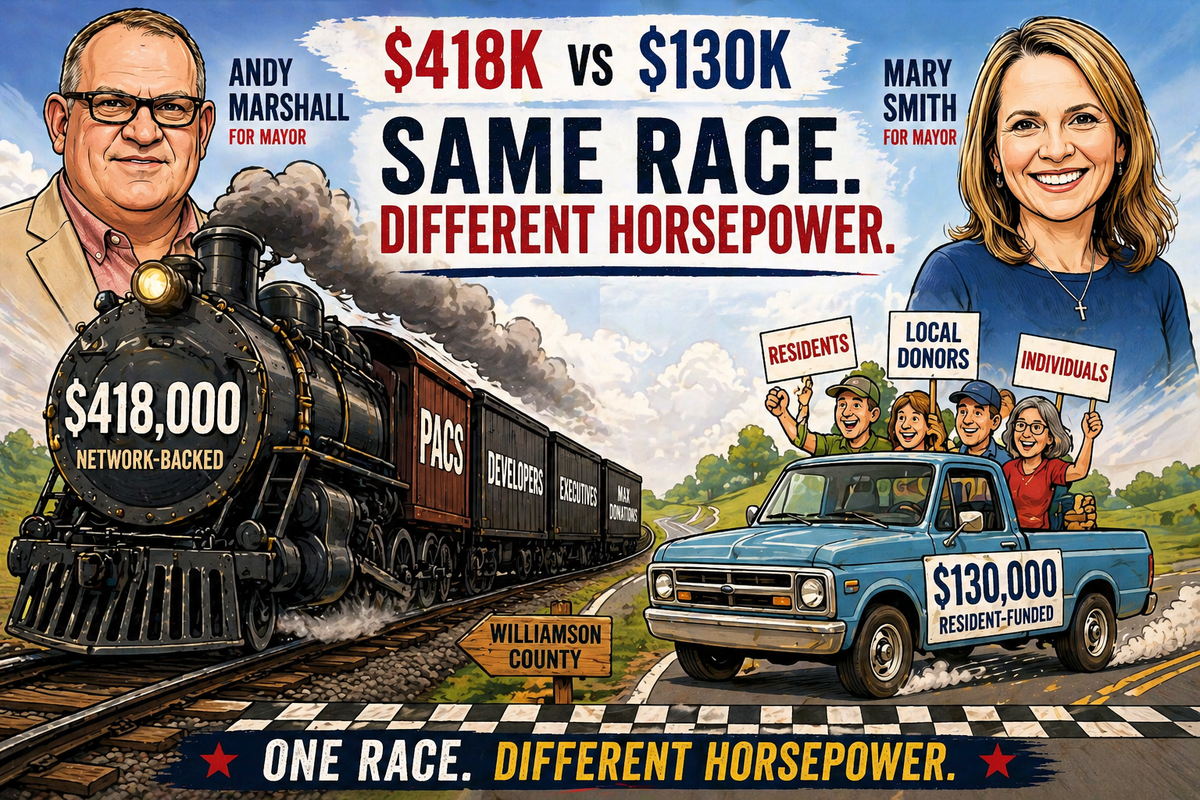
Andy Marshall’s campaign has now raised more than $418,000, combining an initial $100,500 personal loan with $188,504.66 in additional contributions in the most recent reporting period alone. That’s a significant number on its own, but it becomes more telling when you look at where it’s coming from.

Because the structure behind that total hasn’t really changed, it has just grown.

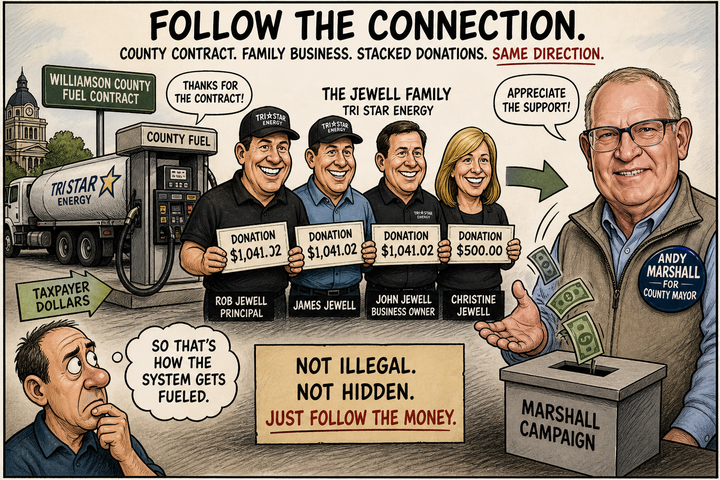
From the beginning, Marshall’s campaign has drawn heavily from a connected group of donors, business leaders, political insiders, and industries tied directly to county growth, including construction, engineering, development, and contracting. The most recent report shows that same pattern continuing. Contributions are still concentrated at or near the maximum level, and they continue to come from individuals tied to the same firms and sectors.

There is simply more of it now.

As previously documented, seven development-related companies, represented by roughly 12 to 15 executives and additional family members, combined to contribute around $40,000, much of it at the legal maximum. That group is still present in the updated filings, and the pattern is consistent. You see multiple people connected to the same companies contributing in close proximity, sometimes alongside family members.

This isn’t random support. It reflects participation from a specific economic group, one that operates in and around the decisions county government makes every day, roads, infrastructure, zoning, and contracts. The scale has increased, but the alignment looks the same.

That same alignment shows up outside the filings as well.

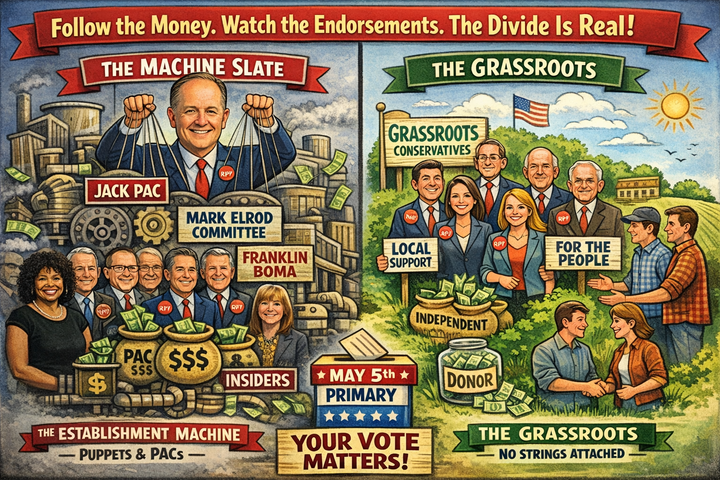
Marshall has been endorsed by Governor Bill LeeRogers Anderson, and sitting mayors Ken MooreNelson Andrews, and Matt Fitterer.

What stands out isn’t just who they are, but how closely that lines up with what’s already in the filings. The same general group, people operating within current government and the industries most affected by its decisions, shows up in both places. Financial support and public endorsements are coming from overlapping circles.

That doesn’t make it improper. But it does make it consistent.

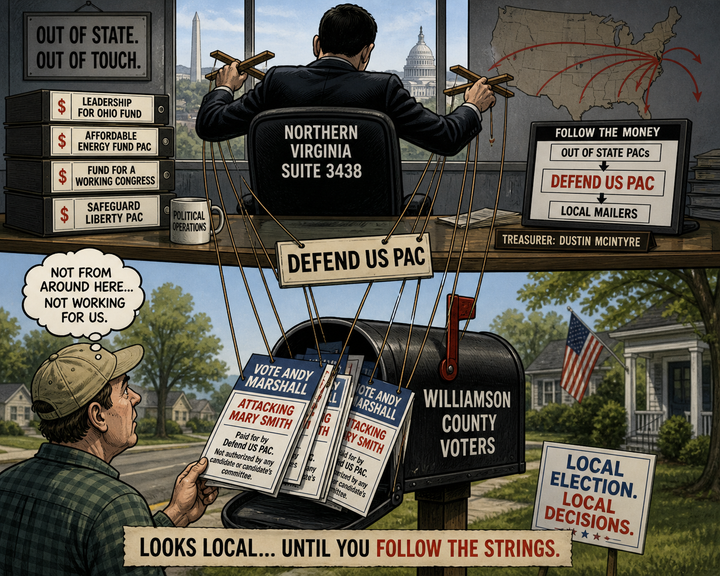
In addition to direct contributions, outside spending appears to be supplementing that network. According to Smith's campaign, mailers supporting Marshall have been tied to industry groups such as the National Association of Realtors, out of Illinois, where independent expenditures for a single mail campaign can run in the range of $25,000 to $40,000, depending on scope and frequency.

On the other side of the race, the filings tell a different story.

Mary Smith’s campaign has now raised more than $130,000 across two reporting periods, with no loans and no PAC support. There is no early infusion of capital and no institutional backing shaping the trajectory. Instead, the report shows a steady build, contribution by contribution.

The donor list is overwhelmingly local, Franklin, Brentwood, Arrington, College Grove, and the pattern holds throughout. These are individuals, not organizations. The support is spread across many contributors, rather than concentrated within a few.

There are larger contributions mixed in. A $1,000 check from a developer tied to Cameron Properties, and a $1,900 contribution from a self employed developer. But those stand out because they are not part of a broader pattern. They don’t repeat across company leadership, and they don’t appear alongside matching contributions from others tied to the same firm.

While the donor base is overwhelmingly local and dispersed, a small number of contributors tied to development and construction do appear in the filings. Three individuals fall into that category, Don Russell of Cameron Properties, Barry Sullivan, listed as a developer, and John Floyd, associated with Old South Construction.

Together, their contributions total approximately $8,600. What stands out is not just the size of that number, but the lack of any surrounding pattern. These contributions do not cluster across multiple executives from the same firm, they are not accompanied by matching family donations, and they do not repeat across a broader company network. They appear as isolated entries within a much wider base of individual support.

What comes through in these filings is not just a difference in totals, it’s a difference in how the money comes together.

One campaign has crossed $400,000, built on concentrated, high dollar support from networks with shared professional and economic ties. The other has grown to $130,000 plus, built gradually through contributions from individuals whose connection to county government is as residents.

Both approaches are allowed, and both campaigns have filed what they are required to file. But the numbers do more than check a compliance box.

They show who is engaged, who is investing, and how that support is structured.

In a county carrying roughly $1.2 billion in debt, and facing ongoing growth along with major decisions about infrastructure, development, and spending, that structure is not just academic. It reflects the groups paying attention, and potentially the perspectives that will carry weight.

The earlier filings outlined the difference. These filings put numbers to it.

$418,000 versus $130,000.

Same race, different scale, different structure. At this point, the contrast speaks for itself.

If you want to support what we do, please consider donating a gift in order to sustain free, independent, and TRULY CONSERVATIVE media that is focused on Middle Tennessee and BEYOND!