David vs. Goliath in Williamson County: How Donor Lists Reveal Two Very Different Campaigns for Mayor
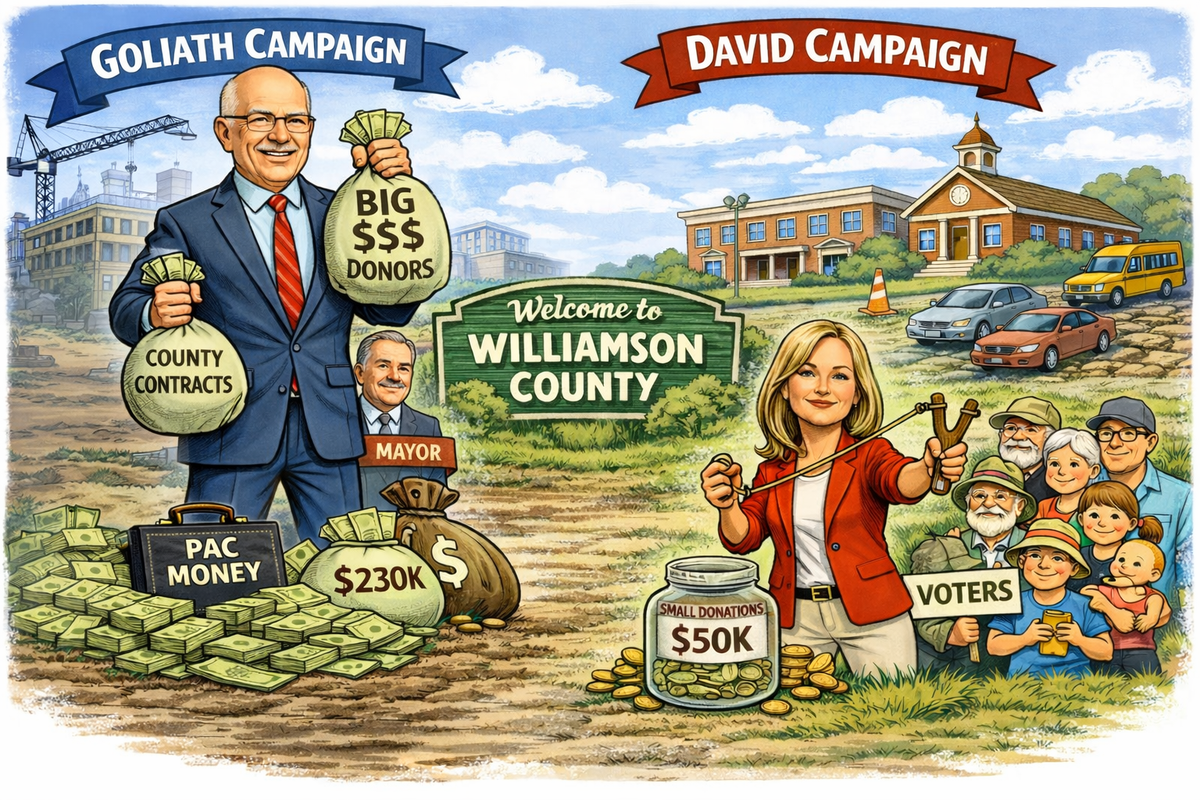
David vs Goliath in Williamson Co mayor race: Marshall raised $230K from elites, contractors & PACs; Smith raised $50K from local grassroots donors.
5 Key Highlights: David vs. Goliath in the Williamson County Mayor’s Race
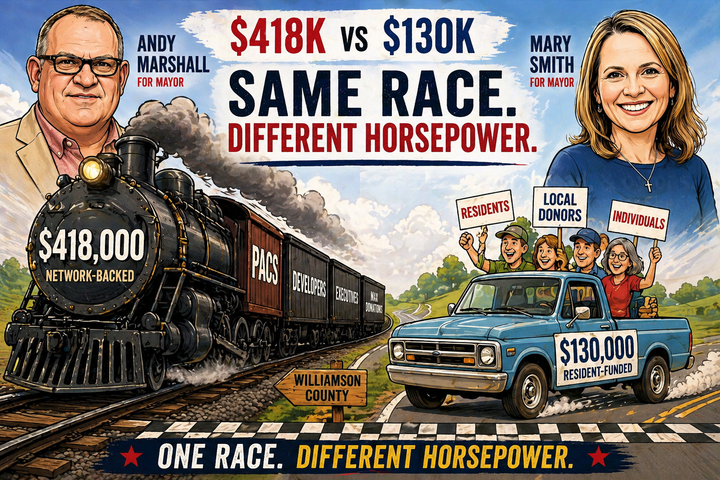
- Funding Gap: Marshall raised $230,178 — including a $100,500 personal loan — while Smith raised $50,574 entirely through small local donations with no loans or PACs.
- Elite vs. Everyday Donors: Marshall’s donors include CEOs Dave & Sharon Ramsey, Lee & Julie Beaman, Franklin Mayor Ken Moore, and Williamson County Mayor Rogers Anderson; Smith’s come almost entirely from retirees, homemakers, and working families.
- Construction Interests vs. None: Marshall received maximum donations from executives at Haury & Smith Contractors, Old South Construction, Diverse Disposal, and T-Square Engineering — firms that bid on county contracts; Smith received zero industry-tied money.
- Outside PAC Money: Freedom First PAC of Raleigh, NC — which also gave $1,000 to Sen. Marsha Blackburn — donated $1,000 to Marshall; Smith’s campaign has no PAC or out-of-state funds.
- County Context: In the first open mayor’s race in 24 years, with the population roughly doubled in 6–7 years and $1.2 billion in new debt, Marshall is financed by the establishment that shaped that growth while Smith is financed by the average taxpayers living with its consequences.
- READ ENTIRE ARTICLE BELOW 👇
Williamson County is heading into its first contested mayor’s race in 24 years. Rogers Anderson has held the office since 2002 and is not seeking re-election. In that time the county’s population has roughly doubled, driven largely by families relocating from other states during and after the COVID-19 pandemic. The result has been explosive demand for roads, schools, housing, and services. At the same time, county debt has climbed to approximately $1.2 billion—a burden that simply did not exist when the current administration began. Against this backdrop of rapid growth and mounting fiscal pressure, the campaign finance reports of the two candidates offer a clear, numbers-driven picture of who is supporting each campaign and why that support matters.
Andy Marshall’s Year-End Supplemental report, filed February 2, 2026, for the period July 1, 2025, through January 15, 2026, shows total receipts of $230,178.20. Of that amount, $100,500 came in the form of a personal loan Marshall made to his own campaign. The remaining $128,921.94 in itemized contributions (plus $756 in unitemized gifts of $100 or less) arrived almost entirely from the upper reaches of Middle Tennessee’s business and political establishment. This is the Goliath side of the race—well-connected, high-dollar, and heavily tilted toward individuals and companies with direct stakes in county growth and contracting.
The donor list reads like a who’s-who of Williamson County influence. Dave Ramsey, founder and CEO of Ramsey Solutions, and his wife Sharon each gave the maximum $1,900. Lee Beaman, CEO of Beaman Ventures, and his wife Julie contributed the same amount. Franklin Mayor Ken Moore wrote a $1,900 check, and Williamson County Mayor Rogers Anderson gave $250 personally plus another $1,000 through his re-election committee. These are not casual donors. They are leaders whose businesses and public roles shape daily life in the county.
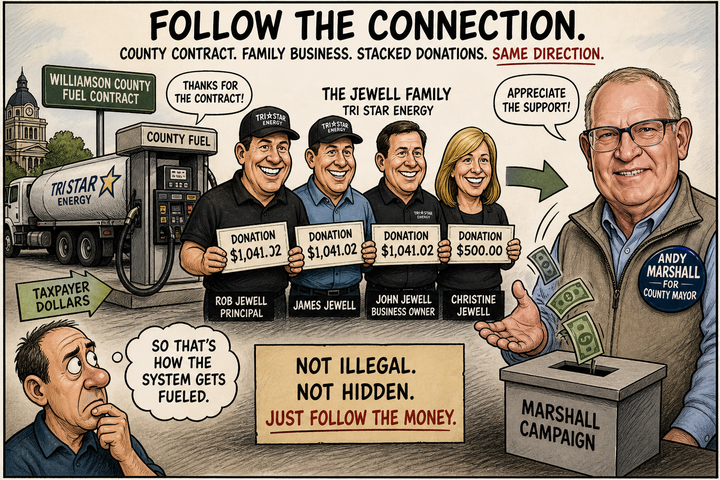
Even more striking are the contributions tied to industries that routinely compete for county work. Multiple executives from Haury & Smith Contractors Inc. each donated $1,900. Old South Construction of Tennessee LLC and Diverse Disposal Service LLC each gave $1,900 initially and followed up with an additional $1,000. T-Square Engineering Inc. added $1,000. In a county that has doubled in size and now faces $1.2 billion in debt, decisions about road paving, waste management, zoning approvals, and infrastructure contracts carry enormous financial consequences. Donors from these sectors are not writing checks in a vacuum; they have ongoing business relationships with the very government the next mayor will lead.
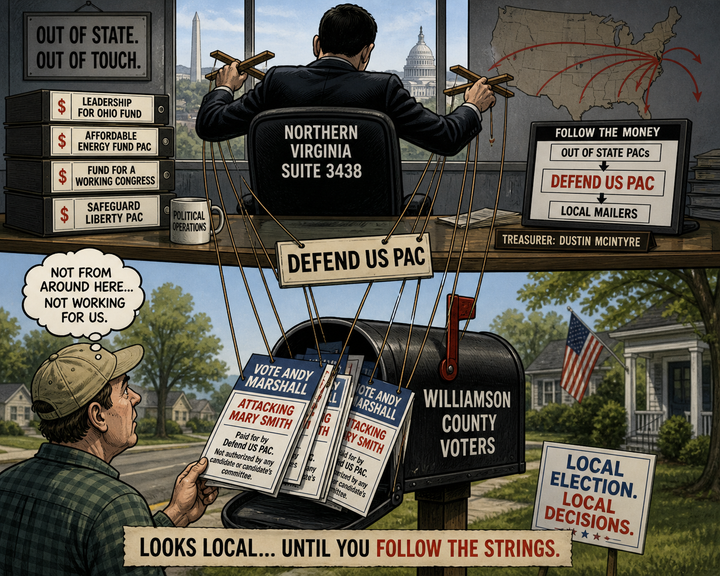
Outside political money reinforced the pattern. Freedom First PAC, based in Raleigh, North Carolina, contributed $1,000—the same amount the PAC gave to U.S. Senator Marsha Blackburn. Smaller gifts came from the Greater Nashville Hospitality Association PAC and Pape-Dawson Tennessee PAC. Marshall ended the period with $202,480.74 in cash on hand after modest spending. The self-loan provided an immediate head start, and the donor network supplied the fuel to sustain it. This is classic establishment financing: maximum allowable gifts from people and entities positioned to benefit from, or be affected by, county policy.
In stark contrast, Mary Smith’s First Quarter 2026 report, filed April 11, 2026, for the period January 16 through March 31, 2026, tells the David story. Total receipts reached $50,574.32—roughly one-fifth of Marshall’s haul in a comparable early window. The breakdown is telling: $275 came from unitemized contributions of $100 or less, while the $50,299.32 in itemized gifts arrived mostly in modest increments. Tennessee law requires itemization once a donor exceeds $100 in a reporting period, so every detailed entry reflects real participation from average residents rather than a handful of large checks.
The donor profile is overwhelmingly grassroots. Page after page lists contributions from local retirees, homemakers, and working families across Franklin, Brentwood, Arrington, College Grove, and surrounding communities. These are people whose primary connection to county government is as taxpayers and daily users of its services—families worried about property taxes, traffic congestion, school overcrowding, and the pace of development that has swallowed farmland and strained infrastructure. Smith herself contributed a modest $124.32. A small number of local developers and business owners gave at higher levels, but they remain exceptions in a sea of smaller, neighborhood-scale support. There are no PAC contributions, no self-loans, no sitting mayors or corporate CEOs writing maximum checks, and no out-of-state political money.
Smith’s campaign address is the same modest Arrington home she lists as her residence. The absence of institutional backing means her financial base rests almost entirely on ordinary Williamson County citizens who opened their checkbooks because they live with the consequences of county decisions every day. In a jurisdiction that has not elected a new mayor in nearly a quarter-century and now carries $1.2 billion in debt after a period of unprecedented growth, this kind of funding reflects a different set of incentives: accountability to the broader community rather than to a narrow circle of high-dollar interests.
The side-by-side numbers highlight a classic David-vs.-Goliath dynamic. Marshall’s campaign launched with a six-figure self-loan and was sustained by repeated maximum donations from the county’s economic and political elite—CEOs whose companies shape commerce, mayors whose policies set the tone, and contractors whose bids depend on county decisions. Smith’s campaign grew incrementally through hundreds of smaller gifts from the very residents who will feel the next tax increase, the next rezoning decision, or the next infrastructure shortfall in their daily lives.
Neither set of disclosures suggests any violation of campaign finance rules. Both candidates filed detailed, public reports exactly as state law requires. The data simply reveal two very different coalitions. One is built on established power centers with ready access to large checks and institutional networks. The other is built on broad but modest participation from the grassroots—neighbors who lack six-figure war chests but who, collectively, still get to vote.
In a county transformed by population influx and fiscal expansion, these donor profiles offer voters a concrete way to assess alignment. The May 5, 2026, election will choose the first new mayor in 24 years. The financial foundations of the two campaigns—one Goliath-sized and establishment-backed, the other David-sized and community-driven—provide one clear, factual measure of how each candidate’s support network matches the long-term challenges facing Williamson County.
If you want to support what we do, please consider donating a gift in order to sustain free, independent, and TRULY CONSERVATIVE media that is focused on Middle Tennessee and BEYOND!