The Company You Keep, The Contracts You Hold

Tri Star’s $6M county contract and family donations raise questions about influence as voters head into a competitive race.
Share
The Company You Keep, The Contracts You Hold

With early voting now behind us, Williamson County is heading into the final stretch of what has become a far more competitive mayoral race than many initially anticipated. What once appeared to be a straightforward contest has evolved into something more dynamic, driven not just by messaging, but by the underlying structures of support that are beginning to come into clearer focus.

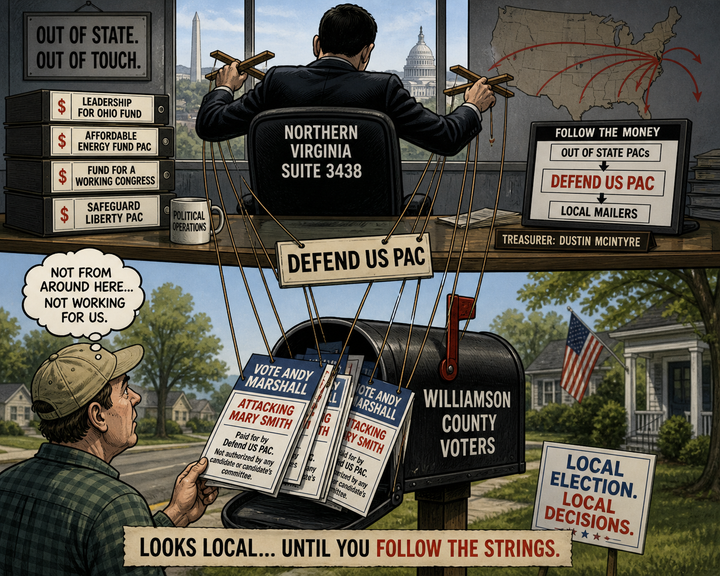
There is a difference between political support and political alignment, and then there is something else entirely, something quieter, more structured, and far more revealing if you take the time to look at it closely.

Campaign finance reports are not commentary, they are not interpretation, they are not opinion. They are disclosures, required by law, intended to show voters who is financially backing a candidate. Most people glance at totals, maybe recognize a name or two, and move on. But the value is not in the total, it is in the pattern.

And patterns, when they show up, tend to be consistent.

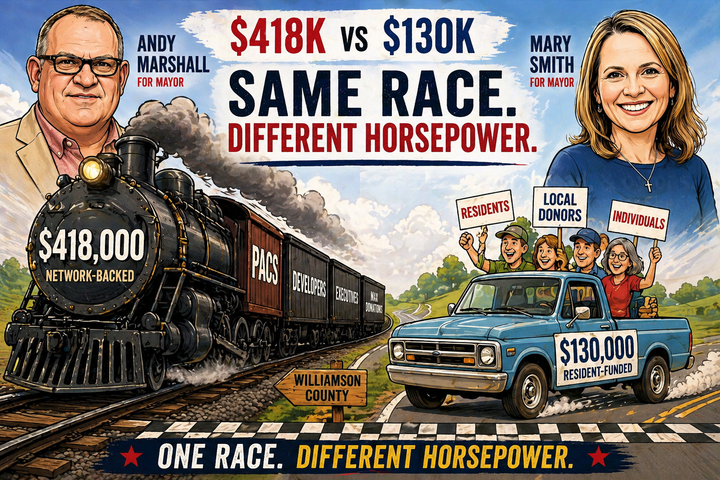
In the most recent disclosure, Andy Marshall’s campaign reports a broad base of contributions across a range of individuals and professions. On the surface, it looks like what you would expect in any competitive countywide race. But as you move past the surface and begin isolating clusters, a more specific alignment begins to take shape.

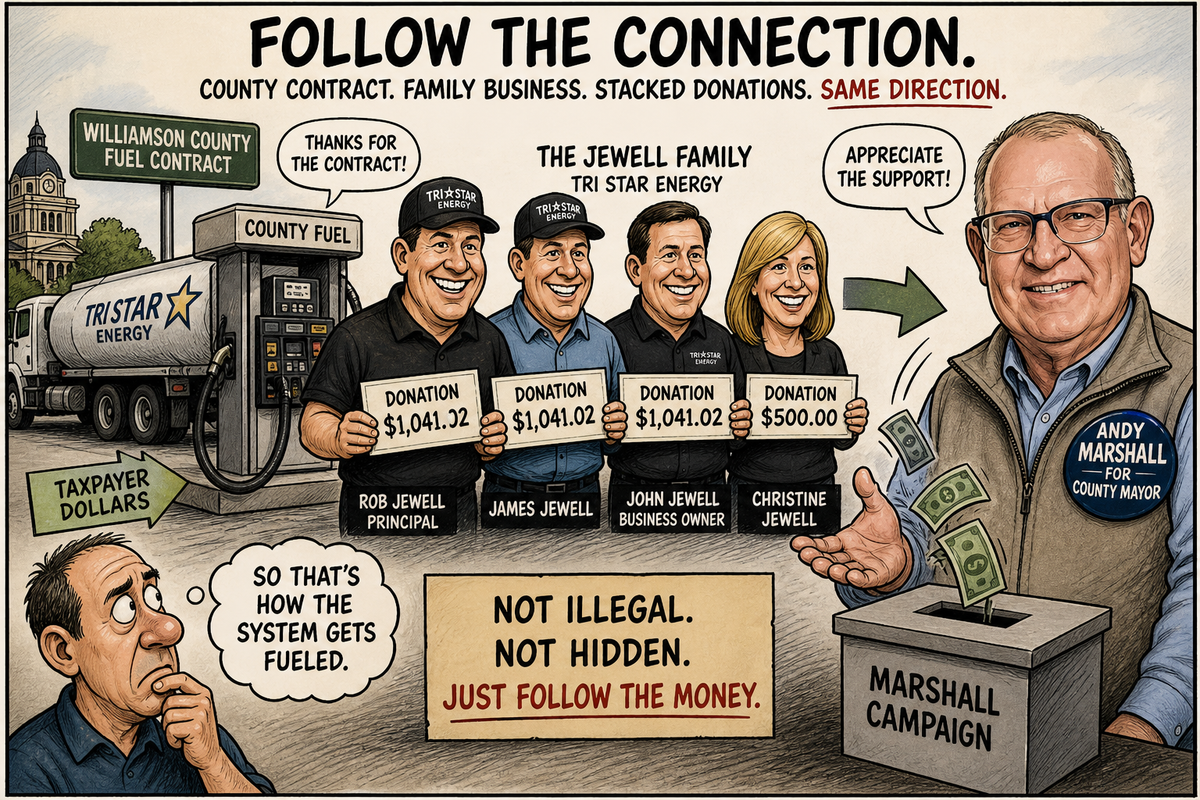
One of those clusters centers on the Jewell family, individuals tied directly to Tri Star Energy, a company that currently operates as a vendor within Williamson County.

The report shows Rob Jewell, identified as a Principal at Tri Star Energy, contributing $1,041.02. John Jewell, listed as a business owner at the same company, also contributed $1,041.02. James Jewell contributed $1,041.02, and Christine Jewell added another $500. These are not scattered, unrelated donations, they are concentrated, both in timing and in origin, forming a clear pattern of support from individuals connected to the same company. 

That alone would be notable. It becomes more relevant when placed in context.

Tri Star Energy is not just another private business operating in a vacuum. It has an existing relationship with the county as a vendor, awarded through RFP #1309 for fuel procurement. Based on the bid structure and estimated usage, the contract carries a total annual value of roughly $6 million across participating entities, including approximately $2.5 million for Williamson County Schools, $2 million for county government operations, and another $1.5 million for Franklin Special School District.

Pricing is structured off the OPIS rack rate plus a fixed markup, with separate rates for retail fuel cards and bulk or consignment purchases. In practical terms, this is not a one-time agreement or a limited engagement, it is a recurring, system-wide expenditure tied directly to taxpayer-funded operations, fueling school buses, county vehicles, and essential services on an ongoing basis.

At the same time, residents have raised concerns about fuel pricing disparities, with some reporting paying significantly more per gallon at these locations than they would elsewhere. Whether those concerns are fully substantiated or not is a separate question. The point is not the price itself, it is the structure.

When a company maintains a government vendor relationship, and individuals tied to that company collectively support a candidate in a local executive race, it creates an intersection of interests that deserves scrutiny. Not accusation, not speculation, scrutiny.

This is where the conversation usually goes off the rails, because people rush to assign intent. But intent is not required to recognize alignment. The pattern stands on its own.

Financial support in politics is rarely random. It reflects preference, expectation, or confidence in a particular outcome. Sometimes that outcome is ideological. Sometimes it is practical. Sometimes it is simply familiarity. But when support clusters this tightly around a specific family connected to a company doing business with the county, it raises a more grounded and necessary question, what does that alignment represent?

This is not about a single family, and it is not about a single company. It is about a structure that shows up repeatedly in local politics, where relationships, contracts, and financial support begin to overlap in ways that are perfectly legal, but not always reassuring.

Mary Smith’s campaign, by contrast, has centered much of its messaging on debt reduction and fiscal restraint. That platform, if pursued seriously, would almost certainly require a reassessment of existing spending, contracts, and vendor relationships. Whether one agrees with that approach or not, it introduces a variable that does not exist in a status quo framework.

And that is where the contrast becomes meaningful.

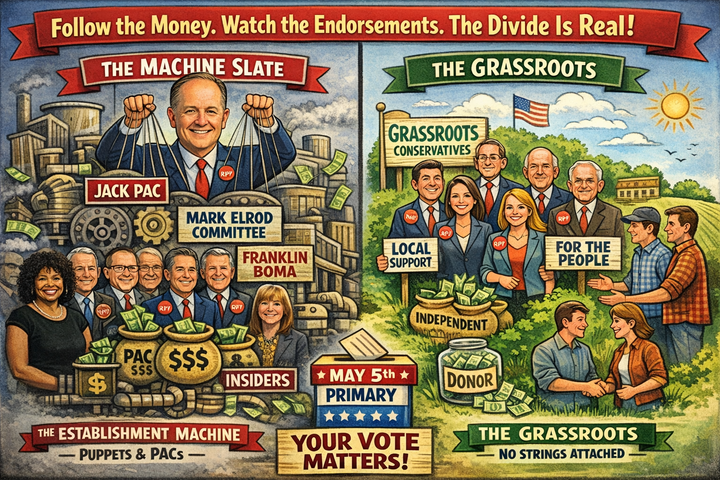
When one candidate represents continuity, and another represents potential disruption of how resources are allocated, it should not be surprising that different networks of support begin to form around each. What matters is not that those networks exist, but what they reveal.

In this case, the disclosures do not show a random assortment of disconnected donors. They show alignment, concentrated, identifiable, and tied to an existing economic relationship with the county.

That does not prove wrongdoing. It does not need to.

What it does is provide voters with a clearer picture of how influence organizes itself, not through a single transaction, but through patterns of support that reinforce existing structures.

And once you see the pattern, it becomes difficult to ignore.

Because at that point, the question is no longer who gave, it is why these particular relationships continue to show up, again and again, in the same places, around the same outcomes.

That is not a conspiracy. It is how local power tends to operate.

The primary election is Tuesday, May 5th. At this point, the question is straightforward, whether voters want something different from what Williamson County has operated under for the last quarter century, or whether they are comfortable with a continuation of it.

If you want to support what we do, please consider donating a gift in order to sustain free, independent, and TRULY CONSERVATIVE media that is focused on Middle Tennessee and BEYOND!