Should the Government Prefer Money to People?
Is Tennessee serving its people, or sacrificing community, culture, and justice for economic growth and GDP at all costs now?

5 Key Highlights:
- Questions whether government exists to serve citizens or simply maximize economic growth
- Critiques policies that prioritize corporate interests and GDP over local communities
- Explores the cultural and infrastructure impacts of mass immigration and rapid expansion
- Argues that justice, safety, and the well-being of citizens are the proper role of government
- Calls for Tennessee leaders to prioritize families, heritage, and long-term community stability over short-term economic gains
In every case, we judge an institution’s success not by the first measuring stick that comes to have but by the measure of its purpose: does it do what it exists to do? All too often, we find that secondary purposes have been made primary. Schools yammer on about test scores, forgetting the education they’re supposed to be providing, and churches proclaim a swelling membership, forgetting to foster real community. The civil government is no exception to this trend, and so we must ask it some hard questions. We must discern what purpose our government ought to serve- and if it is serving that purpose.
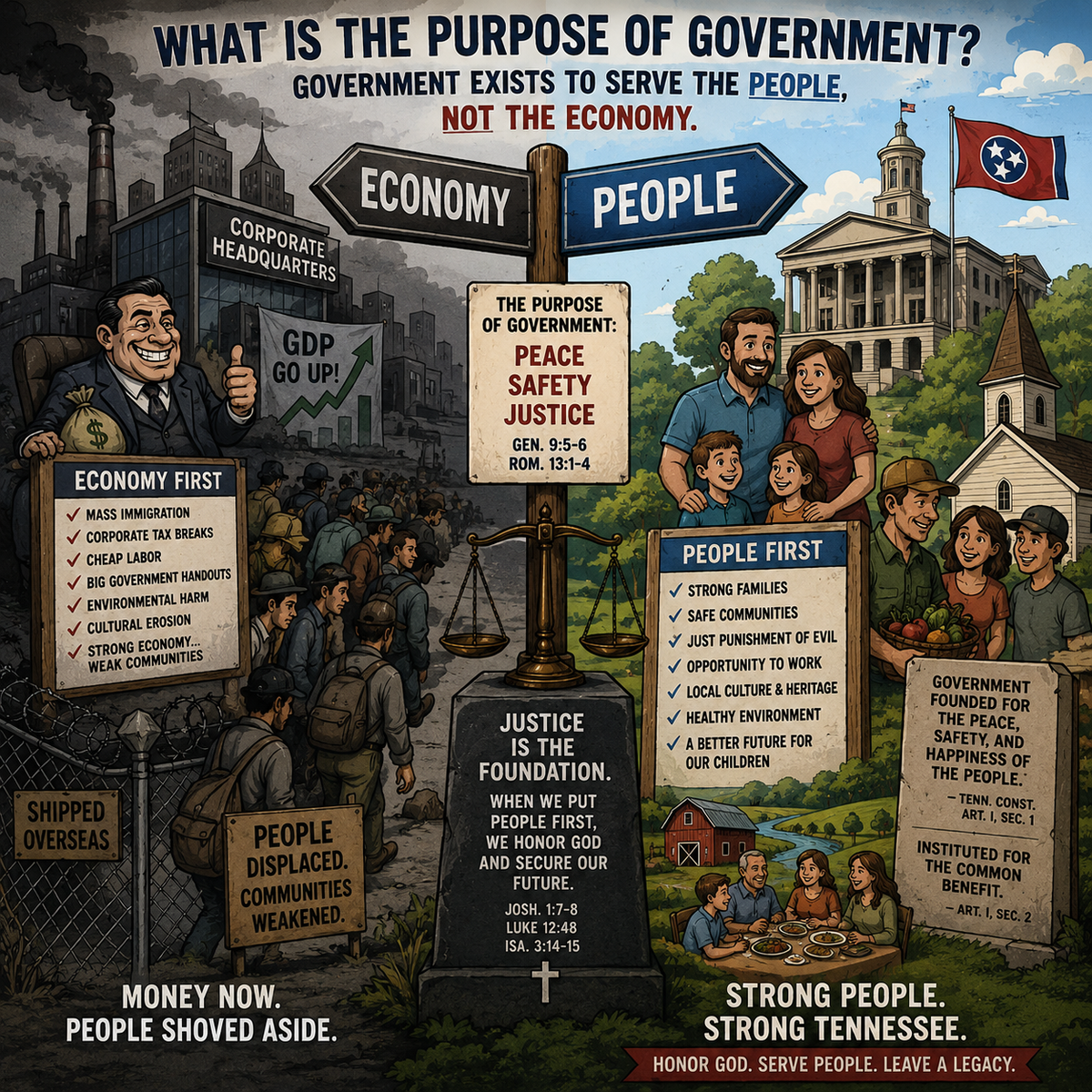
Now, at the base the purpose of civil government is to execute punitive justice (Gen. 9:5-6; Rom. 13:1-4); much of what our government does is definitionally outside its purpose. But in these non-ideal circumstances, we can properly set aside this greater question and consider not purpose overall but the direction of that purpose. We can ask not what government is supposed to do but who it is supposed to benefit- a different angle to purpose, but only a little less important. We can ask whether the economy or the people are more important.
Thus, in plain words:
Is the purpose of Tennessee’s government to grow the economy of the state of Tennessee, or is it to make the lives of Tennesseans better?
Context
I do not press a question without controversy or conflict. The push to prioritize the economy over the people is real and salient, and the choice does make a difference.
Consider the argument for mass immigration (legal or otherwise). One argument much-proffered is the economic argument: more labor, more economic growth. Immigration raises the Holy GDP, and the economic zone prospers. Now, while the argument has become less tenable over time, it is still a major part of the H1B visa argument and its relatives. Indeed, we end up having to distinguish between different parts of the economy in order to fully grasp the problems. Native workers suffer from increase in labor-supply. Housing becomes more expensive, and so do commodities. Cultural cohesion nosedives. The economy as a whole stutters, across the West, but that only proves mass immigration isn’t a solution, because we’re giving the economy plenty of other reasons to crack (welfare, foreign policy, taxation, etc). The corporate agents benefit massively; they pay less for workers and have to worry less about relations with the citizenry.
Mass immigration policies are undertaken on an explicitly economy-first basis (as are the repeated Trump proposals to keep illegal immigrants who work on the factory farms, if sometimes not officially), even if ‘floats all boats’ arguments pop up in the tail. Meanwhile, people-first policymakers, like Rupert Lowe’s Restore UK, have rather different impressions of immigration: “If [remigration] means millions go, then millions go.”
Other policies that contrast the two approaches are data centers, factory farming v regenerative practices, pesticides and immunity, in-country immigration (with its deleterious effects on local culture, morals, traffic, infrastructure, and voting base), favoritism to big business via tax breaks or other measures (with environmental, immigration, and economic effects), and more. When money is more important than people, and money now is important above all, the people get shoved aside. We start erecting Shiriff houses and shipping off all the pipe weed to foreign countries and preferring the new, pliable, imported labor/ enforcement to the natives who have ‘customs’ and ‘long term concerns’ and ‘desire for beauty.’
The best way to build an economy, in the short term at least (and government never thinks in a longer term than it has to), is to import an economy. Tennessee has over the past years put much effort into enticing various companies into the state (like the burger chain head-quarters now south of Franklin, for one of the less impressive successes) and importing employees for those corporations. The economy benefits, at least while the company sticks around, but it has minimal roots in the area and stays only because of government bribes. The cost is government interference in our affairs, cultural change, and strained infrastructure.
Which Way?
Ought our government to prioritize its citizens or its economy? The people who call it to govern them or the maximal output of the territory that people occupies? I ask the question in a way calculated to elicit a certain answer, but I do not ask it inaccurately. Ours is a government established by the people, as per both the federal and the state constitutions. Ours is not a government established to maximize profit.
Scripturally, the government has little role at all in uplifting the economy. The government’s role is to guard the citizens by ensuring just punishment of the thief and the violent man (Gen. 9:5-6; Rom. 13:1-4). This work does benefit the economy, but it is not directly concerned with economic prosperity at any point. The government’s job is justice, that the people have justice against violence, not its own paycheck or the numinous number-go-up of a territory’s income stream. If we violate that command of God, we call down a curse upon ourselves, both eternally and on this earth (Josh. 1:7-8). An economy bolstered through wickedness is a curse, not a blessing (Luke 12:48), and the clear-eyed man will not expect it to last long.
In American history, meanwhile, we have a long history of preferring the citizen to the dollar sign. We have also a long history of preferring the dollar sign to the person- and of calling such preference evil. We call it evil to spend blood for oil. We call it wicked to replace a population with cheaper labor. We do not desire big corporations to take over our land, stuffing it with pollutants and immigrants foreign to Tennessee’s culture and more. We want the American dream: a steady life for every man; the opportunity to raise a family in peace; the chance to work and be rewarded for work, without government interference.
The Tennessee Constitution bears witness to this, albeit with a bevy of theological errors we’d be well advised to amend someday. In Article I, Section 1, that document states that the government is founded for the “peace, safety, and happiness” of the people; Section 2 states it is “instituted for the common benefit” (and enjoins a duty of resistance to tyranny which makes a mockery of the theory of sovereign immunity). Now, these sweeping goals are founded more on rationalism and the remnants of Christian political theology than straight Scripture, are buttressed (outside these quotes) by social compact theory rather than investiture-through-consent, but they are clear on the point at hand: the people come first.
People, not money, are the point of government. But we might need to remind Nashville of that fact, and a whole lot of other people too. Are they going to be concerned with how much money Tennessee makes (for its government) or with how the Tennesseans live? As a rule, the government seems much more concerned with line-go-up on the economic charts than with whether their citizens are living happier, healthier, more virtuous lives. Economic prosperity is equated with societal vigor, perhaps, if the latter is not entirely forgotten. We must return to prioritizing the people and the heritage we will leave to our descendants- and, most importantly, our standing in the sight of the Lord (Is. 3:14-15).
God bless.
If you want to support what we do, please consider donating a gift in order to sustain free, independent, and TRULY CONSERVATIVE media that is focused on Middle Tennessee and BEYOND!