
BEYOND THE INDICTMENT: WHAT THE CHARGES AGAINST SEVIER COUNTY PROSECUTORS ACTUALLY MEAN
Two Tennessee prosecutors face criminal charges after a citizen's fight for grand-jury access. Court records reveal constitutional-waiver demands, disputed procedures and a bigger question: How many citizens faced these barriers for years?

A Tennessee citizen tried to bring allegations of wrongdoing to a grand jury. He says he was told he had to waive constitutional protections before he could testify. He refused. Weeks later, he was arrested as he left a grand-jury proceeding. Now, more than three years later, two prosecutors are facing criminal charges—and a court record raises a much bigger question about how many other citizens encountered the same system.
5 Key Takeaways:
- Tennessee law gives citizens a direct path to the grand jury. The process was designed to give ordinary people access when they have evidence of possible criminal wrongdoing, including wrongdoing involving government officials.
- Cooper says he was told to waive constitutional protections before he could testify. He refused, and a court later determined that he was not required to execute that waiver to invoke the citizen grand-jury statute.
- Cooper was arrested after trying to report alleged misconduct involving a prosecutor. That arrest is now central to criminal charges against Dunn and Marsh, including allegations that an incomplete capias was knowingly obtained and used.
- The indictment is not the only evidence that matters. A prior court ruling, the appellate record, court documents and other potential witnesses all exist independently of whether someone personally trusts Erik Cooper.
- The biggest question may be how many other citizens encountered the same system. The Court of Appeals said the DA office’s application, identification and scheduling requirements had been used “for many years,” raising questions about how many people complied, were discouraged or simply walked away.
It would be easy to make this story about Erik Cooper—whether people like him, trust him or believe every allegation he has made over the years.
But at this point, the story is bigger than Cooper.
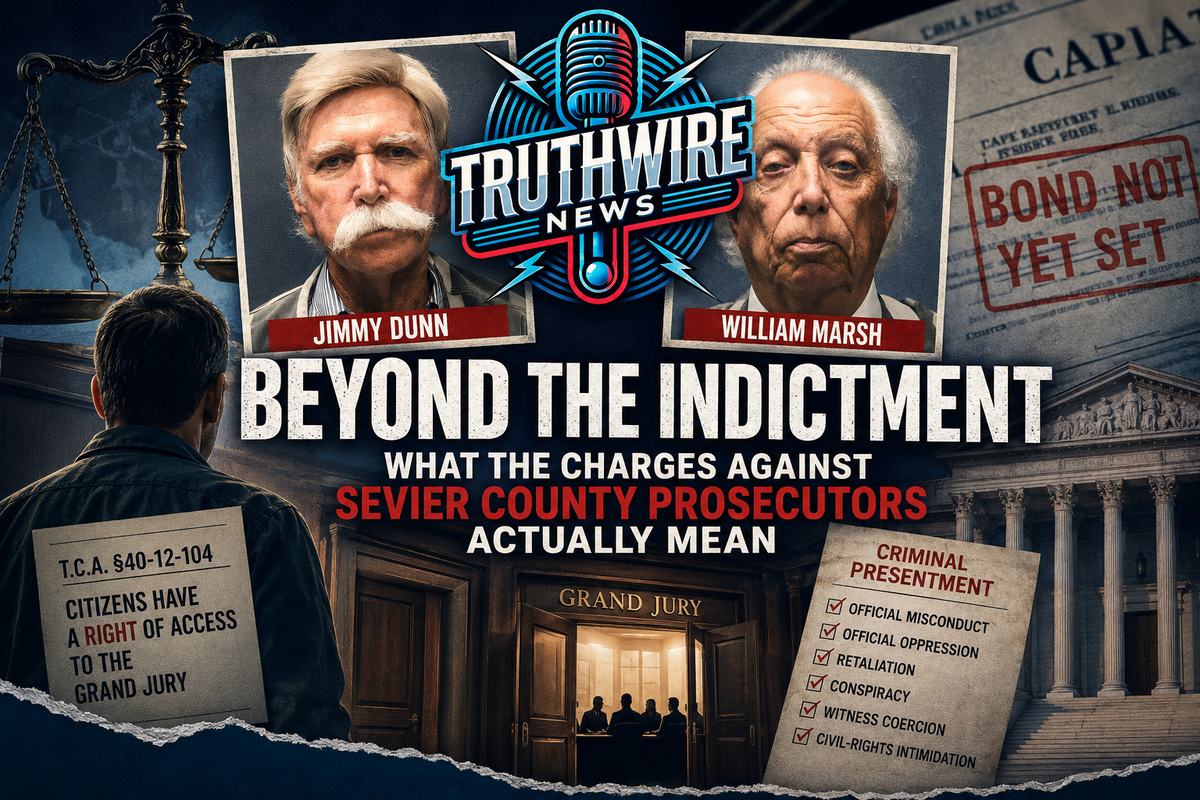
A Sevier County grand jury has returned a six-count criminal presentment against Fourth Judicial District Attorney General James Bruce “Jimmy” Dunn and Assistant District Attorney General William Brownlow Marsh. The charges include official misconduct, official oppression, retaliation, conspiracy to commit official oppression, witness coercion and civil-rights intimidation.
Dunn and Marsh are presumed innocent. An indictment is not a conviction. But to understand why two Tennessee prosecutors are now facing criminal charges, you have to go back several years to Cooper's attempts to use a Tennessee law most people probably don't even know exists.
A LITTLE-KNOWN PATH TO THE GRAND JURY
Tennessee law gives citizens who have knowledge or proof of a crime a way to take that information to a local grand jury.
Under T.C.A. §40-12-104, the citizen appears before the grand-jury foreperson and designates two grand jurors who, along with the foreperson, decide whether the information warrants further investigation. The panel can consult the District Attorney or the court for guidance.
That last part matters. The law says the panel “may” consult the District Attorney. Tennessee's Rules of Criminal Procedure describe the statutes as providing citizens “free access to the local grand jury.”
Yet in Tennessee's Fourth Judicial District, citizens seeking to use that process were required to submit an application, provide photo identification and schedule their testimony through the District Attorney's Office.
Most people would never question that.
If a prosecutor tells you that you need to complete a form, meet a deadline or follow a particular procedure before you can approach a grand jury, you are probably going to assume the prosecutor knows the law.
Erik Cooper didn't make that assumption forever.
THEN CAME THE WAIVER
Cooper says his involvement began with evidence he reviewed while working as a litigation consultant in federal litigation related to the deadly 2016 Gatlinburg wildfire. He came to believe the evidence supported criminal allegations involving local officials. Those remain Cooper's allegations, not findings of criminal responsibility.
Between 2018 and 2023, Cooper appeared before Sevier County grand juries multiple times while following the DA office's application and scheduling procedures.
Then came March 27, 2023.
According to the later appellate record, Assistant District Attorney General Ronald Crockett Newcomb was advising the grand jury when Cooper attempted to testify. Cooper alleged that Newcomb would not permit him to proceed unless he signed a waiver of his constitutional right to remain silent and waived any immunity he might otherwise receive.
Cooper refused.
The grand-jury panel denied his application to testify.
That may sound like another procedural dispute until you consider what Cooper was being asked to do.
He was not a criminal defendant negotiating a plea deal. He had not been subpoenaed and forced to testify. He was a citizen attempting to report alleged wrongdoing through a Tennessee law intended to give citizens access to a grand jury.
And according to Cooper, he was being told he could not give that testimony unless he first surrendered constitutional protections.
Imagine being an ordinary citizen standing there with that document in front of you. Would you know whether you actually had to sign it?
Most people wouldn't. They would assume the assistant district attorney telling them it was required knew the law.
Cooper refused to sign.
What happened next is where the story takes another turn.
COOPER TRIED TO REPORT THE PROSECUTOR
The following day, Cooper says he filed a written report and sworn affidavit with the Sevier County Sheriff's Office alleging that Newcomb's interference with his grand-jury appearance was itself criminal conduct.
Several weeks later, on May 1, Cooper returned to the grand jury intending to present allegations concerning Newcomb.
He made his appearance.
When he left the grand-jury proceeding, he was arrested.
At the time, that arrest was another chapter in Cooper's years-long battle with officials in the Fourth Judicial District.
Three years later, the circumstances surrounding that arrest are at the center of criminal charges against Dunn and Marsh.
WHAT ALLEGEDLY HAPPENED BEHIND THE SCENES
According to the new criminal presentment, Dunn directed Marsh to obtain the capias for Cooper before Cooper's scheduled May 1 grand-jury appearance.
A capias is the court process directing that someone be taken into custody.
But according to the presentment, there was a problem: Cooper's capias was not complete because bond had not yet been set.
The grand jury alleges Marsh learned of that problem but nevertheless obtained an incomplete copy after representing that it was for his file and that no one would see it. Marsh allegedly gave the document to Dunn, who then provided it to Sheriff's Deputy Brad Wilds.
Immediately before Cooper entered the grand-jury proceeding, the presentment alleges Dunn asked Wilds, “We are ready, correct?”
Wilds allegedly responded, “Yes, sir.”
Cooper was arrested as he left.
Those are allegations, not proven facts. Dunn and Marsh are entitled to challenge them, and the State will ultimately have to prove its case beyond a reasonable doubt.
But this is not merely an accusation that somebody made a paperwork mistake. The grand jury is alleging that an incomplete arrest document was knowingly obtained and used to arrest Cooper immediately after he attempted to report alleged wrongdoing through the citizen grand-jury process.
And many of those details do not depend solely on Cooper's word. Whether bond had been set, whether the capias was complete, how the document was obtained and when Cooper was arrested are questions that can be tested against records and other witnesses.
THEN A JUDGE ANSWERED AN IMPORTANT QUESTION
Two months after Cooper's arrest, a judge addressed the dispute that had been building around citizen access to the grand jury.
Were all those requirements Cooper had been encountering actually required by Tennessee's citizen grand-jury law?
For Cooper, the court's answer was no.
On July 26, 2023, the Sevier County Circuit Court determined that §40-12-104 did not require Cooper to submit the written application, meet the DA-imposed application deadline or schedule his appearance through that process.
And remember the waiver Cooper refused to sign?
Because Cooper had not been subpoenaed and compelled to testify, the court determined that he did not have to execute the written waiver of immunity to invoke §40-12-104.
That is a significant piece of this story.
The constitutional waiver Cooper says stood between him and giving his testimony was later determined by a court to be something he did not have to execute to use the statute.
Neither party appealed that order. Years later, the Tennessee Court of Appeals said it remained “valid and in full effect.”
WHAT ABOUT THE U.S. SUPREME COURT?
Cooper later petitioned the U.S. Supreme Court in connection with a separate attorney-disciplinary complaint involving Dunn. You may hear that characterized as Cooper taking his case to the Supreme Court and “losing.”
That isn't what happened.
The Supreme Court denied certiorari, which simply means it declined to hear the case. The Court did not hear Cooper's allegations and rule that they were false, exonerate Dunn or decide that the Sevier County grand-jury procedures were lawful.
That distinction is important, but it is also where that particular part of the story ends.
The much more consequential development came this month.
THREE YEARS LATER, THE TABLES TURNED
In August 2026, Cooper again appeared before a grand jury with allegations involving members of the local prosecutor's office.
This time, District Attorney General Pro Tem Stephen Crump prepared the resulting presentment at the grand jury's request.
On August 26, the grand jury returned its true bill against Dunn and Marsh.
Again, that does not mean Dunn and Marsh are guilty. Grand juries determine whether criminal charges should proceed; they do not determine guilt beyond a reasonable doubt.
But dismissing what happened by saying “a grand jury can indict anybody” ignores everything that came before the indictment.
There is already a court order determining that several of the requirements imposed on Cooper were not necessary for him to use §40-12-104. There is an appellate record documenting the procedures used by the DA's office. And the new allegations surrounding Cooper's arrest involve court documents and witnesses that exist independently of whatever anyone thinks about Cooper personally.
You do not have to believe everything Erik Cooper says to recognize that there are now serious questions requiring answers.
And one of those questions is much bigger than Cooper.
THREE WORDS CHANGE THE ENTIRE STORY
Buried in the Tennessee Court of Appeals opinion is a phrase that could easily be overlooked.
In describing the process used in the Fourth Judicial District, the court said private citizens had been required to submit an application, provide identification and schedule their testimony through the DA's office “for many years.”
Those three words change the scope of this story.
If these procedures had been imposed only on Erik Cooper, this could remain largely a dispute involving one extraordinarily persistent citizen and one prosecutor's office.
But they weren't described that way.
They were procedures used on private citizens for many years.
Now consider the average person who walked into that system.
How many completed the application because they assumed Tennessee law required it? How many believed they had to obtain the prosecutor's permission or get onto the prosecutor's schedule before they could reach a grand jury? How many encountered a requirement they couldn't satisfy and simply walked away?
We don't know.
And there is currently no basis to claim that citizens with legitimate allegations were improperly prevented from reaching grand juries.
But there is now every reason to find out.
Government records should be able to tell us when these procedures began, who authorized them, how many citizens attempted to use §40-12-104 and what happened when they did.
Because most people aren't going to do what Erik Cooper did.
They aren't going to spend years reading statutes, challenging prosecutors and litigating over the meaning of Tennessee grand-jury law.
They're going to trust that the government official standing in front of them knows the rules.
The criminal courts will decide whether Dunn and Marsh committed the crimes alleged against them. But the larger public-interest question does not depend upon those verdicts.
Tennessee created this process so ordinary citizens with evidence of possible crimes could reach a grand jury. If requirements the law did not impose on Cooper stood in that pathway “for many years,” Tennesseans deserve to know how many other citizens encountered them—and what happened when they did.
TruthWire exists to provide independent investigative journalism that holds Tennessee's political establishment accountable. We aren't funded by corporations, political parties, or large media companies. We're funded by readers who believe the truth is worth defending.
If this reporting has informed you or helped your community, please consider becoming a monthly supporter.