When Your Political Party Starts Looking Suspiciously Like a Golden Calf
When political loyalty demands blind obedience, excuses wrongdoing, and punishes dissent, has the party become an idol? A biblical look at fear, power, and the danger of putting political allegiance ahead of faith, truth, and conscience.

5 Key Takeaways:
1. When Party Loyalty Becomes Idolatry: If protecting a political party takes precedence over biblical convictions, Christians need to examine where their ultimate allegiance lies.
2. Fear Is Not a Substitute for Faith: The threat of losing an election does not give Christians permission to abandon their principles or surrender their conscience.
3. Loyalty Without Accountability Is a Dangerous Bargain: Political organizations that demand unquestioning loyalty while punishing dissent and withholding grace contradict biblical principles of servant leadership.
4. God Doesn't Recognize Partisan Double Standards: Dishonesty, cruelty, corruption, and abuse of power do not become acceptable simply because they benefit the preferred political party.
5. Christ Comes First, Not the Party: Scripture calls Christians to examine their loyalties, reject fear-driven compromise, and seek God's Kingdom above political power.
There is a peculiar phenomenon in American politics, particularly among people who profess to follow Jesus Christ. Over the past several decades, Republicans and Democrats have moved further apart on questions of government, morality, culture, and the direction of the country. As that divide has widened, political affiliation has become more than a statement of policy preferences.
For some, it has become an identity so deeply ingrained that questioning party leadership is treated as betrayal, demanding accountability is considered disloyalty, and losing an election is regarded as something approaching the end of civilization. Every election is supposedly the most important election of our lifetime, every opponent represents an existential threat, and every questionable decision by party leadership must be overlooked because there is simply too much at stake. Apparently, the continued existence of Western civilization depends on keeping the correct letter beside someone's name on the ballot.
Pastor Josh Howerton has raised a question that addresses the core of the issue: Are you a conservative Christian or a Christian conservative? The distinction is whether Christianity informs your political convictions or your political identity determines which biblical convictions you are willing to defend. It is easy to claim that Christ comes first when your faith and your political loyalties happen to agree. The real test comes when they don't.
And that brings us to the familiar instruction to hold your nose and vote. Increasingly, the argument doesn't even bother defending a candidate's character, conduct, or record. The problems are acknowledged, sometimes openly, but the demand for loyalty remains. Principles are apparently wonderful things to campaign on, but rather inconvenient things to insist upon when an election approaches.
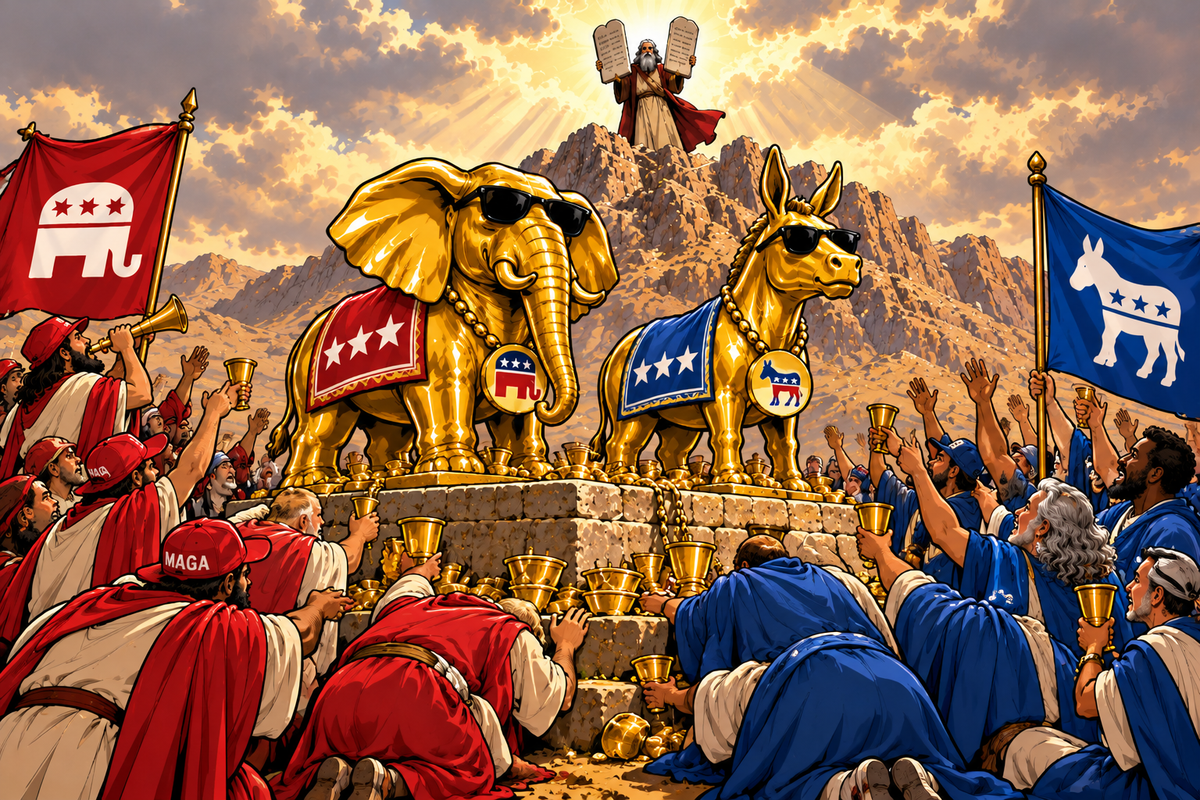
Government matters, and elections have consequences. But when preserving political power becomes more important than the biblical principles that supposedly justified seeking that power, Christians have a spiritual problem, not merely a political disagreement. Scripture has a word for misplaced worship and ultimate allegiance. It is idolatry, and idols do not always come with golden hooves.
When the Party Becomes Your Golden Calf
In Exodus 32, the Israelites grew impatient while Moses was on Mount Sinai. They demanded that Aaron make gods to lead them, and he fashioned a golden calf. Remarkably, Aaron then proclaimed a feast to the Lord. The people had experienced God's deliverance from Egypt, yet they transferred their devotion to something they could see and control, even wrapping their idolatry in religious language. Human beings have not changed much. We still have an extraordinary capacity to elevate something we created into something we believe we cannot survive without.
Political parties are especially attractive candidates for misplaced allegiance because they promise security, influence, and control over an uncertain future. But a political party is a human organization. It is not the Church, it is not the Kingdom of God, and its continued control of government is not a biblical promise.
When Christians begin treating the survival of a political institution as indispensable to God's purposes, they have confused the institution with the God they claim to serve.
When Fear Becomes More Powerful Than Faith
Perhaps the most revealing symptom of political idolatry is the panic that erupts when someone suggests that party loyalty should have limits. Suddenly, accountability is irresponsible, independent judgment is dangerous, and insisting upon principle is practically an invitation to national ruin. The message is simple: Whatever you have seen, whatever you know, and whatever objections you may have, put them aside. The other side might win. It is an extraordinary argument from people who routinely campaign on the importance of standing firm on principle.
Isaiah 8:12–13 warns God's people against surrendering to fear, even amid political turmoil, while Psalm 146:3–5 warns against placing our trust in rulers. God was sovereign long before the Republican Party existed and will remain so long after its current leaders are forgotten. Political consequences matter, but fear does not excuse abandoning biblical convictions, and no party's survival is a prerequisite for God's faithfulness.
When Loyalty Is Demanded but Grace Is Withheld
For four years, I have watched what happens when grassroots conservatives challenge an entrenched political establishment and succeed. After a grassroots won control of a local Republican leadership for two consecutive terms, what followed, in my experience, was a sustained effort to malign, embarrass, and humiliate those who had upset the established order.
Repeated olive branches and attempts at reconciliation did not end the hostility. It would be like humbling yourself to wash your enemy’s feet as an act of reconciliation, only to have them take advantage of your humility to kick you in the face. With impunity.
What makes this especially revealing is the expectation that the very people subjected to such treatment should nevertheless remain unquestioningly loyal to the institution. They are welcome to volunteer, donate, organize, knock on doors, and deliver votes. But challenging those accustomed to holding power can become an offense that years of service and repeated attempts at reconciliation cannot overcome.
Preserving control of the organization has become an end in itself, taking precedence over the principles it professes to represent. In my experience, the offense was never a disagreement over principle. It was the audacity of challenging who was entitled to power in the first place. Apparently, loyalty is mandatory, but grace is available only at management's discretion.
Jesus had something to say about leadership that looks remarkably different from this arrangement. In Matthew 20:25–28, He contrasted rulers who exercise dominion over others with the servant leadership He expected of His followers. And in 3 John 9–10, John describes Diotrephes, a man who loved having preeminence, spoke maliciously against others, and excluded people who challenged his authority. The setting was the early church, but the lesson about the love of preeminence is hardly confined to church walls. When an institution becomes primarily concerned with who controls it, its stated mission can quickly become secondary.
When Your Moral Standards Depend on Who Is Guilty
There is something almost impressive about the speed with which some people can identify dishonesty, corruption, and moral compromise when the offender belongs to the opposing party, only to discover an astonishing capacity for flexibility when the same behavior comes from their own side.
Apparently, the standard hasn't changed. It has simply become more accommodating. Proverbs 20:10 condemns dishonest weights and measures, a warning against applying different standards to different people, while James 2:1–9 warns against showing favoritism based on a person's status. Neither passage contains an exemption for politically useful people.
Dishonesty, cruelty, and malice do not become righteous because they serve a political cause, nor does calling an organization conservative make its conduct moral. Scripture sets the standard, not party loyalty or political expediency.
When the Ends Begin Justifying the Means
In 1 Samuel 15, King Saul disobeyed God's instructions and attempted to justify his conduct by pointing to circumstances and supposedly worthy religious purposes. Samuel responded that obedience is better than sacrifice. Saul eventually acknowledged that he had feared the people and obeyed their voice. Saul had explanations and reasons, but what he did not have was obedience. That distinction matters whenever Christians are told that questionable conduct must be accepted because the political consequences of objecting are too severe.
Romans 3:8 rejects the reasoning that people should do evil so that good may result. The possibility of a desirable political outcome does not sanctify dishonest methods, malicious behavior, or the abuse of authority. Nor does the prospect of an undesirable outcome erase a Christian's responsibility to exercise moral judgment. God has never needed people to suspend His commandments temporarily so that He can accomplish His purposes.
When Party Loyalty Replaces Loyalty to Truth
In 1 Corinthians 1:10–13, Paul rebuked believers for dividing into factions loyal to different leaders. The same problem arises when allegiance to an organization outweighs truth and accountability. Suddenly, criticism is betrayal, questions are rebellion, and blind loyalty is mistaken for virtue.
Scripture never demands loyalty to a political party at the expense of conscience. Acts 5:29 puts obedience to God above obedience to men. No party can redefine righteousness, no leader can excuse wrongdoing by demanding unity, and no political threat gives anyone authority over a Christian's conscience.
The Question Every Christian Must Answer
The first commandment, recorded in Exodus 20:3, establishes that God's people are to have no other gods before Him. An idol does not have to resemble an ancient pagan statue. Anything that receives the ultimate trust, devotion, or authority belonging to God has become spiritually disordered.
A political party may represent sincerely held convictions and advance worthwhile policies, but it remains a human institution, subject to ambition, weakness, corruption, and error.
The Kingdom of God has outlasted empires and kings. It certainly doesn't depend on the fortunes of a political party. God isn't running for office, His authority isn't subject to a recount, and His promises don't expire after an election. In Matthew 6:33, Jesus commands us to seek God's Kingdom first. No political party gets to rearrange that order.
Every Christian involved in politics eventually faces the same fundamental question: When allegiance to an earthly institution conflicts with allegiance to Christ, which one has the final word?
Because if your biblical convictions are negotiable but your party loyalty is not, it is worth considering which one has become your god.
TruthWire exists to provide independent investigative journalism that holds Tennessee's political establishment accountable.
We aren't funded by corporations, political parties, or large media companies.
We're funded by readers who believe the truth is worth defending.