
WHEN THE LINE MOVES: WHAT LINDSAY CLANCY, ABORTION CULTURE AND A STRING OF CHILD-KILLING CASES SHOULD FORCE US TO ASK
A post-Clancy cluster of mothers accused of killing or attacking their children raises a deeper question: what happens when a culture makes innocent life conditional, then centers sympathy and explanation on the person who destroys it?

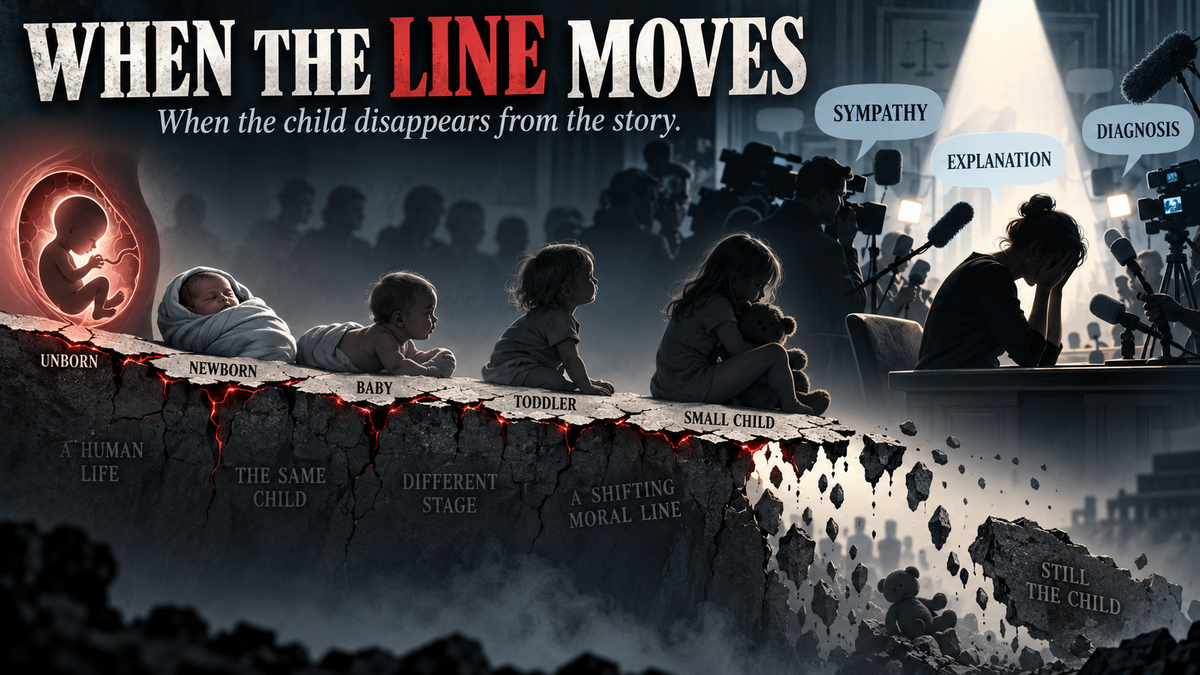
5 Key Takeaways:
- The argument is bigger than abortion itself: once innocent human life is treated as conditional, the moral line becomes easier to move.
- Lindsay Clancy’s case may have given already-disturbed women a recognizable script built around sympathy, notoriety, explanation and possible relief from full criminal responsibility.
- A troubling cluster of maternal violence followed the Clancy mistrial, including cases involving stabbing, shooting, starvation and attempted murder of children.
- Christian teaching places human worth in God, not in wantedness, convenience, age, development or another person’s circumstances.
- Compassion for mental illness and women in crisis must not erase accountability or make the child disappear from the center of the story.
For decades, Christians and pro-life advocates warned that abortion was never just about abortion. The deeper question was whether innocent human life has value simply because it is human, or whether that value can change depending on someone else’s circumstances, desires, convenience or state of mind.
We were first told the issue was early pregnancy, when the developing child was still described almost entirely in clinical terms and abortion was supposed to remain limited, regrettable and rare. Zygote. Embryo. Fetus. All biologically accurate terms, but also words that made it easier to forget the obvious truth underneath them: these are stages in the development of a human being.
The 1992 Democratic Party platform defended abortion rights while saying the goal should be to make abortion “less necessary.” Over time, the legal and political boundaries shifted. Roe v. Wade used a trimester framework. Planned Parenthood v. Casey moved the constitutional focus to viability. Dobbs overturned both and returned abortion policy largely to the states. Today, some jurisdictions impose no gestational-duration limit at all.
The warning was not that lawmakers would suddenly legalize killing 5-year-olds. It was that once human worth became conditional, the logic would be harder to contain.
That warning feels a lot less abstract now.
Lindsay Clancy killed her three children, Cora, 5, Dawson, 3, and Callan, 8 months, in January 2023. At trial, the central question was whether she should be held criminally responsible because of her mental condition. Her first trial ended in a mistrial on September 4, 2026. A note from the foreperson indicated there was one holdout, and subsequent juror interviews described an 11-1 split. CBS News reported on the mistrial and holdout, and later reported a juror’s account of the split.
Most people saw a complicated legal case involving severe mental illness. But a woman already unraveling may see something much simpler: a mother killed all three of her children, the country learned her name, her suffering became a national discussion, people sympathized with her, experts explained her mental state, her husband publicly forgave her, and eleven jurors were reportedly prepared to find her not criminally responsible.
For an already-disturbed woman, that can create a very different message. Do something unspeakable, and suddenly everyone is looking at you, talking about you, analyzing your pain and searching for reasons to explain what you did. There is even the possibility that mental illness becomes a path away from an ordinary murder conviction.
There is something almost like a bizarre variation of the dynamic people associate with Munchausen syndrome by proxy. The clinical disorder itself is different. What is now called factitious disorder imposed on another involves a caregiver deliberately falsifying or inducing illness in someone else, often a child. The comparison here is the attention dynamic: a child’s suffering becomes the vehicle through which the caregiver becomes the center of concern, sympathy or validation.
What I am describing is darker: the possibility that an already unstable woman may see the destruction of her own children as a way to transform private misery into a public crisis in which she becomes the center of attention, sympathy and explanation.
Women killed their children before Lindsay Clancy. Maternal filicide is not new. What is striking is the apparent clustering of cases after the country watched one of the most sensational maternal-filicide trials in recent memory and learned that eleven jurors were prepared to find Clancy not criminally responsible.
That timing raises a question worth asking: Did the Clancy case become a catalyst by showing already-disturbed women a recognizable path from private despair to public sympathy, notoriety and possible exemption from full criminal responsibility?
Within weeks, case after case appeared involving mothers accused of stabbing, shooting, starving or killing their own children.
In South Carolina, 35-year-old Taylor Gosnell was charged with two counts of attempted murder after authorities said she attacked her 3-year-old and 6-year-old children with a knife and blunt object. Deputies found both children badly injured and alone. Reports described approximately 50 stab wounds between them, with injuries to the older child reportedly severe enough that doctors considered amputations.
Days later, deputies in Ladson, South Carolina, found 2-year-old Emory Deacon and 15-month-old Harlow Deacon dead inside their home. Their mother, Justine Marie May, was charged with two counts of homicide by child abuse. The coroner determined the girls died from starvation and dehydration caused by neglect. According to the arrest affidavit, May said the previous two weeks had been a “blur” and that she could not remember when she had last fed the children or given them something to drink.
Around the same time in Houston, 4-year-old Vivian Savella was shot and killed. Police said her mother, Cibelle Savella, shot Vivian and then herself after a custody hearing in which the father had been given greater authority and the mother’s access had been restricted. Vivian was supposed to be returned to her father that evening. Whatever was happening between the adults, the child who had no control over any of it is the one who died.
In Montemorelos, Nuevo León, authorities discovered five members of a family dead. Prosecutors said their principal theory was that Cinthia Abigail Tamez Rivera killed her partner and three children before killing herself. Authorities continued investigating the possibility of third-party involvement.
On October 1 in Waxahachie, Texas, 42-year-old Colleen Nichole Lemmon was charged with two counts of capital murder after her two sons were shot. Twenty-one-year-old Christopher Scott Pitre died at the scene, and his 15-year-old brother later died at the hospital.
Then, on October 6, police in Northlake, Texas, arrested 37-year-old Holly Leeann Flores after authorities said she stabbed her husband and their two young children. Her 3-year-old daughter and 10-month-old son were stabbed in the chest, while her husband suffered injuries to his head. All three survived. Flores was charged with two counts of attempted capital murder and one count of aggravated assault with a deadly weapon. Police said they had previously responded to the home multiple times for welfare concerns.
Taken together, the timing and similarity of these cases raise a larger question about the moral environment in which they are happening.
Christians start from a different premise. Human value does not come from whether we are wanted, useful, independent, healthy or convenient. It comes from God. Psalm 139 tells us God forms us in the womb. Jeremiah 1:5 says God knows us before birth. Luke 1 describes John the Baptist responding while still in Elizabeth’s womb. Psalm 127 calls children a heritage from the Lord. Jesus gave some of His strongest warnings about harming little ones in Matthew 18.
The message is simple: human life has value because God gave it value.
For decades, Americans have been taught to view abortion almost entirely through the circumstances of the woman. What will this pregnancy cost her? What will it do to her career, education, finances, relationships, mental health or future? Those considerations may be real, but there was always another human being in the equation. And at some point, personal responsibility has to enter the conversation. If those consequences matter enough to justify ending another human life, perhaps they were worth considering before engaging in the act that creates one.
There is a reason Christianity places sex within marriage and connects it to responsibility, commitment and family, but that is another article for another day.
The cultural damage comes when compassion for one person makes the other nearly invisible. A woman can be frightened, pressured, desperate, mentally unwell or abandoned by people who should have helped her, and we can respond with compassion without pretending there is no second human life involved.
That same habit of thought matters after birth.
The abortion argument began with early pregnancy, when the child was tiny and unseen. Then the debate moved toward viability. Later abortions became part of the fight. Today, some states impose no gestational-duration limit at all. The point was never that abortion and maternal filicide are legally identical. They are not. The point is that both force the same moral question: does innocent human life have value on its own, or does that value depend on the circumstances of somebody else?
That is where Clancy becomes so significant. The case may have added something immediate to an already weakened cultural boundary: a highly publicized example of a mother killing her children and becoming the focus of extraordinary sympathy and psychological explanation.
For someone already disturbed enough to contemplate the unthinkable, that can become a script. The child’s suffering becomes the means by which the mother’s misery becomes visible. When that possibility is followed by a tight cluster of maternal violence, it deserves more than a shrug.
Postpartum depression is real. Postpartum psychosis is real. Severe psychiatric illness can devastate a family, and warning signs should be taken seriously. But mental illness and legal insanity are not the same thing. A person can be depressed, unstable or seriously mentally ill and still understand what she is doing and know that it is wrong.
There are cases where someone truly cannot be held criminally responsible, and the law already has a mechanism for those circumstances. But compassion should not become automatic exoneration whenever a mother does something horrific.
Christians should understand this better than anyone because mercy and justice are not enemies. We can care about a suffering woman and still insist that the child she harmed matters.
One of the most disturbing things about the Clancy case was how easily Cora, Dawson and Callan faded into the background while the conversation became overwhelmingly about their mother. That should bother us. A child strangled with an exercise band cannot tell us what happened. A toddler dying from starvation cannot explain those final days. A 4-year-old shot after a custody hearing cannot describe her fear. A 6-year-old suffering dozens of wounds cannot go on television and ask why everyone seems more interested in the condition of the person accused of hurting her.
Someone has to speak for them.
A society cannot stop every murder or identify every unstable person before tragedy occurs. But it can make clear what it values. It can help women in crisis without making the child disappear. It can take mental illness seriously without confusing every diagnosis with legal insanity. It can preserve compassion without sacrificing accountability.
The post-Clancy cluster should force us to ask whether we are watching the consequences of decades of moral erosion unfold in real time. A culture cannot spend decades teaching that innocent life is negotiable, then act stunned when already-disturbed people begin finding new reasons to negotiate it.
The answer is not to move the line again. It is to restore it. Innocent human life has value before birth, after birth and at every point in between. That value does not come from whether a child is wanted, convenient, healthy, independent or easy to love. It comes from God.
And once we lose sight of that, the question is no longer where the line is. It is whether there is any line left at all.