Easements: It Makes the Arsenic Go Down
Tennessee’s new conservation-easement grant program incentivizes landowners to surrender control of their property. This piece argues the policy undermines true conservatism by trading personal responsibility for government-approved restrictions.

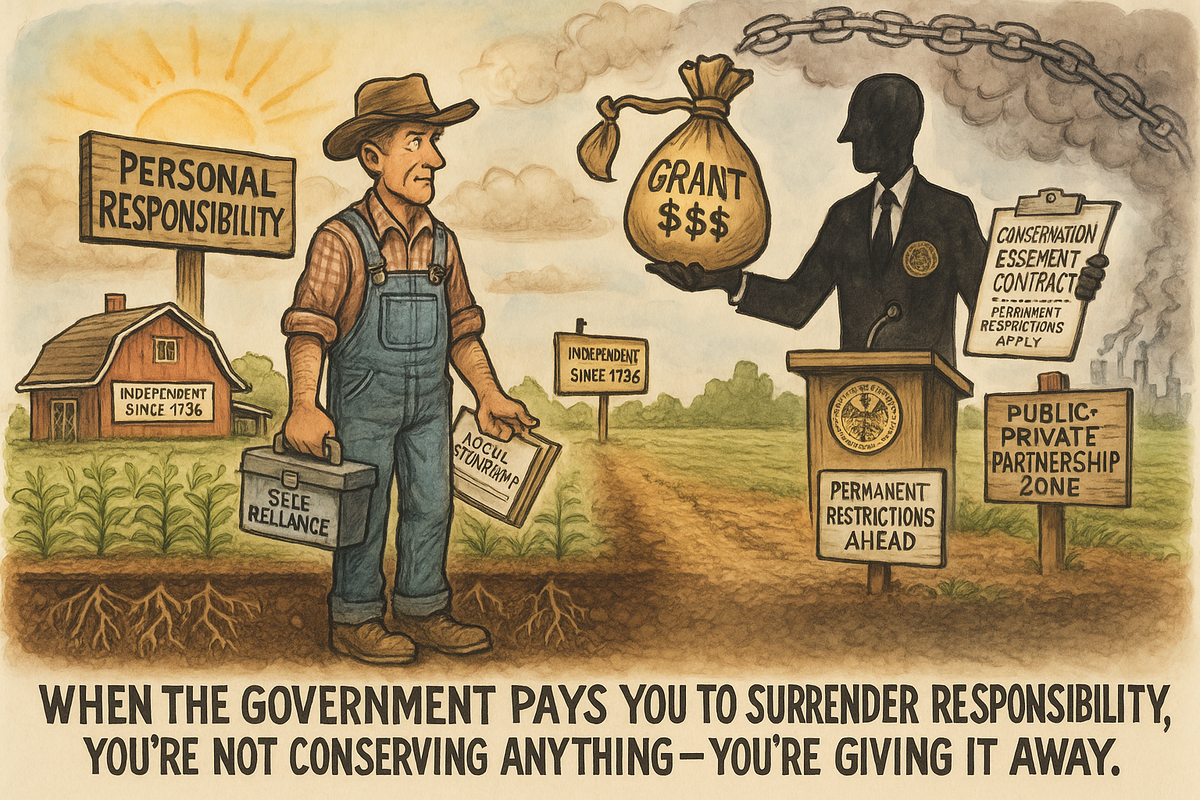
The fundamental principle of true conservatism is personal responsibility. That may seem a strong assertion, when ‘conservative’ is right there in the label, but we have to distinguish between ‘Conservatism,’ of the sort which we often deal with, and ‘Conservatism,’ of the sort that actually conserves. The difference between the two lies in their basic principle. True conservatism, the kind that is the backbone of America (and thoughtful populism), makes personal responsibility its bedrock, knowing that a culture of responsibility bears fruit of liberty and respect for tradition (because responsibility encourages that change be made only with careful forethought, on the basis of the past rather than in rebellion against it). Mere conservatism, placing ‘conservation’ at its base, turns in another direction: it becomes a rowdy retreat, forever falling into the position it derided two decades ago.
Personal responsibility is the basic element of American conservatism. If a politician seeks to enable and promote personal responsibility in the citizenry, he acts conservatively; if he attacks our personal responsibility or weakens it, even by temptation, he is no conservative, except in the style of R.L. Dabney’s ‘Northern conservatism,’ which “demurs to each aggression of the progressive party, and aims to save its credit by a respectable amount of growling, but always acquiesces at last…” (6). The legacy of America which we seek to conserve is a legacy of robust reliance on myself, my family, and my local community, not of offloading my choices to the government for fear I or my children will slack from responsibility, not of giving the government stewardship of some part of my life in exchange for government money.
Public Chapter No. 470, passed as HB1325/SB0207 in the most recent session of Tennessee’s legislature and sponsored by Sen. Jack Johnson, provides that “The department of agriculture may award a grant to a qualified easement holder or directly to the farmer or forest landowner,” contingent on “Proof… that the farmer or forest landowner has entered into… a conservation easement with a qualified easement holder,” as well as proof that the land so bound will be used for “farm or forestry purposes” (2). Land made into a conservation easement is land the owner legally cannot use for a variety of purposes, as he must ‘conserve’ its natural value, as per this definition.
This law, Jack Johnson’s law, is hostile to personal responsibility. The landowners, of course, are not being outright forced to partake in this program. So far, so good. But the welfare state and the debt economy have not denigrated America as far as they have merely through coercion. As B.F. Skinner recognized (103, 199 [page numbers]), governments can change people via incentive just as much as by punishment; indeed, incentive, being an easier pill to swallow, can often get farther than coercion, just because its friends are buoyed by it and its foes have less outrage to work with. A spoonful of sugar makes the medicine go down, even when the medicine is hydrogen cyanide or granulated arsenic.
SB0207 (which entered law as P.C. No. 470) offers Tennessee landowners money to sign over their control of their own property to various trusts. The involvement of trusts makes this private-public partnership, a possibility we should always be wary of (including in education). We should also consider the downstream economic effects: those who give up their independence get tangible, if (for now) temporary economic benefits. As such, they have a competitive advantage over those who hold on to full ownership of their land. While a one-time cash injection may not have over-much effect (depending on the amount, which is determined by the administration, not the legislature), it sets a precedent for much more destructive policies, like an ongoing stipend (subsidy), which would put government-non-compliant farmers at a long-term disadvantage. Such a policy would be coercive, albeit not in the legal sense.
Quite apart from all this, the law’s mandate is that the government pay citizens to give up their personal responsibility, rather like a voluntary gun buy-back. How can this be conservative?
Conserving Tennessee’s natural beauty is a worthwhile goal for Tennessee. Such conservation is a proper concern for Tennessee’s government. But we must assess means as well as ends. Good goals don’t excuse evil methods. Here, the government offers bribes to farmers who hand over part of their property rights to a third party in perpetuity. That third party gains the right to limit the owner’s use of his property (because he doesn’t really completely own it). This grant, moreover, cannot be reversed.
This assault on personal responsibility by Sen. Johnson, Rep. Lamberth, and the 28 co-sponsors, as well as the many Republicans who voted for the legislation, is not a death-knell. Currently, it only directs that grants be established to tempt farmers into giving up their and their children’s right to use their land to the fullest. Currently, the meaning of ‘conservation easement’ has some limits, and the contracts creating the easement can (legally) only be directly modified by the consent of the landowner. I say ‘currently’ with good reason, though: did you ever hear of a government program that didn’t get bigger as time went on?
Consider the breathtaking level of tyranny which could be elicited from this law’s spirit with just a little nudging. Grants as incentives could be paired with regulation and other such measures, giving privileges and exceptions to those who agree to sell off some of their responsibility, imposing restrictions on those who resist. Even as simple a change as making the grant a recurring expenditure would create significant pressure on dissenters.
Further, the meaning of ‘conservation easement’ could be tweaked, whether legislatively or judicially, allowing the third party holder (NGO) or the state government more power, at the cost of the landowner. For instance, he could be required to get permission to switch crops, in order to be sure he’s not damaging the landscape. Once a man signs of on the easement, he has much less ground to stand on in protesting such tyranny.
Senator Johnson’s scheme, now law, is all about tempting people to sell off their personal responsibility. The law dismisses all trust that Tennesseans can take care of their own country and teach their children to do the same. No, we must be coaxed and cozened into giving a state-approved third party veto rights over how we use our own land, in perpetuity. Indeed, so foolish are we that we must be drawn to what is good for us not by forthright argument and honesty but by being paid off. Only a third party, approved by the government, can be trusted to conserve Tennessee’s beauty. You, who live on the land, you, whose children will live on that land (God willing), cannot be trusted with its care.
What can we do about this?
Reformation starts at home, so the first step is not partaking in the largesse. The next step, in the short term, is to work against this sort of legislation, repealing this and other laws hostile to personal responsibility, electing honest, principle legislators to guard our liberty and leave us our responsibility. Both of these answers, though, are just part of the greater responsibility we must uphold.
We have to live up to the challenge issued by conservatism: to be thoroughly responsible with what God has given us. We must ourselves use the land with an eye not only to present profit and pleasure but to the future decades, balancing beauty and history with economic fruitfulness and care for our families. We must cultivate in ourselves and in our children a love for God’s world which conserves and produces beauty—beauty of thought, word, deed, and legacy, material and immaterial. We must, above all, teach our children to carry forward this legacy of personal responsibility, conserving the beauty and righteousness God gave us in America and in Tennessee, teaching them to be even better stewards than we are.
God bless.