
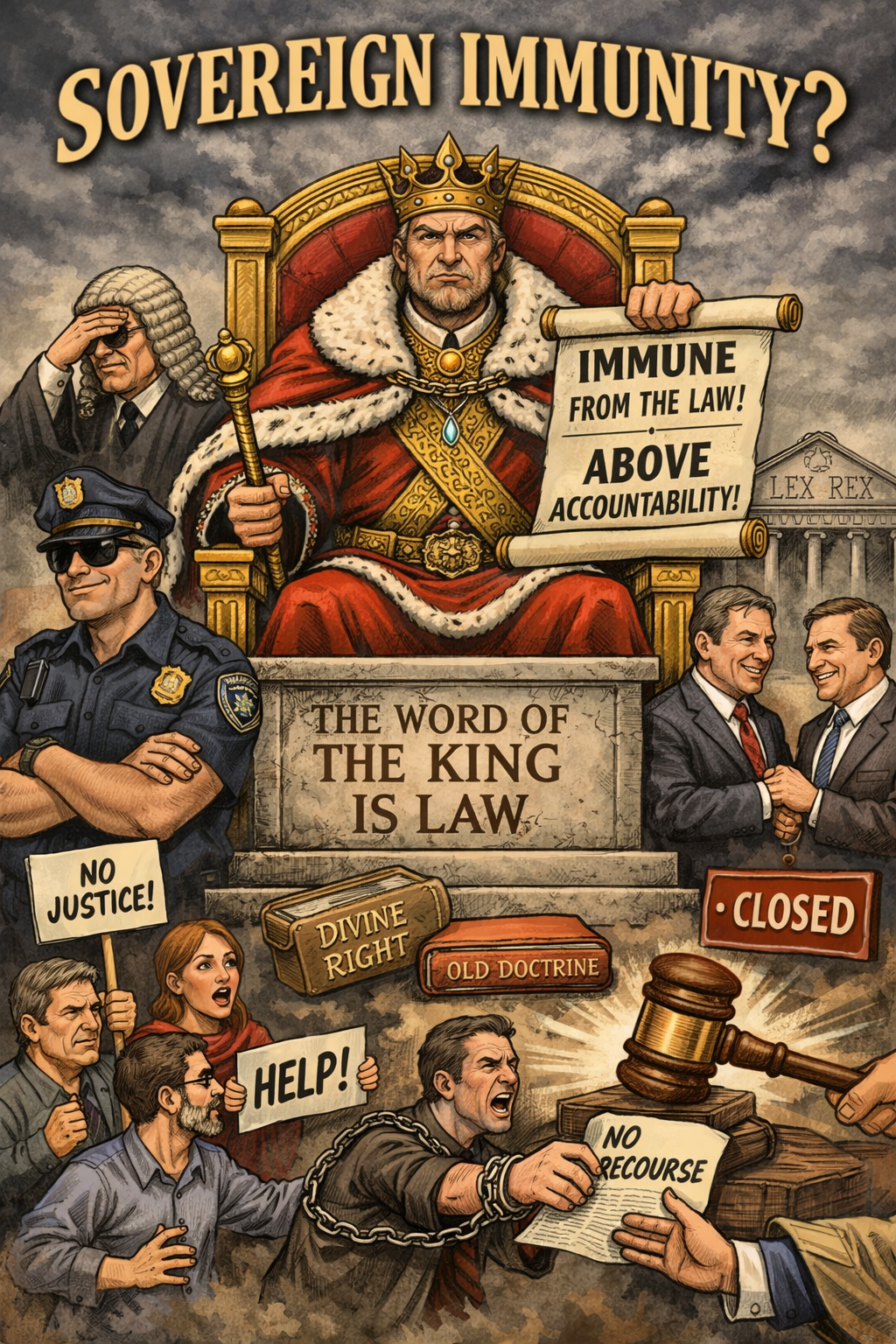
SB1958 would restore broad sovereign immunity in Tennessee, forcing citizens to break the law before challenging unconstitutional government action. Is the state above accountability — or subject to the same rule of law it enforces?
Sovereign immunity is an old doctrine whose spirit is summed in these words: “The word of the king is the word of God,” and, in the words of James I of England, “Kings are gods on earth.” The fundamental idea of sovereign immunity, historically, is the belief that the state, if it is capable of wrong, is not subject to any earthly accountability. In the modern day, this has practically reverted to the Roman, Persian, and Assyrian doctrine that the king’s word, the word of the state, is the basis of right and wrong. Senate Bill 1958/ House Bill 1971, appeals to this doctrine explicitly, averring that (as a rule) Tennessee’s government ought not to allow itself to be accountable in the courts.
Sovereign Immunity?
Sovereign immunity, in the plainest terms, is the common law doctrine (promulgated largely by judicial fiat) which prevents any citizen from suing the government, state or federal, without the consent of that government, whether individual or by statute. Under this doctrine, I cannot simply allege that the government has wronged me by stealing my property or curtailing my rights or imposing an illegal law upon me; I must show that, in addition to these wrongs, the government has given me permission to sue it for its purported crimes. Moreover, this immunity applies to all government officers in their governmental office.
This immunity may be ‘absolute’ or ‘qualified.’ The state itself claims absolute sovereign immunity, breachable only by its own allowance. Qualified sovereign immunity can be breached by a breach of certain boundaries—such as if the police officer decides to use his police cruiser to flatten a toddler on his neighbor’s driveway. As he was not acting within his official duties, he is not protected; if he had simply enforced a clearly unconstitutional rule, he would be in the clear. Judges, the people largely responsible for deriving the doctrine, get a hefty allowance of ‘judicial immunity’. In fact, under Stump v Sparkman (1978), a judge can order a woman sterilized without her knowledge or consent, and when the woman discovers her sterilization two years later, the judge is immune from consequences for the atrocity.
What SB1958 Does
What is the law which Senate Bill 1958 (House Bill 1971) seeks to repeal? This is the section of our current law which Section 1 of SB1958 orders deleted: “Notwithstanding any law to the contrary, a cause of action shall exist under this chapter for any affected person who seeks declaratory or injunctive relief in any action brought regarding the legality or constitutionality of a governmental action. A cause of action shall not exist under this chapter to seek damages.” (To read for yourself, use this portal and go to Section 1-3-121.)
This statute does not abolish sovereign immunity in total. As it states quite clearly, it bars damages and allows suit only for “declaratory or injunctive relief,” meaning that this law allows only for obtaining judicial barriers against continued unconstitutional or illegal action, not for obtaining recompense or punishing the tyrant. Still, while it is a bare minimum, the law is good in itself, a path to check government over-reach.
SB1958 seeks to get rid of this provision. Under SB1958, suit against the state would still be possible—but no longer would the citizen have the right to sue without an allegation of damages. In other words, in order to sue for an unconstitutional or illegal governmental action, you would have to show that you have actually suffered harm from it (and no, misuses of your taxes do not count). An allegation that an unconstitutional law infringes on your rights would have no ‘standing’ (no right to be heard in court) unless you could show that your exercise of your rights was actually prevented. The only way to do this, as a rule, is to disobey the government and hope you win the court case.
This requirement obviously imposes massive burdens on the citizen. He can no longer bring the government to account proactively. Instead, he must go violate the law (if he is able to) and hope he can win his court case, must put himself in jeopardy in order to defend his rights. By increasing the danger of challenging an unconstitutional law, SB1958 protects those unconstitutional laws and works to deter citizens from protecting not only their own rights but the rights of every Tennessee citizen.
(But don’t worry. Under this law, you can still sue city and county governments for injunctive relief. It’s only the state government, whose legislature is contemplating this, which benefits from its protection.)
Is Sovereign Immunity Moral?
This bill is abhorrent and tyrannical. From David to Christ, every king and every government has been accountable to God’s law, in the implicit understanding that every government run by fallen men will do evil at some point. The Christian cannot simply excuse the government falling short of the standard set in Romans 13:3-4 (“[Rulers] are not a terror to good conduct, but to bad…. [He] is God's servant for your good. “). The government’s job is not to hallow itself as perfect; if a government official commits a crime, a sin which it is the civil government’s job to punish (Gen. 9:5-6), he ought to be punished by the government, that the government may be a “terror… to bad [conduct]” even in itself (Rom. 13:3).
The contrary position, that of sovereign immunity and the Divine Right of Kings, has horrific implications. If we say with James I, “Kings are justly called gods, for that they exercise a manner or resemblance of divine power upon earth,” if we say with too many judges and legislators that the government can absolve itself at will (this being the rationale of sovereign immunity), we implicitly abdicate the right to punish even the greatest excess-in-evil of our rulers. Sovereign immunity makes legal the ‘Just following orders defense’ repudiated at Nuremberg and condemned by 1 Kings 2:9-15, where Elijah destroys those men sent by Ahaziah to (it is heavily implied) murder him.
Sovereign Immunity’s Legality
Sovereign immunity has three supports: common law & history, the federal constitution, and Tennessee’s state constitution. Of these, the second is technically irrelevant, but it speaks to the first, to the history which justifies the ‘common law’ doctrine created by judges.
Moreover, sovereign immunity is legally absurd in light of our history; indeed, the contrary should be upheld as an implicit and core right of the American, a part of the guarantee of the Tenth Amendment to the people. The government has no authority (though it has seized the power) to render itself immune.
America’s law starts in England, and here we find a repudiation of the Divine Right of Kings. This repudiation comes not merely in the words of a few citizens, such as the wonderful Lex Rex (whose very title is ‘The Law is King,’ a repudiation of sovereign immunity), but from the entire nation. The English Civil War decisively demonstrated that Englishmen did not abide their government claiming immunity from retribution or accountability (and America’s rights are a refinement and expansion of the English rights). The execution of Charles I, despite its immense controversy, declared as much in no uncertain terms: if the king can be executed for his crimes, he is not immune. The same principle was upheld, with much less bloodshed, in the Glorious Revolution of 1688.
Over in America, meanwhile, sovereign immunity gained no more legitimacy. Our War for Independence was an act of desperation following a long series of attempts to gain redress for the evil actions of the British government. Among the reasons for secession stated in the Declaration of Independence, we find the following: “[For affecting] to render the Military independent of and superior to the Civil power…For Quartering large bodies of armed troops among us: For protecting them, by a mock Trial, from punishment for any Murders which they should commit on the Inhabitants of these States….” One reason for America’s independence, therefore, was the vitiation (not even the refusal!) of court remedies for government criminality.
This denial of governmental immunity continued after the War for Independence. While the president and congress were given specialized immunity (the president subject to breach-by-impeachment and congress for words spoken in legislative discourse, subject to internal regulation), no general doctrine of officer immunity appeared. Indeed, government officers were subject to suit in court for their governmental actions, suits in which their governmental authority was a defense, not a provision of immunity. They had to show not only that they had a warrant or authorization but that said warrant or authorization cohered with the pertinent statutes, constitution, and rights (Hamburger, Is Administrative Law Unlawful, 305-307).
The very history of the Eleventh Amendment, alleged as the ground for much sovereign immunity, testifies to the illegitimacy of the doctrine. The political cause for the case was the furor surrounding Chisholm v. Georgia, in which the citizen of one state used federal court to sue another state’s government. In response, the Eleventh Amendment established that a state could not be sued in federal court by the citizen of another state or by a foreign citizen, except by their own consent. It clearly does not (except in the court’s fantasies) block citizens from suing their own state in federal court, and it does not block citizens from suing a state in that state’s own court (jurisdictional and enforcement issues render it effectively a non-starter to sue a state in another state’s court, regardless of immunity). Indeed, because it is premised on Chisholm’s legal validity, the Eleventh Amendment must be seen as not an instatement of true immunity but as a jurisdictional restriction. It did not dispute or amend Chisholm’s decision that the state could be sued; it simply directed that they not be sued in federal court.
The State Constitution
Under our state constitution, Article I, Section 17 has been held to provide sovereign immunity to the state. Here I cannot fully disagree. While the section does not demand sovereign immunity, it can be read to plausibly assume it when it empowers the legislature to choose whether or not to set up paths to sue the state for remedy of past injury. Notably, the direct implications of this section deal only with remedy for “damages done,” a different area of law that injunctions and declarative relief. However, the fact remains that proponents of sovereign immunity have a foothold in the Tennessee Constitution, though only a foothold.
The legislature, however, is empowered to fully dispense with that immunity, insofar as it exists. Their duty, therefore, is to dispense with it forthwith. This duty is not only legal, born of the ancient rights of citizens of this country, as carried with us from England, but moral, born of the command of God that men do not regard themselves as gods, above the law established for their good. Genesis 9:5-6, the commissioning of civil government, does not have an except for the officers of civil government. Senate Bill 1958, in this light, may be constitutional under the Tennessee constitution, but it is immoral and tyrannical.
Even this legality, note, is less than it may seem. The Tennessee constitution never truly endorses sovereign immunity; it merely omits to remove it and provides a section consonant with it. The judicial reliance on sovereign immunity must therefore rest strongly on the ‘common law’ doctrine, not on our constitution. That doctrine, however, is a falsity, a judicial construct contrary to the rights of Americans and Englishmen (the two halves of our common law’s history). The case for sovereign immunity is thus relatively weak even with the flaws in our current constitution.
The restoration of sovereign immunity desired by SB1958/ HB1971 is the removal of a right of Tennesseans and Americans. This right is not just a right recognized since the federal constitution’s passage, founding of the country, or the early days of the colonies, before the English Civil War. This right is a right founded in Scripture, in God’s law, in the certainty that the king is but a man given authority, still subject to the rule of law just like the rest of us. The slim legality of removing that right is thus merely an excuse.
SB1958 for Sovereign Immunity
Senate Bill 1958 (sponsored by Senator Stevens) and its companion bill, House Bill 1971, sponsored by Representative Farmer, seek to reinstate Tennessee’s sovereign immunity. The bill says as much: “[To] retain Tennessee's sovereign immunity; now, therefore….” In this, it has open support of Republican leadership, including Senator Jack Johnson, Rep. Sexton, and Rep. Lamberth (for a full list of sub-sponsors see this page). This doctrine of sovereign immunity, however, is constitutionally and historically bankrupt, lacking support or firm legality. Moreover, it is clearly immoral, a way for tyrants to escape consequences on this earth which they will not escape in eternity. If we allow this law to pass unremarked or unfought, if Tennessee adopts it, we take onto ourselves that curse and become those who close their eyes to wickedness, join hands with those who “have rejected the law of the Lord of hosts” (Is. 5:24) and therefore perish.
House Bill 1971, SB1958’s companion, will come to the House Judiciary Committee on March 4th (moved up from March 11th). If it passes there, the bill revives in the Senate. If you’re worried about this bill, this article gives you the details you need to make a difference.
If you want to support what we do, please consider donating a gift in order to sustain free, independent, and TRULY CONSERVATIVE media that is focused on Middle Tennessee and BEYOND!


Comments ()