The $500 Million Trigger: When a Law Only Applies If the Numbers Cooperate
A $500M clause may decide everything. Williamson County’s hospital sale law only applies if that threshold is met—otherwise proceeds default to a trust. The real issue isn’t control of funds, but whether the law applies at all.

5 key highlights:
- The $500 million threshold is the trigger point that determines whether the new law applies or becomes irrelevant.
- If the hospital is valued below that threshold, proceeds automatically default to a trust under existing state law.
- The legislation does not guarantee local control of funds—it only makes it possible if specific conditions are met.
- Valuation is not just a number; how the deal is structured could determine which legal framework governs the proceeds.
- Concerns about limited transparency around the RFP process raise additional questions as the county approaches its largest financial transaction.
As Williamson County continues to explore the potential sale of Williamson Health, much of the public discussion has centered on what happens after the sale—who controls the money, how it might be used, and whether it could meaningfully impact the county’s financial future. But beneath those broader conversations sits a far more precise and consequential question, one that has received far less attention than it should: when does the law even apply?
Because under the amended language of Senate Bill 2194, the answer is not automatic. It is conditional. And that condition is defined by a single number—$500,000,000.
The legislation, as rewritten by Amendment #1, does not simply change the rules governing hospital sale proceeds across the board. Instead, it creates a narrow pathway for those rules to be altered, but only if specific criteria are met. Among those criteria is the requirement that the hospital be valued at more than $500 million. Only then, and only with the additional approval of a two-thirds vote of the County Commission, does the exemption take effect—allowing proceeds to be used outside of the traditional trust structure that has historically governed public-benefit hospital sales in Tennessee.
That nuance is not just technical. It is determinative.
Because if the hospital is valued below that threshold—or if the sale is structured in a way that keeps it below that threshold—the exemption never activates. The new law, despite the attention and momentum behind it, does not come into play. The proceeds default back to existing statutory requirements, meaning they are placed into a trust, remain tied to their original public-benefit purpose, and continue to fall under the oversight of the Tennessee Attorney General.
In that scenario, nothing changes.
The bill, as it is currently being debated and advanced, becomes effectively moot—not because it fails procedurally, but because the conditions required for it to matter were never met in the first place. And that is where the conversation should be more focused than it has been.
Compounding that concern is a growing frustration among members of the County Commission who are not part of the hospital board. Several commissioners have indicated that once a formal Request for Proposals (RFP) is in circulation, the process should move into a higher level of transparency, given that it signals active engagement with potential buyers. Yet according to those commissioners, that level of openness has not materialized. They point to the limited flow of information from the hospital board—which includes three sitting commissioners—as well as from County Mayor Rogers Anderson, raising questions about whether the process is being conducted with the degree of visibility that a transaction of this magnitude warrants. When the largest financial decision in county history is being explored, the expectation is not just procedural compliance, but proactive transparency. And where that expectation is not being met, skepticism is not only predictable—it is justified.
Much of the public discourse has operated under the assumption that passage of SB 2194 creates new flexibility for Williamson County, particularly the ability to redirect proceeds toward debt reduction or capital improvements. But that flexibility is not guaranteed by the legislation itself. It is contingent on valuation, and valuation in a transaction of this scale is not a fixed or neutral variable. It is shaped by negotiations, structure, timing, and how the deal is ultimately framed.
Which introduces a dynamic that has not been widely addressed: when a law only applies above a certain threshold, the threshold itself becomes a strategic inflection point.
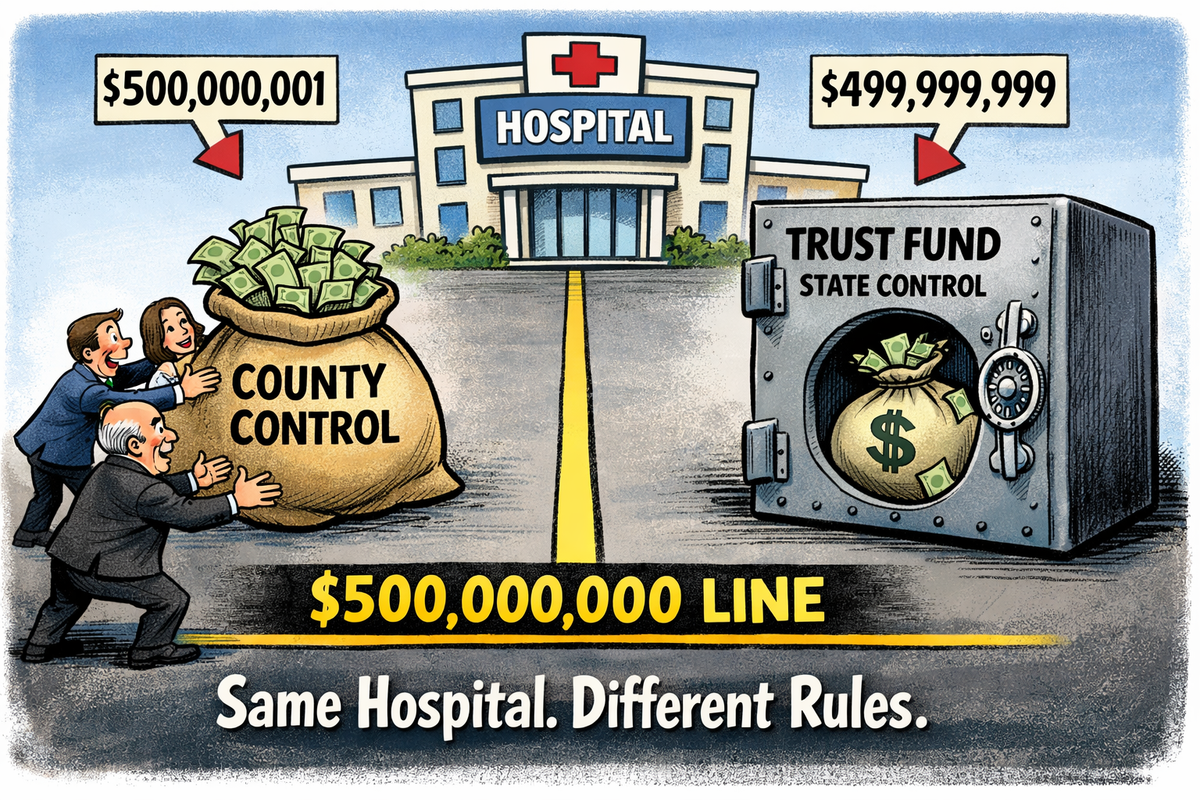
The $500 million figure does not simply define eligibility. It creates a dividing line between two entirely different legal outcomes. Above that line, the County Commission may have the authority—subject to a 16-vote supermajority—to direct how proceeds are used. Below it, that authority disappears, and the funds are governed by existing trust requirements with far less local discretion.
There is no partial application. No sliding scale. No middle ground.
Either the threshold is met, and the law activates, or it is not, and the law is functionally irrelevant.
That reality raises an important question that has not been fully explored: is the public conversation accurately reflecting the conditional nature of this legislation, or is it being presented as a more definitive shift than it actually is?
Because if the hospital is ultimately valued at $450 million, or $499 million—or if the structure of the transaction places it just under that line—then the central premise of the bill, the ability for local government to redirect those proceeds, never materializes. The outcome reverts entirely to the framework that already exists.
And that makes the $500 million threshold far more than a detail buried in legislative language. It is the trigger point upon which the entire strategy depends.
In a transaction being described as the largest in the county’s history, that kind of conditionality matters. It means that the future use of these proceeds is not simply a matter of policy preference or political will. It is dependent on whether a specific numerical benchmark is reached, and whether the structure of the deal allows it to be reached in the first place.
And keep in mind, the bill also removes what were lawfully mandated guardrails provided by the Attorney General's office, furnishing the oversight that would be necessary for such a large financial transaction.
Which is why the focus on what could happen after the sale may be premature.
Before those decisions can even be considered, the threshold must be met. And if it is not, the outcome is already defined—regardless of legislative intent, public expectation, or political messaging.
That is the piece of this conversation that deserves more clarity.
Because SB 2194 does not guarantee a new outcome. It makes one possible, but only under very specific conditions. And those conditions are not procedural or philosophical.
They are numerical.
If the number clears the line, the conversation moves forward.
If it does not, the conversation ends before it begins.
And in that sense, the most important question surrounding this legislation may not be how the money will be used—but whether the law enabling that choice will ever actually apply at all.
If you want to support what we do, please consider donating a gift in order to sustain free, independent, and TRULY CONSERVATIVE media that is focused on Middle Tennessee and BEYOND!