The Baker Influence, Part 1: Inside Marsha Blackburn's Political Operation
Senate ethics scrutiny, staff recordings, and $2.6 million in campaign payments reveal Ward Baker's influence over Marsha Blackburn's political operation, raising questions about who would really wield power in a Blackburn administration.

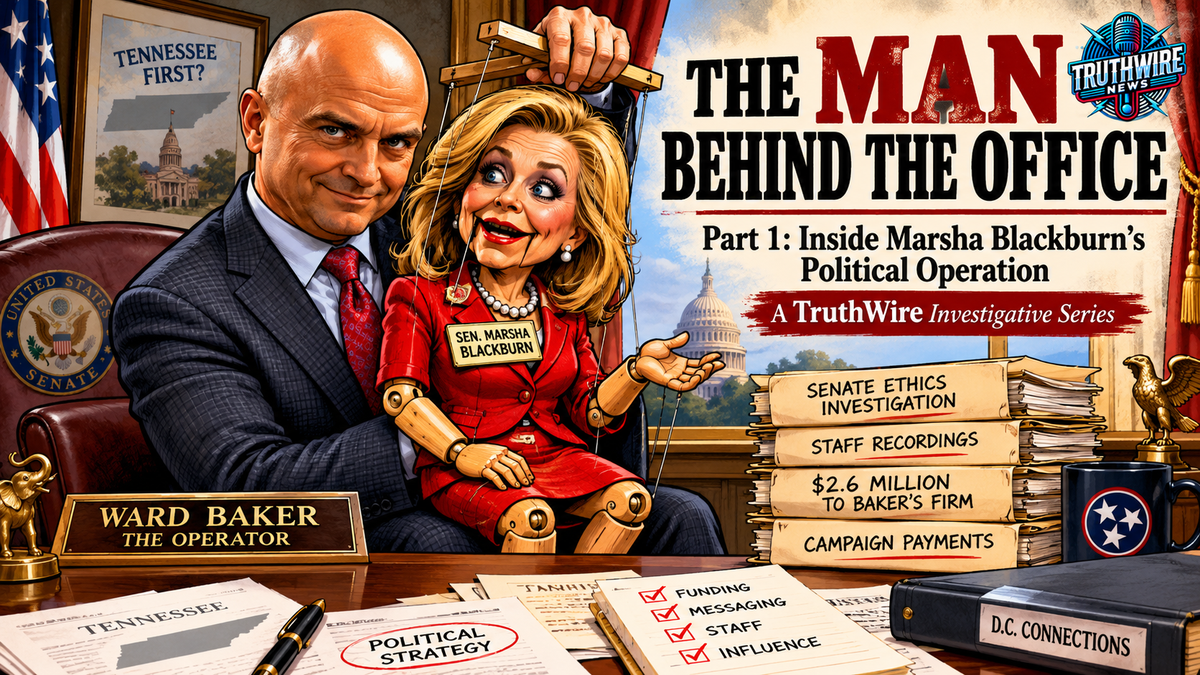
Senate staff recordings, an ethics investigation, and millions in campaign payments expose the political operation surrounding Blackburn—and the unelected strategist at its center.
5 Key Takeaways
1. Blackburn's Senate Office Faced an Ethics Investigation: A 2025 Senate Ethics Committee inquiry examined allegations that taxpayer-funded employees and resources were used for political campaign activities. Blackburn maintains the matter was resolved without disciplinary action.
2. Senate Staff Recordings Reveal Concerns About Baker's Influence: Recordings verified by NewsChannel 5 captured employees discussing political pressure, campaign expectations, and fears of retaliation, with Ward Baker repeatedly identified as an influential figure.
3. More Than $2.6 Million Paid to Baker's Firm: Campaign finance records compiled by WardBakersMess.com identify approximately $2.64 million in gross payments from Blackburn-affiliated political committees to The Baker Group between 2017 and 2026.
4. The Ethics Findings Remain Out of Public View: Despite Blackburn's assurances that the inquiry was resolved, correspondence detailing the committee's findings and any requested corrective measures has not been publicly released.
5. Baker's Influence Raises Questions About a Blackburn Administration: His longstanding role in Blackburn's political operation brings renewed attention to who would influence executive decisions, appointments, and political relationships if she becomes governor.
🚨👇 READ THE FULL ARTICLE BELOW FOR ALL THE DETAILS! 👇🚨
For more than two decades, political strategist Ward Baker has been a central figure in Marsha Blackburn's political operation, managing campaigns, directing strategy, and helping maintain the political infrastructure surrounding her career. As Blackburn seeks Tennessee's governorship, that longstanding relationship deserves far more scrutiny than it has received.
In July, Nashville's NewsChannel 5 revealed that Blackburn's Senate office had been investigated by the Senate Ethics Committee over allegations involving taxpayer-funded employees and political campaign activities. Days later, the station published excerpts from recorded conversations among Blackburn's own Senate employees, who described concerns about political pressure, campaign expectations, and Baker's influence over the operation. Meanwhile, campaign finance disclosures document millions of dollars in payments from Blackburn-affiliated political committees to Baker's consulting firm.
This information has been publicly available for months, much of it through investigative reporting by NewsChannel 5's Phil Williams and Ben Hall. A website called WardBakersMess.com has assembled those investigations alongside campaign finance records, public documents, and other reporting, including a previous TruthWire News investigation.
TruthWire is bringing that information together in a two-part series because the individual stories reveal something considerably larger when examined collectively: the extraordinary influence of an unelected political consultant operating alongside a woman seeking Tennessee's highest executive office.
The question voters should be asking extends beyond Blackburn's campaign promises. It concerns the operation behind the candidate, the influence Baker exercises within it, and whether Tennessee should expect the same political relationships and management practices to accompany Blackburn into the governor's office.
A Senate Ethics Investigation That Deserves More Answers
On July 15, 2026, NewsChannel 5 investigative reporter Phil Williams revealed that Blackburn's Senate office had been the subject of a confidential Senate Ethics Committee investigation in 2025. Investigators examined allegations that taxpayer-funded Senate employees and government resources had been used to advance Blackburn's political campaigns.
The inquiry included questions concerning the relationship between Senate staff members and Baker, Blackburn's longtime political strategist. Investigators examined whether employees were being pressured to participate in political activities while performing their official government responsibilities.
The distinction between those responsibilities is fundamental. Senate employees are paid by taxpayers to perform official duties on behalf of their constituents. Campaign employees are paid to advance a politician's electoral interests. When those responsibilities become intertwined, the public is entitled to know who authorized the activities, who directed the employees, and whether taxpayer resources were used appropriately.
Reports examined specific examples involving Blackburn's Senate field staff attending Republican county organization meetings during 2023, as her 2024 reelection campaign approached. The station found official travel reimbursements corresponding to dates on which staff members attended partisan political gatherings.
In Putnam County, photographs placed Senate staff member Blake Neely at a Republican Party meeting while official Senate expense records showed taxpayer-funded transportation and per diem charges for travel that day. Similar overlaps were reported involving Tyler Privette in DeKalb County and James Matthew Wyatt in Weakley County.
The investigation identified additional instances of official travel corresponding with Republican Party events across Tennessee. Those records provided a concrete basis for examining the concerns that had reached Senate ethics investigators.
Kedric Payne, general counsel and vice president of the nonpartisan Campaign Legal Center, explained to NewsChannel 5 that such circumstances raise ethics concerns requiring examination of the actual purposes and activities involved.
Blackburn's office acknowledged the investigation but denied wrongdoing. Her communications director, Audrey Cook, stated that the Senate Ethics Committee had completed its review and resolved the matter with the office's full cooperation. Blackburn subsequently characterized the complaint as politically motivated and maintained that no disciplinary action had resulted.
Yet the correspondence between her office and the committee has not been publicly released. Blackburn's explanation offers her characterization of the investigation's outcome, while the underlying documents that could provide a fuller account remain unavailable to the public.
That lack of transparency matters. An elected official whose taxpayer-funded office becomes the subject of an ethics inquiry should understand why constituents want to examine the findings for themselves, particularly when the allegations involve the use of public employees and resources for political purposes.
What Blackburn's Own Employees Were Saying
On July 20, Channel 5 published another investigation, this time based on recorded conversations among employees working inside Blackburn's Senate office.
Channel 5 obtained transcripts and subsequently listened to the recordings to verify their contents. The conversations, which were also reportedly provided to Senate ethics investigators, captured employees privately discussing their concerns as Blackburn prepared for her 2024 Senate reelection campaign.
The recordings are among the most revealing material in the investigation because they provide a window into how employees themselves described the operation.
According to the investigative report, employees discussed expectations surrounding political activities, concerns about being asked to perform campaign work, and the consequences they feared for refusing those demands. One senior employee expressed concern that official staff would be expected to perform political work rather than focus on their government responsibilities.
Another questioned why the campaign did not simply hire additional campaign employees instead of relying on Senate staff. The conversation turned to Baker, whose name surfaced repeatedly as employees discussed the expectations and pressures surrounding the campaign.
In one exchange, a senior employee suggested that Baker operated with a freedom from rules and restrictions that others did not enjoy. The discussions reflected frustration among employees who believed political expectations were affecting the responsibilities of the government office in which they worked.
These were private employee accounts, not formal findings of misconduct. Their significance lies in what they reveal about the concerns circulating inside Blackburn's own Senate operation, particularly regarding Baker's influence and the perceived consequences of resisting political demands.
NewsChannel 5 reported that the source who provided the material asked the station not to broadcast the actual recordings because of concerns about retaliation. The station also withheld the employees' identities.
That detail deserves attention. The employees' concerns extended beyond how campaign work was being handled. They also involved fear of the personal and professional consequences that could follow from speaking openly about what was happening.
The reporting presents a picture of an operation in which some government employees felt caught between their official responsibilities and the demands of Blackburn's political organization. Baker's repeated presence in those conversations makes his role an unavoidable part of the story.
What Did the Ethics Committee Actually Require?
Blackburn's office has repeatedly maintained that the Senate Ethics Committee resolved its inquiry without disciplinary action. Yet NewsChannel 5 reported that a person briefed on the investigation's outcome indicated the committee had planned to request a corrective action plan addressing problems within the office.
That is an important distinction. An inquiry can conclude without a formal public sanction while still identifying practices requiring correction. The presence or absence of disciplinary action is only one component of understanding what investigators found.
The public still lacks the correspondence needed to clarify what the committee communicated to Blackburn's office. Did investigators identify deficiencies in the separation between government and campaign activities? Were changes requested? What measures, if any, were implemented to address the concerns raised by employees?
Those are straightforward accountability questions arising from an investigation Blackburn's own office acknowledges occurred.
The unresolved issue is particularly relevant because Blackburn is now seeking an office with considerably broader executive responsibilities. The governor oversees state agencies, participates in major appointments, administers executive operations, and directs substantial government resources.
Understanding how Blackburn managed the boundaries between official duties and campaign activities during her Senate tenure is therefore directly relevant to evaluating the management and accountability practices she would bring to Tennessee's executive branch.
Following the Money: More Than $2.6 Million to Baker's Firm
The recorded employee concerns are one component of the story. Campaign finance records provide another.
According to a compilation of Federal Election Commission and Tennessee campaign finance disclosures assembled at WardBakersMess.com, Blackburn-affiliated committees reported approximately $2,638,040.72 in gross payments to The Baker Group LLC across 182 transactions between September 2017 and June 2026.
The disclosed transactions involve several Blackburn-associated political committees, including Marsha for Senate, Blackburn Tennessee Victory Fund, MARSHA PAC, and her Tennessee gubernatorial campaign.
The website provides links to the underlying filings, allowing readers to examine the reported transactions. The total represents gross payments to Baker's firm, including expenditures that may have covered advertising, travel, event costs, and other campaign expenses rather than consulting fees alone.
What the records establish is the substantial and sustained financial relationship between Blackburn's political operation and Baker's business. His firm has received payments across multiple election cycles and from multiple committees associated with Blackburn's political activities.
The compilation identifies recurring payments during late 2024 and early 2025, including combined monthly transactions totaling approximately $40,000 across several Blackburn-affiliated federal committees. It also identifies a February 2025 transaction of $210,242.82 involving The Baker Group, an expenditure whose precise purpose must be evaluated through the associated campaign filings.
The financial relationship was also examined in a March 25 Tennessee Lookout investigation.
TL reported that Blackburn's Senate campaign spent nearly $3.2 million between December 2024 and August 2025, following her successful Senate reelection and before the formal announcement of her gubernatorial campaign. Baker's firm and three colleagues reportedly received nearly $50,000 per month during 2025, broadly comparable to payments during Blackburn's preceding Senate election cycle.
The report also traced the movement of political personnel and consultants from Blackburn's federal political organization into her campaign for Tennessee governor.
Blackburn campaign manager Abigail Sigler defended the expenditures as lawful and routine, emphasizing that federal law permits a sitting senator to pursue state office while maintaining an active federal campaign committee.
The significance of the payments goes beyond their total dollar value. The financial disclosures demonstrate that Baker's consulting operation has been an integral and consistently compensated part of Blackburn's political infrastructure for years. That relationship provides context for the influence described by Senate employees in their recorded conversations.
The Unelected Figure at the Center of the Operation
Political consultants routinely advise campaigns, manage advertising, coordinate fundraising, and help candidates secure electoral victories. Baker's longstanding relationship with Blackburn, however, places him in a particularly consequential position as her political career approaches a possible transition from the U.S. Senate to the Tennessee governor's office.
His firm has received substantial payments from Blackburn-associated committees. Senate employees identified him in conversations concerning campaign expectations and political pressures. Investigative reporting has examined the relationship between Blackburn's official office and the political organization surrounding her.
Considered together, those facts demand a closer examination of where Baker's influence begins and ends.
The formal distinction between a political consultant and a public official is clear.
A consultant answers to the candidate or campaign employing him, while government employees have duties established by law and the responsibilities of their offices. The practical exercise of influence, however, depends on who makes decisions, who gives instructions, and whose approval is required within an organization.
That is why the recorded employee conversations matter. The issue is not merely whether Baker held an official Senate position. It is the influence employees attributed to him and the political expectations they described while working in taxpayer-funded roles.
The same questions become more significant when considering the governor's office. A governor's advisers and political associates can influence appointments, access, policy discussions, and relationships with legislators and outside organizations. Transparency about those relationships is essential because those advisers exercise influence without having received an independent electoral mandate.
In September, NewsChannel 5 investigative reporter Ben Hall examined concerns about Baker's prospective influence in a Blackburn administration. That investigation included allegations concerning consulting retainers, political relationships, and access to government decision-makers.
Those allegations form a central part of the second installment of this series, along with previously reported accounts involving political retaliation and the treatment of individuals who have challenged Blackburn's political operation.
What Tennesseans Should Be Asking
The significance of this history is not confined to a Senate ethics inquiry or the total amount paid to one consulting firm. It concerns the operation surrounding a candidate seeking control of Tennessee's executive branch and the influence exercised by individuals who answer directly to her rather than to the electorate.
Blackburn's office has acknowledged the ethics investigation and defended its handling of the matter. NewsChannel 5 has documented the existence of employee recordings, reported the concerns expressed within them, and examined official expense records. Campaign finance filings reveal the extensive financial relationship between Blackburn-affiliated committees and Baker's consulting business.
Together, those records establish a history that deserves examination as Blackburn seeks the governorship.
Tennessee voters are entitled to know who directs the political operation behind their prospective governor, how decisions are made, and whether the boundaries between public responsibilities and private political interests have been respected.
They are also entitled to understand whether the individuals who have exercised considerable influence over Blackburn's political career would continue occupying similarly influential positions in a gubernatorial administration.
For years, Baker has operated at the center of Blackburn's political organization. The Senate ethics inquiry and employee recordings have brought aspects of that relationship into public view, while campaign finance records reveal the financial structure supporting the operation.
The question moving forward is what that documented history tells Tennesseans about the people who would surround Blackburn in the governor's office.
Because voters elect the governor, not the political consultant standing behind the candidate. Understanding the relationship between the two is essential to understanding who would influence the decisions made on behalf of Tennessee.
In Part 2, TruthWire News will examine NewsChannel 5's reporting on allegations involving political access and consulting retainers, the accounts of former Blackburn staff members, claims of political retaliation, and the relationship between Baker's campaign operation and the governor's office Blackburn hopes to occupy.
Editor's note: This series compiles previously published investigative reporting, campaign finance disclosures, and source material assembled at WardBakersMess.com. Original reporting is attributed and linked throughout. TruthWire's October 15 investigation concerning allegations from a former Blackburn staff member will also be revisited in Part 2.
TruthWire exists to provide independent investigative journalism that holds Tennessee’s political establishment accountable.
Independent journalism depends on the support of readers who believe in that mission.
Your contributions help us continue investigating the issues, asking difficult questions, and reporting the stories that matter to Tennesseans. If you value our work, please consider becoming a monthly supporter. Every contribution makes a difference.