
WHY THE RUSH? New Ascension Crisis Raises Bigger Questions About Williamson Health Sale
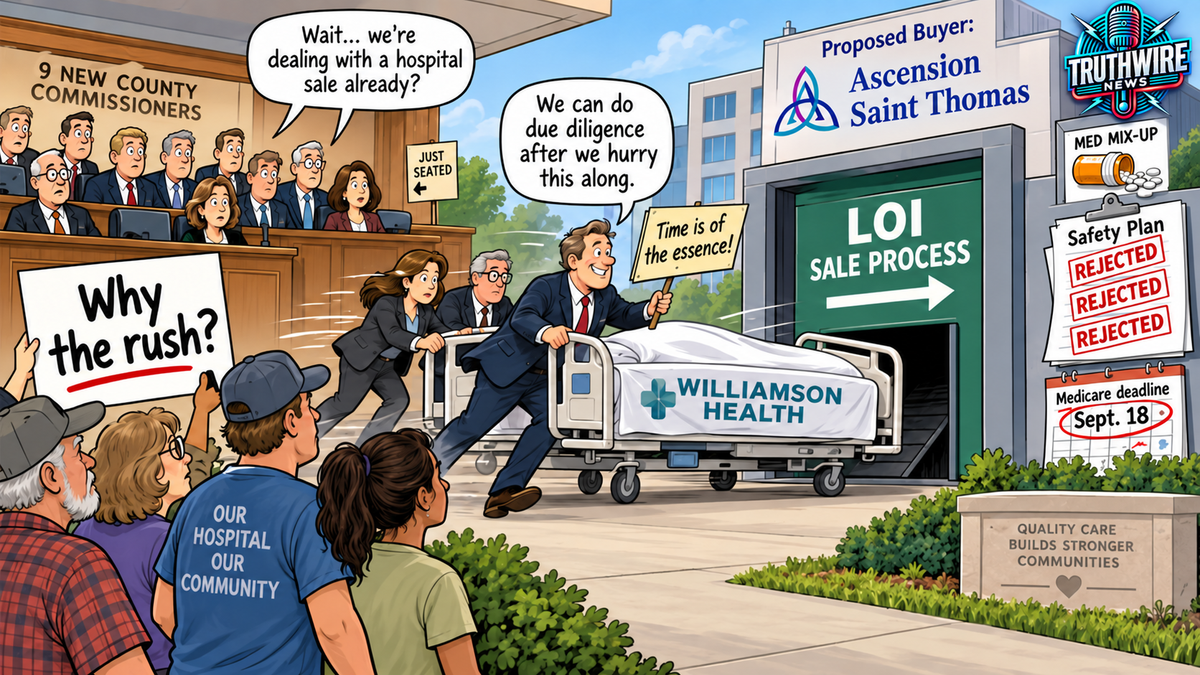
Williamson County votes tonight on advancing the $950M Williamson Health-Ascension deal as Ascension faces immediate-jeopardy findings, rejected safety plans and the possible loss of Medicare funding. The growing question: Why the rush?

5 TAKEAWAYS
- Williamson County commissioners meet tonight at 6 p.m. to consider authorizing a non-binding Letter of Intent with Ascension Saint Thomas.
- Ascension faces unresolved regulatory concerns following a medication error involving four patients at Saint Thomas Midtown.
- Midtown and Saint Thomas West face possible loss of Medicare participation September 18 if federal requirements are not satisfied.
- Questions about transparency preceded the Ascension crisis, including how much information the full County Commission received compared with elected officials serving on the hospital board.
- Tonight is not the final sale vote, leaving commissioners to decide whether advancing the LOI facilitates necessary due diligence or whether recent developments warrant additional time first.
A newly seated Williamson County Commission will consider advancing a nearly $1 billion hospital transaction tonight as the proposed buyer faces an unresolved patient-safety crisis, potential civil litigation and the possible loss of Medicare funding at two Nashville hospitals.
FRANKLIN, Tenn. — Williamson County commissioners will gather in a specially called meeting tonight to consider another significant step toward selling Williamson Health to Ascension Saint Thomas, but the circumstances surrounding the proposed buyer have changed considerably since the hospital board selected Ascension in July. Commissioners are not being asked to approve the final sale tonight; instead, they will consider authorizing newly seated County Mayor Andy Marshall to execute a non-binding Letter of Intent, along with a second resolution concerning the statutory treatment of proceeds from an eventual sale. The meeting begins at 6 p.m. in the auditorium of the Williamson County Administrative Complex, 1320 West Main Street in Franklin, and no other business may be conducted during the special-called meeting.
The question being raised by some residents and commissioners is whether recent developments involving Ascension, combined with longstanding concerns over transparency in the Williamson Health process, should give the county reason to take more time before moving further into the transaction. Those concerns did not begin with last month’s medication error, and they are not limited to whether Ascension can resolve its current regulatory problems. They go to the much larger issue of how Williamson County arrived at this point, how much information the full County Commission has had throughout the process, and whether a newly seated commission should be expected to move quickly on a transaction of this magnitude.
ASCENSION’S PROBLEMS HAVE GROWN SINCE JULY
On August 14, four joint-replacement patients at Ascension Saint Thomas Midtown mistakenly received potassium phosphate instead of the intended anesthetic medication, mepivacaine. Ascension has acknowledged the medication error, apologized to the patients and their families and said it self-reported the incident to regulators. The hospital says it has since implemented additional safeguards, including isolated storage of certain high-alert medications, mandatory escalation when spinal-medication scanning generates an alert and independent verification by a second pharmacist.
The resulting investigation went far beyond the actions of a single employee. State inspectors identified three findings of “immediate jeopardy” involving pharmacy services, surgical services and hospital governance, documenting multiple failures before and after the medication error. Inspectors concluded that the deficiencies had created a “culture of overall noncompliance.” Ascension submitted three separate corrective-action plans, but all three were deemed unacceptable because regulators said they lacked enough information to demonstrate that the underlying safety problems had been corrected.
The regulatory stakes have now become significantly higher. Recent reporting revealed that Ascension Saint Thomas Midtown and Saint Thomas West face possible termination of their Medicare provider agreement on September 18 if Ascension cannot satisfy state and federal regulators that the immediate-jeopardy conditions have been corrected. Because Midtown operates under the same Medicare provider agreement as Saint Thomas West, both facilities are affected, and the potential loss of such a substantial reimbursement stream could place enormous financial pressure on both hospitals.
What means, is Williamson County is being asked to advance negotiations with a hospital system dealing simultaneously with severe patient injuries, unresolved federal and state safety concerns and an active TBI investigation. The four injured patients also create the possibility of substantial civil litigation, adding another layer of uncertainty that was not part of the information available when the Williamson Health Board selected Ascension in July.
TRANSPARENCY QUESTIONS PRECEDED THE MEDICATION ERROR
The Ascension crisis is not the beginning of the debate over the Williamson Health sale. TruthWire has been reporting on questions surrounding transparency, access to information and the relationship between the Williamson Health Board and the County Commission since well before Ascension was selected. In October 2025, TruthWire reported that while Williamson Health publicly described the effort as a strategic “exploration,” consultants had already been screening potential bidders before the public or full County Commission understood how far the process had progressed.
The governance structure has complicated those concerns. Several elected county officials have served simultaneously on the Williamson Health Board while the full 24-member County Commission retains the ultimate authority to approve a change in ownership. That means some elected officials were inside the hospital board process while other commissioners were being asked to exercise oversight over a process in which they had considerably less involvement, creating persistent questions about whether the entire commission was operating with the same information.
Those concerns became more pronounced in November 2025 when the commission debated legal representation surrounding a possible sale. TruthWire reported that commissioners were asked to approve the hourly rate for outside mergers-and-acquisitions counsel they had not selected, while questions also surfaced about the county attorney’s simultaneous representation of the County Commission and hospital board, conflict waivers and whether commissioners should have access to truly independent counsel of their own. The debate was not simply over which lawyer would be paid; it raised a larger question about who was independently representing the interests of the commission and taxpayers as the hospital process moved forward.
By March, the process had advanced considerably, yet another unresolved question remained. In 2011, the Williamson County Commission passed Resolution 6-11-12 by an 18-3 vote, declaring that Williamson Medical Center was “not surplus property and is not for sale.” TruthWire reported in March that the resolution had not been rescinded even as an active bidding process was underway, raising the question of why the county was proceeding toward a potential transaction without first formally revisiting the policy adopted by an earlier commission.
As the process moved toward a recommendation, questions also emerged about what commissioners knew and when they knew it. Earlier this year, commissioners publicly questioned basic information including the hospital’s valuation, who was bidding and how proceeds from a sale might ultimately be used. By the time the hospital board publicly recommended Ascension, residents and commissioners were learning many of the transaction’s major details essentially alongside the recommendation itself. TruthWire’s July reporting emphasized that the hospital board’s selection of Ascension was only a recommendation and that the next stage required greater transparency, oversight and public accountability.
THIS IS NOT A DISTRESSED HOSPITAL FIRE SALE
That history matters because Williamson Health is not presently being described as a hospital in an immediate financial emergency. Hospital officials have said the system is currently stable but face longer-term challenges from changing reimbursements, staffing pressures, competition and other healthcare-industry trends. The argument for a transaction has therefore centered primarily on the system’s future needs and access to capital rather than an imminent inability to continue operating.
That distinction should matter when evaluating the urgency surrounding tonight’s vote. Williamson County is considering the possible transfer of a major community healthcare asset through a transaction valued at approximately $950 million, including roughly $700 million in purchase consideration and additional commitments. Selling such an asset is fundamentally different from entering an agreement that can easily be reversed later, particularly when the hospital being sold remains an important healthcare provider and significant economic asset for the county.
THE MONEY ADDS ANOTHER LAYER
The debate has never been limited to who might buy Williamson Health. TruthWire has also examined what happens to potentially hundreds of millions of dollars after a sale and the legislative changes that altered how those proceeds could be handled. Commissioner Gregg Lawrence previously described the potential transaction as the largest financial transaction in county history, while legislation passed this year expanded the County Commission’s authority over how proceeds could be used.
That issue is particularly relevant in a county carrying substantial bonded debt and facing major future capital needs. The legislation does not simply dictate that proceeds must be used to eliminate county debt; rather, it provides the commission with broad authority, subject to the required voting threshold, to determine how those funds are ultimately deployed. That means a decision to sell Williamson Health is not simply a healthcare decision. It could reshape county finances for decades.
THE ARGUMENT FOR MOVING FORWARD — AND FOR WAITING
Supporters of advancing the LOI argue that signing it is not equivalent to selling the hospital and could actually provide the county with greater access to the information necessary to investigate Ascension. According to recent reports, Commissioner Brian Clifford has said the LOI would allow Williamson County to conduct deeper due diligence into issues such as patient safety and risk management before commissioners ever consider a definitive sale agreement. That argument rests on the idea that advancing the preliminary agreement places the county in a better position to require information rather than committing it to a final transaction.
Other commissioners have questioned why that examination should not occur before the county advances further into the Ascension transaction. Former Commissioner Lisa Hayes publicly questioned repeated assertions that “time is of the essence,” while Commissioner Barb Sturgeon asked why commissioners were not receiving a comparable opportunity to question HCA. Jody Todd also expressed concern about entering even a preliminary agreement while the investigation surrounding Ascension remained unresolved.
Tonight’s meeting therefore presents a broader question than whether Ascension submitted the strongest proposal when the hospital board completed its review. Commissioners must consider whether the circumstances that existed when Ascension was selected remain sufficiently unchanged to continue on the same timetable, particularly as a new mayor and nine new commissioners inherit a process largely developed before they took office. Recent developments do not automatically establish that Ascension is no longer the best option, but they do provide commissioners with significant new information that did not exist when the original recommendation was made.
The LOI may be non-binding, but the eventual consequences of selling Williamson Health would not be. After a process that has already generated public questions about transparency, legal representation, oversight, the county’s longstanding “not for sale” policy and control of the proceeds, the latest crisis surrounding the proposed buyer adds another reason for commissioners to closely examine whether the pace of the process still makes sense.
MAKE YOUR VOICE HEARD BEFORE TONIGHT’S MEETING
Residents who want to share questions or concerns about the proposed Williamson Health transaction can contact all 24 Williamson County Commissioners at once by emailing County.Commissioners@williamsoncounty-tn.gov. Tonight’s specially called meeting begins at 6 p.m. in the auditorium of the Williamson County Administrative Complex at 1320 West Main Street in Franklin.
TruthWire exists to provide independent investigative journalism that holds Tennessee's political establishment accountable. We aren't funded by corporations, political parties, or large media companies. We're funded by readers who believe the truth is worth defending.
If this reporting has informed you or helped your community, please consider becoming a monthly supporter.