
Campaign Finance Review Finds Pattern of Misreported Occupations, PAC Funding, and Concentrated Family Contributions in Perry Keenan Campaign
TruthWire reviewed Perry Keenan's campaign finance reports, finding repeated occupation discrepancies, significant PAC funding, and concentrated family donations. We examine what Tennessee law requires and why accurate disclosures matter to voters.
TruthWire | We don't just tell you what happened. We tell you why it matters.
5 Key Takeaways
- Campaign finance reports are legal disclosure documents. Candidates and campaign treasurers are responsible for accurately reporting contributor information, including occupation and employer when required by Tennessee law.
- TruthWire identified multiple occupation discrepancies. Several contributors were reported as "Retired" or "Homemaker," despite public records showing they remain active judges, attorneys, business owners, engineers, and other professionals.
- PACs played a significant role in campaign funding. Perry Keenan's campaign received more than $16,000 from Political Action Committees and organized political interests, providing voters with insight into institutional financial support.
- A small number of families contributed substantial sums. While legal under Tennessee law, coordinated household donations from a handful of families accounted for a significant share of the campaign's fundraising, illustrating how political influence can be concentrated.
- Transparency is the purpose of campaign finance law. Accurate disclosures allow voters to understand who is financing candidates and evaluate potential influences. Whether the reporting discrepancies warrant amended filings or other action is a matter for the Tennessee Registry of Election Finance to determine.
Campaign finance reports are more than fundraising summaries. They are legal disclosure documents filed with the Tennessee Registry of Election Finance under penalty of law. Tennessee campaign finance law requires candidates and campaign treasurers to accurately disclose contributor information, including a contributor's occupation and employer once contributions exceed the statutory reporting threshold. Those reports become public records and are intended to provide voters with transparency into who is financing political campaigns.
The responsibility for filing complete and accurate reports ultimately rests with the candidate and campaign treasurer. If reports contain inaccurate or incomplete information, the Tennessee Registry of Election Finance has the authority to require amended reports and assess civil penalties for violations.
Why this matters: Campaign finance reports are only as valuable as the accuracy of the information they contain. Voters rely on those disclosures to understand who is financially supporting candidates, identify potential conflicts of interest, and evaluate the interests surrounding a campaign.
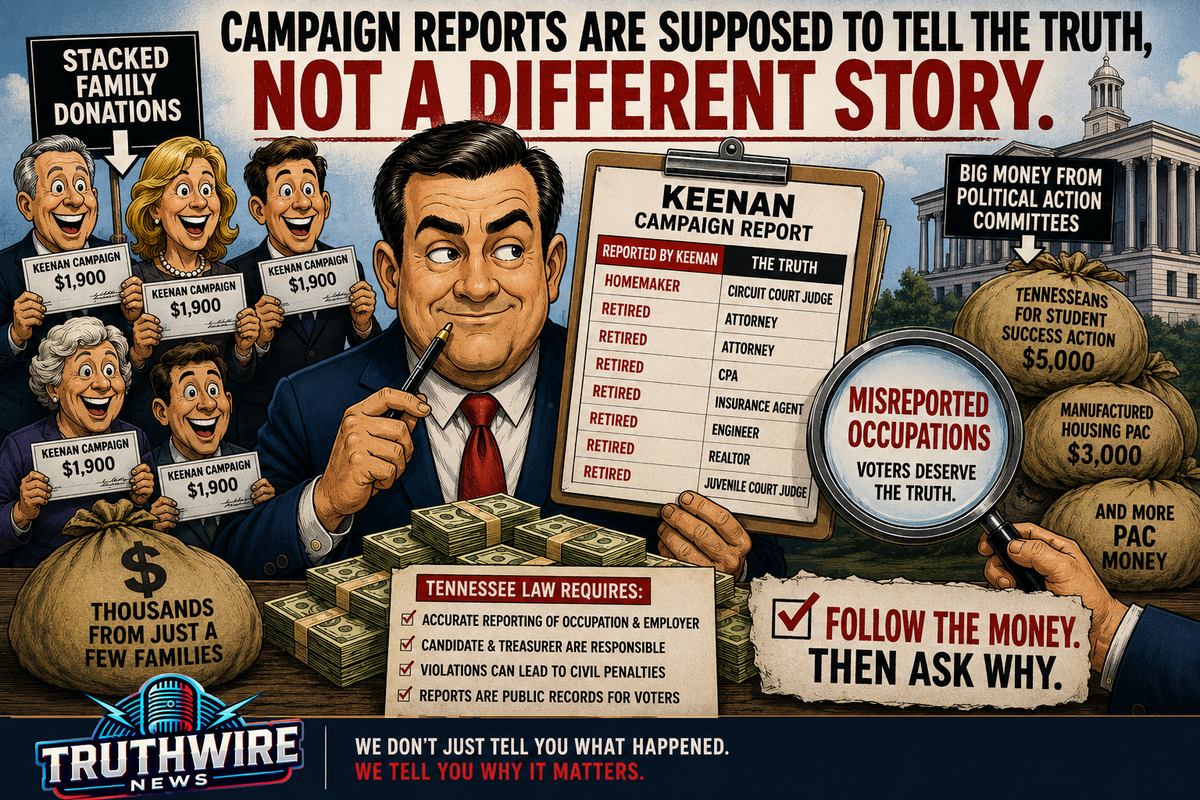
A TruthWire review of Perry Keenan's (current Republican candidate for House District 78, recently vacated by Mary Littleton, being challenged in the primary by grassroots conservative John Louallen) campaign finance reports identified a recurring pattern involving contributors reported as either "Retired" or "Homemaker," despite public records showing many remain actively employed in professional or public service positions.
TruthWire independently verified these occupations through public court records, professional licensing databases, business records, and previous campaign finance disclosures filed with the Tennessee Registry of Election Finance.
Contributors Reported by the Keenan Campaign
| Contributor | Reported by Keenan | Verified Occupation |
|---|---|---|
| Suzanne Lockert Mash | Homemaker | Circuit Court Judge |
| Brian Ragan | Retired | Attorney, Dickson County Attorney |
| Leslie Ann Benmark | Retired | Attorney |
| Valerie Kemp | Retired | Certified Public Accountant |
| Michael Petty | Retired | Insurance Agent |
| Darrell James | Retired | Engineer |
| Johnny Lindahl | Retired | Realtor |
| Jerred Creasy | Retired | Juvenile Court Judge |
Any single discrepancy could reasonably be explained as a clerical mistake. However, the repeated appearance of judges, attorneys, licensed professionals, business owners, engineers, and public officials being reported as retired or homemakers suggests a broader pattern rather than an isolated error.
TruthWire cannot determine from the filings alone whether these discrepancies originated with the contributors themselves, with campaign staff, or through another reporting error. That determination ultimately belongs to the Tennessee Registry of Election Finance. What the records do establish is that multiple occupation disclosures do not match independently verifiable public records.
Why this matters: Tennessee's disclosure requirements are not intended to provide general descriptions or estimates. They exist to give voters an accurate picture of who is financially supporting candidates. Reporting a sitting judge, practicing attorney, licensed Realtor, or active business owner as retired or a homemaker materially changes how the public may perceive a campaign's financial support.
The reports also reveal who helped finance Keenan's campaign through organized political interests.
TruthWire identified $16,250 in contributions from Political Action Committees and political organizations.
PAC Contributions to Perry Keenan
| Political Action Committee | Amount |
|---|---|
| Tennesseans for Student Success Action | $5,000 |
| Tennessee Manufactured Housing Association PAC | $3,000 |
| Lamberth PAC | $2,500 |
| JCB PAC | $1,500 |
| Tennessee Chamber of Commerce and Industry PAC | $1,000 |
| Tennessee First | $1,000 |
| Priority on Demand PAC | $1,000 |
| Wholesalers Association PAC | $750 |
| BIV PAC | $500 |
None of these contributions appear to exceed Tennessee's legal contribution limits.
Why this matters: Political Action Committees exist to pool contributions from individuals and organizations with common policy interests. There is nothing inherently improper about accepting PAC support. However, these disclosures provide voters with important context by identifying which organized interests have chosen to invest financially in a campaign.
The filings also reveal another common feature of modern campaign finance, concentrated household giving.
Five members of the Lindahl family contributed a combined $17,500. Members of the Bolton household contributed $7,600, the Scott household $7,000, and the O'Neil household $5,900. Together, a relatively small number of families accounted for a substantial portion of the campaign's reported fundraising.
Largest Family Contributions
| Family | Total Contributions |
|---|---|
| Lindahl | $17,500 |
| Bolton | $7,600 |
| Scott | $7,000 |
| O'Neil | $5,900 |
There is nothing in the campaign finance reports indicating these family contributions violate Tennessee law. Each individual is permitted to contribute up to the legal limit.
Why this matters: While lawful, coordinated household giving illustrates one of the realities of modern campaign finance. Contribution limits apply to individuals, not households. As a result, families with greater financial resources can legally multiply their political influence through separate maximum contributions made by spouses and family members. Campaign finance reports provide voters with the information necessary to decide whether that reflects the type of representation they want in elected office.
Campaign finance laws are built on a simple principle, transparency. Their purpose is not to discourage political participation or lawful fundraising. Their purpose is to ensure the public can accurately evaluate who is financing candidates seeking public office.
The records reviewed by TruthWire reveal three distinct patterns. Multiple contributors appear to have been reported with occupations that do not match verifiable public records. Institutional political organizations contributed more than $16,000 through Political Action Committees. Finally, a significant share of campaign fundraising came from coordinated contributions made by a relatively small number of families.
TruthWire has reached out to Keenan with a request for comment and as of this publication has not received any response. Any updates to this story will be added as they develop.
Whether the Tennessee Registry of Election Finance ultimately determines these reporting discrepancies warrant amended filings, civil penalties, or no action at all remains within the Registry's authority. What the public record already establishes is that multiple occupation disclosures in the Keenan campaign filings do not align with independently verifiable records.
That is precisely why campaign finance transparency matters. It allows voters to see beyond campaign slogans and evaluate the facts for themselves.
If you want to support what we do, please consider donating a gift in order to sustain free, independent, and TRULY CONSERVATIVE media that is focused on Middle Tennessee and BEYOND!

Comments ()