The Baker Influence, Part 2: The Man Behind the Office
In Part 2 of our series, The Baker Influence, TruthWire examines allegations of political retaliation, paid access, anti-Trump alliances, and millions spent attacking David Hatley, raising questions about Ward Baker's power in a Blackburn administration.

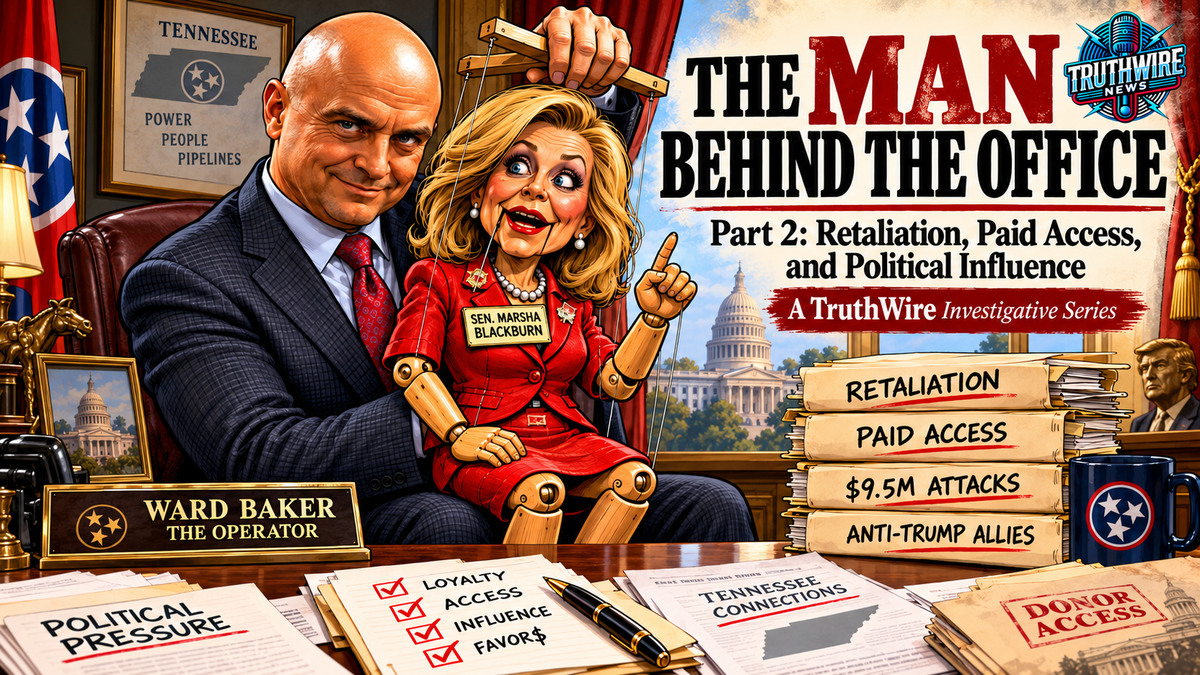
From allegations of political retaliation and paid access to millions spent attacking an opponent's past, the record surrounding Marsha Blackburn's longtime strategist raises questions about influence, accountability, and the standards applied to political opponents.
5 Key Takeaways
1. Allegations of Pay-to-Play Access: Political commentator Steve Gill alleges businesses were encouraged to pay $20,000–$25,000 monthly retainers for access to Ward Baker and a potential Blackburn administration.
2. Political Loyalty Over Public Service: Former Senate staff and local officials have alleged intimidation, retaliation, and threats involving constituent services and government funding for those unwilling to demonstrate political loyalty.
3. Nearly $10 Million Attacking Hatley: Outside groups have spent approximately $9.5 million targeting David Hatley's past, while serious questions surrounding Baker's political operation and the Senate ethics investigation remain unanswered.
4. Anti-Trump Establishment Connections: Baker's 2015 memorandum advised Republicans to capitalize on Trump's voters while distancing themselves from Trump. Organizations that invested in alternatives to Trump are now providing significant political and financial support for Blackburn.
5. An Unelected Power Center in the Governor's Office: Baker's influence over Blackburn's political operation raises questions about who would exercise power in a Blackburn administration, particularly if a politically compliant legislature fails to provide meaningful oversight.
🚨👇 READ THE FULL ARTICLE BELOW FOR ALL THE DETAILS! 👇🚨
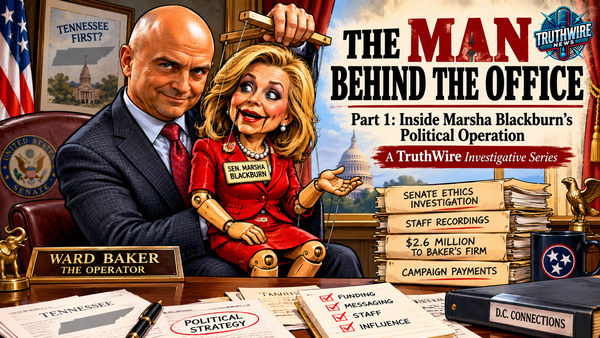
In Part 1 of this series, TruthWire News examined the political operation surrounding U.S. Senator Marsha Blackburn, including a previously undisclosed Senate ethics investigation, recorded conversations among Senate employees, and more than $2.6 million in reported campaign payments to her longtime political strategist Ward Baker's consulting firm.
Those revelations established the extensive financial relationship between Blackburn and Baker and documented concerns among Senate employees about political pressure and the separation of official government responsibilities from campaign activities. But the allegations surrounding Baker extend well beyond Blackburn's Senate office.
Investigations by Nashville's NewsChannel 5, disclosures from former Senate staff, and public campaign finance records have raised questions about the political relationships Baker maintains, the treatment of individuals who challenge Blackburn's operation, and the influence he could exercise inside Tennessee's executive branch.
There is also a striking contrast between the scrutiny Blackburn's campaign has directed toward independent gubernatorial candidate David Hatley's decades-old personal struggles and the questions surrounding the political operation attacking him. While Hatley's past has become the subject of a dedicated campaign website and millions of dollars in attack advertising, the public is still waiting for answers concerning the conduct and influence of those operating behind Blackburn.
Much of this information has already been reported. WardBakersMess.com has compiled the underlying investigations, records, and related reporting, including TruthWire's own October 15 investigation. This series brings that material together to examine the operation surrounding Blackburn as she seeks an office with considerably greater executive authority.
The question is what happens when a political strategist accused of intimidation, retaliation, and wielding influence over taxpayer-funded Senate employees follows his candidate into the governor's office, where the authority, resources, and potential consequences are exponentially greater. Tennessee voters deserve to know whether they are electing Marsha Blackburn to govern or handing Ward Baker a far more powerful operation to control.
The Consultant Who Could Control Access
On September 18, NewsChannel 5 investigative reporter Ben Hall examined concerns about Baker's prospective influence in a Blackburn administration.
Steve Gill, editor and publisher of TriStar Daily, told Hall that Baker was the driving force behind Blackburn's gubernatorial campaign and would occupy an enormously influential position if she became governor.
Gill's concerns centered on access to the governor's office and the financial relationships Baker could maintain with private interests seeking to influence state policy.
According to Gill, companies and lobbying firms were being encouraged to establish consulting retainers of $20,000 to $25,000 per month with Baker or his firm in anticipation of a Blackburn administration.
The allegation introduces an important question about political access. Lobbyists operating under Tennessee law face registration and disclosure obligations. Political consultants occupy a different position, and their private client relationships are not necessarily subject to the same disclosure requirements.
That distinction creates a transparency problem when a consultant with significant influence over an elected official also maintains undisclosed business relationships with companies seeking favorable government decisions.
Gill identified potential areas of concern involving artificial intelligence data centers, automated license-plate recognition technology, and other industries with substantial interests before Tennessee policymakers. He questioned whether the public would know which businesses were paying individuals with close access to the governor.
The reported retainers have not been established through publicly identified payments or contracts. The allegations nevertheless identify a concrete accountability question: whether private business relationships could become an avenue for privileged political access.
NewsChannel 5 contacted Baker, his firm, and Blackburn's campaign with Gill's allegations. According to the September investigation, none responded.
Political Support and the Alleged Price of Disloyalty
Gill's allegations extended beyond consulting retainers.
He described an incident involving a lobbying firm that reportedly hesitated to contribute to Blackburn's campaign during the contested Republican primary. According to Gill, the firm subsequently attempted to provide the requested contribution, only to have it returned.
Gill characterized the message as a warning that organizations unwilling to support the campaign should not expect a place within its political network after an electoral victory.
That account describes a potential relationship between campaign loyalty and access to public officials. For businesses seeking permits, regulatory decisions, contracts, or legislative action, access to the executive branch carries substantial financial implications.
The distinction between political relationships and government obligations matters because taxpayers, local communities, and businesses are entitled to decisions based on governing law and public responsibilities.
The allegations also raise questions about the influence of individuals whose authority comes from their relationships with elected officials rather than from a public position carrying defined duties and disclosure requirements.
Those concerns become more consequential when examined alongside allegations previously reported by TruthWire concerning the treatment of government employees and local officials.
A Former Senate Staffer Describes Political Interference
On October 15, independent gubernatorial candidate Lauren Pinkston held a press conference presenting allegations from a former member of Blackburn's Senate staff.
As TruthWire News reported at the time, the former employee described an office environment in which Baker exercised significant influence over official operations and political considerations allegedly interfered with constituent services.
The former employee's letter identified two troubling incidents involving major tragedies affecting Tennessee communities.
Following the March 2023 shooting at Nashville's Covenant School, which claimed the lives of three children and three adults, the former staffer alleged that employees were reprimanded by Baker for working with Democrats on a response to the tragedy.
The second allegation concerned the aftermath of Hurricane Helene in September 2024. According to the former employee, Senate staff working alongside local officials and emergency management personnel were reprimanded for providing equal attention to affected communities rather than concentrating their efforts on Republican strongholds identified by Baker.
Both allegations concern the responsibility of a public office to serve constituents regardless of partisan affiliation.
Constituent services, disaster assistance, and responses to public tragedies are official government functions. Political preference has no legitimate role in determining whose suffering deserves attention.
Pinkston said she verified the former employee's identity and employment history before releasing the allegations. The employee's identity was withheld because of concerns about retaliation. The specific allegations have not been independently corroborated through publicly released internal communications.
The accounts nevertheless describe conduct that could be investigated through correspondence, personnel records, and additional witness testimony.
They also echo concerns documented in NewsChannel 5's July investigation into recorded conversations among Blackburn's Senate employees.
In those recordings, employees discussed political expectations, concerns about performing campaign work, and the professional consequences they feared for resisting pressure. Baker was repeatedly identified as an influential figure.
The recurring question is why a private political strategist featured so prominently in employees' descriptions of pressure surrounding taxpayer-funded government responsibilities.
When Local Government Funding Becomes a Political Question
Pinkston's October 15 disclosures also included accounts she said were provided by county mayors, municipal officials, nonprofit representatives, and government employees concerned about political retaliation.
According to Pinkston, a Middle Tennessee county mayor reported being warned that his county would receive no funding under a Blackburn administration unless he publicly supported her during the Republican primary.
Other accounts described local officials and nonprofit representatives who reportedly feared financial consequences for failing to demonstrate political loyalty.
One mayor allegedly described feeling trapped between his personal political convictions and his responsibility to protect his community's interests.
The officials involved have not publicly identified themselves, and the reported warnings have not been established through independently released recordings or written communications. Their allegations nevertheless describe a troubling potential use of political influence: treating public resources as leverage in disputes over campaign allegiance.
Local governments depend on state appropriations, grants, infrastructure assistance, and relationships with executive agencies. Decisions affecting those resources have consequences for roads, schools, public safety, economic development, and essential services.
A governor's formal authority is limited by Tennessee law and the General Assembly's control over appropriations. But those constitutional safeguards depend on legislators willing to exercise their independence. If lawmakers become little more than a rubber stamp for the governor's office, whether out of political allegiance or fear of retaliation, the very institution intended to provide oversight becomes an extension of the executive branch. That prospect is particularly troubling given the allegations surrounding Baker's use of political pressure and loyalty as instruments of influence. A compliant legislature would leave fewer meaningful obstacles to the political operation surrounding the governor, allowing its influence to extend well beyond the executive branch and into the decisions affecting every Tennessee community.
The principle is straightforward. State government exists to serve Tennesseans, including those who opposed the governor's election.
Nearly $10 Million to Attack Hatley's Past
While questions surrounding Baker's political influence remain unresolved, Blackburn's campaign and outside groups have devoted enormous resources to scrutinizing David Hatley's personal history.
The campaign established DeadbeatDave.com, a website targeting Hatley's 1998 criminal conviction, financial difficulties, bankruptcy, and related controversies. The website was paid for and authorized by Marsha for Governor.
The attacks have also received substantial financial support from outside organizations.
In an October 30 investigation, Tennessee Lookout reporter Adam Friedman documented nearly $10 million in independent expenditures targeting Hatley. According to the report, the Tennessee Freedom Fund spent approximately $3 million, while the Choose Freedom Fund spent approximately $6.5 million.
The Lookout traced financial relationships involving the Tennessee Freedom Fund, Blackburn's Senate campaign account, billionaire Jeff Yass, and the pro-Blackburn Team Tennessee PAC. The publication also identified contributions associated with business interests including Advance Financial and Reynolds America.
The funding behind Choose Freedom was more difficult to trace. Friedman reported that the committee received millions from a related nonprofit organization whose ultimate donors were not publicly identifiable through the available campaign finance disclosures.
The report documented how Choose Freedom received $4.2 million on September 18 and spent that amount on advertisements attacking Hatley over financial legal matters dating to the 1990s. Another $2.3 million arrived October 13 and was spent that same day on additional advertisements.
Brendan Glavin of OpenSecrets told the Lookout that the structure created distance between the ultimate funding source and the partisan purpose of the advertisements.
The spending reflects the enormous financial resources committed to scrutinizing Hatley's past. Ward Baker's longstanding position at the center of Blackburn's political strategy is especially relevant to understanding the campaign environment in which those attacks have taken place.
Blackburn's campaign independently authorized its own website attacking Hatley. That direct involvement establishes the campaign's decision to make his personal history a prominent election issue.
And the financial scale is remarkable. Nearly $10 million in outside spending has been directed toward attacking an independent candidate's past, much of it involving events nearly three decades old.
Hatley has publicly discussed his conviction and financial difficulties, including in his autobiography, Tested in Tennessee. Those events are part of his public record, and voters can examine them alongside his subsequent business activities and policy positions.
But the campaign's emphasis on personal history raises another question: What standard of scrutiny should apply to those running the operation responsible for the attacks?
Personal Struggles for Thee, but Not for Me?
The attacks on Hatley have extended beyond his criminal conviction and financial history into deeply personal matters.
Political commentary surrounding the campaign has included discussion of a purported domestic 911 call involving Hatley's family during a difficult period of his life. The use of private family circumstances as campaign material raises questions about the boundaries between legitimate public scrutiny and political exploitation.
The broader question concerns how private personal struggles are used in political campaigns. Public office invites scrutiny, but the public interest in a candidate's history should be evaluated through accurate facts and a meaningful connection to the responsibilities of the office.
Baker has spent more than two decades helping direct the political operation now making Hatley's personal struggles an election issue. His influence over Blackburn's campaign, his financial relationships, and the allegations surrounding his treatment of political opponents and government employees deserve at least the same level of scrutiny. A political strategist cannot reasonably expect the public to examine every painful chapter of an opponent's life while treating questions about his own record and conduct as irrelevant.
A 1998 Marine Corps Physical Evaluation Board document provided to TruthWire identifies Ward A. Baker and records a recommendation for separation from active duty with severance pay following a finding of medical unfitness. That recommendation is part of the historical record presented for examination; the document does not establish a disciplinary discharge or the final terms of his separation. Its significance here is the question of consistent scrutiny, rather than an assertion that a past medical condition reflects on Baker's current professional conduct.
The contrast becomes more striking when the discussion returns to matters directly involving public responsibilities. Hatley's private struggles have been repeatedly featured in political advertising, while the public still lacks the correspondence detailing the outcome of the Senate ethics investigation involving Blackburn's office. Recorded employee conversations, substantial campaign payments, and allegations of political pressure have raised questions about Baker's influence that demand substantive answers.
These issues concern taxpayer-funded employees, government resources, campaign finances, and access to public officials. They reach directly into the operation of government and the responsibility of those exercising political influence over public institutions.
If a campaign intends to make character and accountability central to an election, those standards must apply to its own leadership. Selective scrutiny turns a legitimate examination of the public record into a political weapon, particularly when deeply personal experiences receive more attention than unresolved questions about the exercise of public power.
Ward Baker's Anti-Trump History: Disdain for the Candidate, Appreciation for His Voters
Ward Baker's relationship with Trump's political movement has always presented an interesting contrast between ideological enthusiasm and electoral calculation. In a 2015 memorandum obtained by The Washington Post, the then-executive director of the National Republican Senatorial Committee characterized Trump as a “misguided missile,” described his controversies as “farcical fits,” and advised Republican candidates to distance themselves from his inflammatory statements. At the same time, Baker recommended capitalizing on Trump's populist appeal without alienating his supporters. Apparently, the voters were considerably more attractive than the man inspiring them.
A decade later, Blackburn's gubernatorial campaign enjoys support from organizations with their own histories of opposing Trump's political ambitions. The Koch-backed Americans for Prosperity Action endorsed Nikki Haley in 2023, investing resources in an alternative to Trump. Its affiliated Americans for Prosperity State PAC endorsed Blackburn in February 2026 and subsequently reported knocking on tens of thousands of Tennessee doors while working to elect legislators supportive of her administration. The network's political alliances have changed, but its investment in shaping Republican leadership continues.
Club for Growth offers another example. After commissioning polling in 2023 examining Trump's vulnerability against Ron DeSantis, the organization later reconciled with Trump and endorsed Blackburn for governor. More revealing is the money trail. As Tennessee Lookout reported, Blackburn's Senate campaign transferred $4.8 million to Club for Growth Action in May 2026, followed by approximately $4.81 million in spending supporting her gubernatorial campaign by the closely connected Tennessee Freedom Fund. That is considerably more than a friendly endorsement.
The contrast is difficult to overlook. Baker's 2015 playbook recognized the political benefits of Trump's popularity while recommending strategic distance from the candidate. Blackburn's campaign today embraces the Trump-era Republican electorate while maintaining substantial relationships with establishment organizations that previously sought alternatives to him. Whatever their current alliances, their financial involvement and policy priorities are part of the political operation voters are entitled to examine.
The larger question is whose interests carry weight when campaign alliances become governing relationships. Trump's popularity, Baker's political strategy, and the priorities of national donor organizations are distinct forces within the Republican coalition. Understanding how those interests intersect is essential to examining who would exercise influence within a Blackburn administration.
Who Would Answer to Whom?
The question facing Tennessee voters is not whether Ward Baker is an influential consultant. That has been established through years of campaign work, millions of dollars in payments, and the accounts of people who have worked inside Blackburn's political operation. The more consequential question is how much authority an unelected political operative would exercise once the machinery of a statewide campaign is replaced by the considerably greater power of the governor's office.
The allegations compiled in this series describe an operation in which political loyalty is treated as an obligation and resistance carries consequences. Senate employees have described pressure surrounding campaign activities. A former staffer has accused Baker of interfering with constituent services during tragedies. Local officials, according to Pinkston's disclosures, have expressed fears that refusing to support Blackburn could jeopardize funding for their communities. Steve Gill has raised allegations involving expensive private consulting arrangements and privileged access to a prospective administration.
These are not complaints about ordinary campaign hardball. They concern the boundary between political influence and government authority, particularly when public employees, government resources, and the interests of entire communities become entangled in partisan expectations.
Baker does not need to hold elected office to exercise enormous influence over an administration. Control over political access, relationships with donors, recommendations for appointments, and the governor's political agenda can place a powerful consultant at the center of decisions without subjecting him to the direct accountability voters impose on elected officials. Add a General Assembly unwilling to challenge the governor, and the checks designed to restrain executive power become far less effective in practice.
That is the larger concern surrounding a Blackburn administration. If the allegations about intimidation and retaliation reflect how Baker has operated within a Senate office and campaign organization, expanding his influence into Tennessee's executive branch would raise the stakes considerably. Decisions about public appointments, agency priorities, government contracts, and the distribution of resources would affect millions of Tennesseans, including those who refused to support the campaign.
The issue is no longer simply who runs Marsha Blackburn's campaigns. It is whether the people who have exercised influence behind her political operation would become a second, unelected center of power inside Tennessee government, with fewer public obligations and far less accountability.
The Man Behind the Office
For Tennessee voters, the significance of this investigation lies in the pattern documented across years of reporting. A Senate ethics inquiry whose underlying correspondence remains undisclosed. Recorded conversations among employees who feared political pressure and retaliation. More than $2.6 million in campaign payments to Baker's firm. Allegations of political interference during constituent emergencies, concerns over funding tied to campaign loyalty, and claims that private consulting relationships could become a pathway to access within a future administration.
Taken individually, these matters deserve examination. Taken together, they raise a much larger accountability question about the political operation seeking control of Tennessee's executive branch.
Blackburn's office maintains that the Senate ethics matter was resolved without disciplinary action, yet the correspondence explaining that outcome has not been released. Baker's influence has been repeatedly described by political observers and former employees, but the public has received little clarity about the limits of his authority or what role he would occupy in a gubernatorial administration. Those are not insignificant omissions for a campaign asking voters to entrust it with the state's highest executive office.
The contrast with the campaign's treatment of David Hatley is particularly striking. Blackburn's authorized campaign website and millions in outside advertising have subjected his decades-old personal history to relentless scrutiny. Meanwhile, questions involving taxpayer-funded employees, political retaliation, consulting relationships, and access to government remain unanswered. If accountability is the standard, it should not begin and end with the opposition.
There is also a responsibility that belongs directly to Blackburn. Whatever authority Baker exercises, she is the elected official who has maintained this longstanding professional relationship and whose office has been the subject of these investigations and allegations. A governor cannot delegate political decisions to a trusted adviser and then escape responsibility for the consequences of that adviser's influence.
Tennessee's constitutional system provides safeguards against the concentration of executive power, but those safeguards depend on officials willing to enforce them. A legislature that prioritizes party allegiance over independent oversight would compound the problem, particularly if concerns about political retaliation discourage lawmakers from challenging the administration. Under those circumstances, the distinction between a governing institution and a political organization risks becoming dangerously blurred.
The essential questions are straightforward. What decisions would Baker make or influence? Which private interests would retain access to him? Would he continue conducting business with clients seeking government action? And who would be responsible for preventing political loyalty from becoming a condition of receiving public assistance, securing appointments, or gaining access to the governor's office?
Those questions deserve answers before an election, not after the political operation has acquired the authority to make them considerably harder to obtain.
Marsha Blackburn's name would appear on the governor's office door. Ward Baker's would not. That distinction matters little if the person without the title exercises power without the corresponding public accountability.
Tennessee voters are entitled to know whether the authority they confer through an election will remain with the official they choose—or whether an unelected strategist, backed by powerful political and financial relationships, will exercise substantial control over the decisions made in their name.
Editor's note: This is the second installment of TruthWire News' investigative retrospective, The Baker Influence. The series draws on previously published NewsChannel 5 investigations, TruthWire's October 15 reporting, public campaign finance records, and source material compiled by WardBakersMess.com. Allegations are attributed to their original sources, and conclusions are distinguished from findings established by public records.
TruthWire exists to provide independent investigative journalism that holds Tennessee’s political establishment accountable.
Independent journalism depends on the support of readers who believe in that mission.
Your contributions help us continue investigating the issues, asking difficult questions, and reporting the stories that matter to Tennesseans. If you value our work, please consider becoming a monthly supporter. Every contribution makes a difference.