District 65 Race Erupts Into Full Scale Messaging War as Michelle Foreman Pushes Back Against Barrage of Campaign Attacks
TruthWire examines the escalating House District 65 Republican primary, including campaign mailers, outside spending, campaign finance, and Michelle Foreman's response, while exploring what the race reveals about modern political messaging in Tennessee.
5 Key Takeaways
1. District 65 has become one of Tennessee's most expensive and coordinated Republican primaries.
Voters are being inundated with campaign mailers, Facebook ads, television commercials, and text messages as outside organizations and political allies invest heavily to influence the outcome.
2. Michelle Foreman is directly challenging the establishment narrative.
Rather than ignoring the attacks, Foreman released a nearly 12-minute video responding point-by-point to campaign mailers, defending her record, and arguing voters deserve to hear both sides before casting their ballots.
3. The campaign is about more than two candidates.
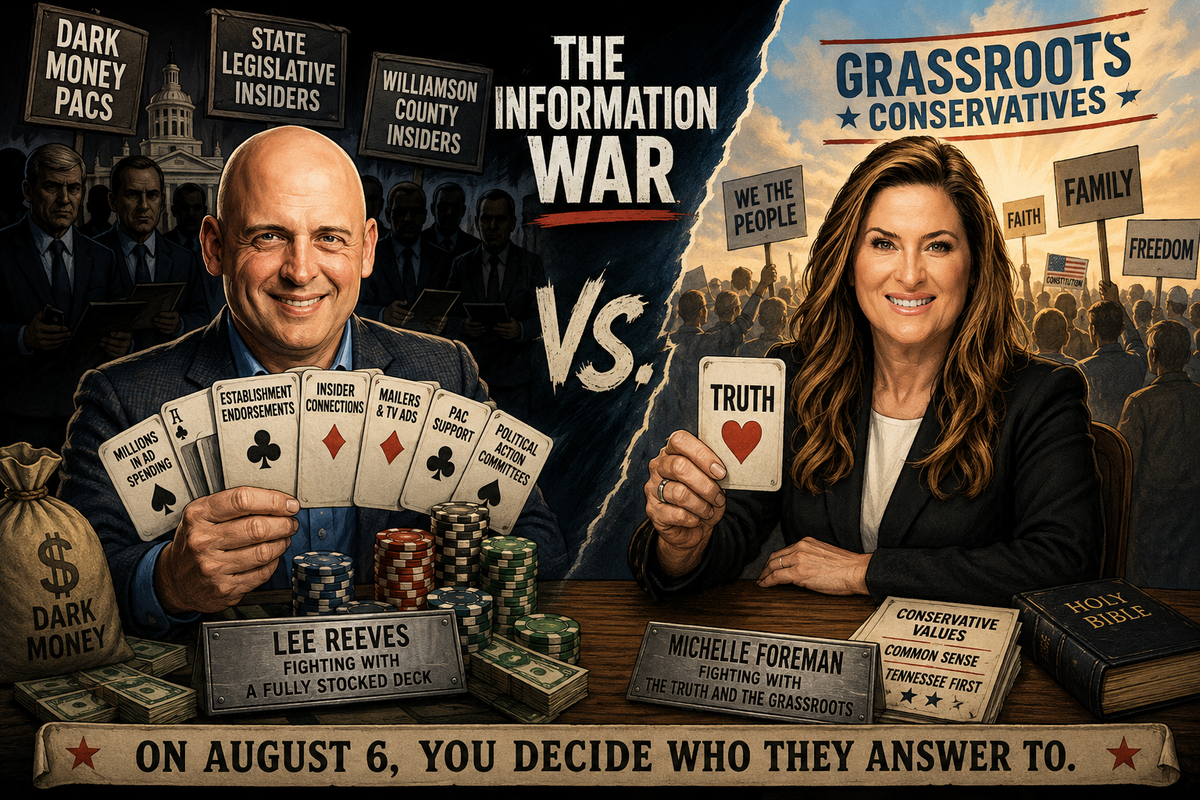
The race has evolved into a broader contest between a grassroots challenger and what Foreman describes as Tennessee's Republican political establishment, with questions surrounding the role of PACs, political insiders, and leadership-backed organizations.
4. Reeves' financial backing remains a central issue.
TruthWire's earlier investigation found approximately 62% of Reeves' campaign contributions came from PACs, elected officials, and political insiders, while outside groups have spent heavily on advertising supporting his reelection.
5. The election raises a larger question about political accountability.
Beyond the campaign rhetoric, District 65 voters are ultimately deciding whether their representative should be primarily accountable to the constituents who elect them or the political networks that help finance and defend their campaigns.
WILLIAMSON COUNTY, Tenn. — Republican voters in Tennessee House District 65 have likely struggled to open their mailbox, scroll Facebook, watch television, or even check their text messages without encountering another campaign message in what has become one of Williamson County's most expensive and aggressive Republican primaries.
With just days remaining before the August 6 election, incumbent Rep. Lee Reeves and challenger Michelle Foreman are battling across virtually every available platform. Campaign mailers, Facebook advertisements, text message campaigns, and television spots have saturated the district, each attempting to define not only the candidates, but what it means to be a conservative Republican.
The intensity of the advertising is not occurring in a vacuum.
Earlier this week, TruthWire examined the financial network supporting Reeves' reelection campaign. Campaign finance reports show Reeves has raised approximately $128,400 for his 2026 campaign, with nearly $80,000, roughly 62 percent, coming from political action committees, elected officials, and political insiders rather than individual grassroots contributors. Those reports also show significant independent expenditures from outside organizations that have financed an extensive advertising campaign on Reeves' behalf, producing many of the mail pieces now arriving in voters' homes.
That earlier investigation explored a broader question extending beyond House District 65: how Tennessee's political leadership, PACs, consultants, and influential elected officials often operate within interconnected networks that recruit candidates, finance campaigns, and protect incumbents viewed as dependable allies. The messaging now flooding District 65 provides a real-time example of how those political networks function once an election enters its final weeks.
For many voters, that campaign has become impossible to ignore.
One mailer portrays Foreman as the "Ringmaster of a Three Ring Circus," highlighting lawsuits she filed following her 2022 campaign, mischaracterizing Cade Cotherin as a campaign advisor, when he had no such role (Foreman was officially advised by Imperial Consulting as financial records will verify), and donor Gary Humble before concluding, "Our politics doesn't need more chaos and drama." Another advertisement labels Foreman's positions a "Radical Agenda," accusing her of opposing President Donald Trump's education priorities, siding with teachers unions, and putting Tennessee parents last. Similar messages have also appeared through Facebook advertisements and campaign text messages delivered directly to Republican voters.

Rather than responding with a series of press releases or social media posts, Foreman released a nearly twelve-minute campaign video addressing many of the attacks directly (see full content below) .
Seated at a table covered with campaign mailers (anecdotal evidence indicates Reeves' campaign has sent out 20 mailers, a staggering number for a state level house race), she walks viewers through the advertisements one by one, arguing they misrepresent both her record and the broader issues at stake in the election. Throughout the video, Foreman contends the campaign has become less about legislative accomplishments than about an organized effort by political insiders and special interest groups to define her before voters hear directly from her.
Foreman introduces herself not as a politician, but as "a Christian, a wife, a mother, a registered nurse, and a juvenile attorney," explaining that whether they are "my patients, my clients, my neighbors or my family," she has always believed in protecting "our way of life and the values that we grew up with." That desire, she says, eventually led her into Republican politics after becoming frustrated with Democrats crossing over to vote in Republican primaries. In 2018 she successfully ran for the Tennessee Republican Party State Executive Committee, where she served four years before later becoming the Republican nominee for House District 59. She is now seeking a second opportunity to represent House District 65 after narrowly losing the Republican primary to Reeves in 2024.
One of Foreman's strongest criticisms centers on campaign pieces she believes intentionally create the impression that President Donald Trump endorsed Reeves. Looking directly into the camera, she says, "My opponent knows that you don't know," arguing Reeves and organizations supporting him have "superimposed the President's likeness...to deceive you," before concluding, "It's political corruption. That's all it is."
Foreman notes Trump endorsed Matt Van Epps during the 2025 congressional special election rather than Reeves and argues voters should distinguish between campaign literature featuring the President's image and an actual presidential endorsement. Those statements reflect Foreman's characterization of the campaign and the advertising supporting Reeves.
She is equally dismissive of advertisements portraying Reeves as the race's only "authentic conservative," calling the claim "just a lie." "My body of work speaks for itself," she says, pointing to her service as a Trump delegate during two presidential election cycles, four years on the Republican State Executive Committee, her work advancing Second Amendment resolutions through the Williamson County Republican Party, and what she describes as a longstanding record supporting pro-life causes, constitutional government, and law enforcement. Throughout the video, Foreman repeatedly urges voters to evaluate records rather than campaign slogans, arguing conservative credentials are earned through years of public service rather than political advertising.
Perhaps no issue has appeared more frequently in campaign advertising than lawsuits Foreman filed following her unsuccessful 2022 campaign. Mailers characterize the litigation as evidence of unnecessary political conflict and poor judgment. Foreman addresses the issue head-on.
"You bet I did," she says when discussing whether she sued a political opponent.
According to Foreman, she was "defamed so badly" that the attacks affected both her family and her professional reputation. She also says that following the Covenant School shooting, threats surrounding the controversy became serious enough that law enforcement provided security at her daughter's school.
"I can promise you," she says, "if he had done the things to you that he did to me, you would have filed a lawsuit as well."
Foreman also argues campaign advertisements fail to explain Tennessee's anti-SLAPP law, legislation she says significantly changed the legal standards governing defamation litigation. She notes sanctions entered against her remain under appeal and says voters are hearing only one side of the legal dispute. Those statements reflect Foreman's account of the litigation and ongoing appellate proceedings.
The campaign extends well beyond personal attacks. Throughout the video, Foreman disputes campaign messaging involving immigration, pro-life legislation, infrastructure, and support for first responders, accusing Reeves of taking credit for accomplishments belonging to others while allowing outside organizations to portray him as the district's lone conservative voice. Returning repeatedly to the stack of campaign mailers beside her, she tells viewers, "You need to know the truth, and I will always tell you the truth."
As the video progresses, Foreman broadens her criticism beyond Reeves himself, arguing the campaign reflects a larger struggle between grassroots conservatives and what she describes as Tennessee's Republican political establishment. She contends Reeves has become the beneficiary of a political system in which elected officials, political action committees, consultants, lobbyists, and leadership-aligned organizations work together to recruit, finance, and defend candidates viewed as reliable partners once they arrive in Nashville.
Those assertions closely mirror the themes raised in TruthWire's earlier campaign finance investigation. That reporting found Reeves' campaign has been supported by a significant network of political insiders, including legislative leadership, political action committees, elected officials, and influential political donors. While campaign contributions are a routine and legal part of the political process, the concentration of support from within Tennessee's political establishment has become a defining issue in the race, particularly as outside organizations continue investing heavily in advertising supporting the freshman legislator.
Foreman argues that support comes with political expectations.
"They bought the election two years ago," she says. "They're trying to do it again."
She contends voters are witnessing the political establishment protecting one of its own rather than allowing the election to be decided solely on the merits of each candidate's record.
Whether Reeves and the organizations supporting him would characterize the campaign in those terms is another matter. Like many competitive legislative races, both campaigns have sought to persuade voters through advertising, endorsements, and political messaging. Independent expenditures made on behalf of Reeves are legally separate from his campaign under Tennessee law, although they have become a prominent feature of the closing weeks of the election.
For voters, however, the practical effect is the same. Mailboxes continue filling with campaign literature. Facebook advertisements appear throughout social media feeds. Television commercials repeat familiar themes. Text messages arrive directly on voters' phones. Each communication asks the same underlying question in a different way: Who deserves to represent House District 65?
Yet perhaps the larger question extends beyond one legislative district.
Modern campaigns are increasingly shaped not only by the candidates themselves, but by the political organizations capable of amplifying their message. Independent expenditures, political action committees, leadership endorsements, digital advertising, coordinated mail campaigns, and sophisticated voter targeting have become defining features of modern elections. None of those activities are inherently improper. They are legal, commonplace, and often highly effective.
The question is whether they also change who elected officials ultimately feel most accountable to.
Representative government functions best when accountability flows outward to the voters. Critics of Tennessee's current political structure argue that an increasing dependence on leadership support, political endorsements, committee assignments, and well-funded outside organizations can gradually redirect that accountability inward, toward the political network that helped secure election or reelection. Supporters counter that those same relationships help build effective governing coalitions capable of advancing a legislative agenda.
House District 65 has become a case study in that broader debate.
On one side is an incumbent whose campaign has received substantial support from Tennessee's Republican political network while emphasizing his conservative record and legislative accomplishments. On the other is a challenger arguing that same network has become too influential, protecting legislators who reliably support leadership priorities while making it increasingly difficult for independent conservatives to compete on equal footing.
Ultimately, the race is no longer simply about Michelle Foreman or Lee Reeves.
It has become a test of how Republican voters evaluate modern campaigns themselves. Do polished mail pieces, coordinated advertising, endorsements, and significant outside spending reinforce confidence in a candidate's qualifications, or do they prompt voters to ask who is financing the message and why?
Those are questions only the voters of House District 65 can answer.
When the television commercials stop airing, the Facebook ads disappear, the text messages end, and the campaign mailers are thrown away, one decision will remain.
On August 6, Republican voters will decide not only who represents House District 65 in Nashville, but whom they believe that representative will answer to once they arrive there.
If you want to support what we do, please consider donating a gift in order to sustain free, independent, and TRULY CONSERVATIVE media that is focused on Middle Tennessee and BEYOND!
Comments ()