
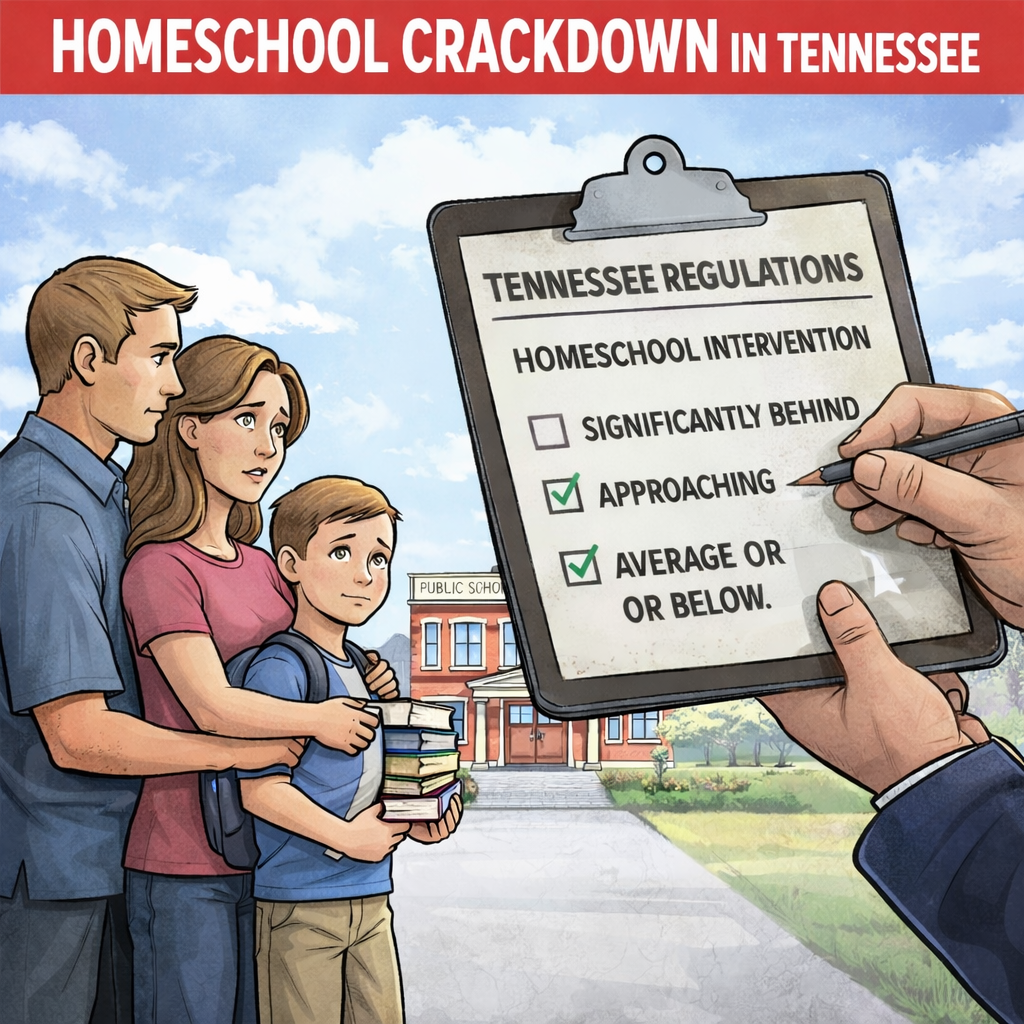
HB1729 lowers homeschool intervention triggers in TN, expands reporting and remediation, and coincides with pushes to grow vouchers.
Tennessee already regulates independent homeschooling. But a newly filed bill, HB1729 (William Slater-R-D35), would change the state’s posture in a meaningful way: it lowers the threshold for when government intervention is triggered, formalizes an escalation ladder that can involve outside professionals, and preserves a pathway that can end with a local school director requiring a child to enroll in a public, private, or church-related school.
Supporters can frame the bill as “accountability” and “test integrity.” Critics will see it as a “homeschool clampdown” — especially because it lands in the same policy moment when Tennessee leaders are also pushing to expand the state’s private-school voucher program far beyond its built-in growth mechanism.
The question families are asking is straightforward: Is Tennessee tightening control over homeschooling while expanding incentives to move students into other systems the state can more easily fund, count, and regulate?
What Tennessee law says now
Under current Tennessee law in TCA 49-6-3050, independent homeschool families operate under a compliance model: register with the local school district, follow attendance requirements, and meet periodic academic checkpoints.
The most important checkpoint is testing. Under current law, homeschool students in grades 5, 7, and 9 must take standardized tests that align with the state’s testing system for public-school students. Those tests are administered through the commissioner of education or designee, or through a professional testing service approved by the local education agency (LEA).
Current law also requires reporting: results must be provided to the parent-teacher, the director of schools (local district leadership), and the state board of education.