Tennessee First Action: New Details Emerge on the Coordinated SEC Advertising Campaign
TruthWire uncovers new details about Tennessee First Action, the anonymous group spending thousands to influence Tennessee GOP State Executive Committee races. The money remains hidden. The questions—and the stakes—keep growing.
5 Key Takeaways:
- A nationally connected political law firm formed Tennessee First Action. The nonprofit behind the coordinated SEC advertising campaign was incorporated by an attorney from one of the country's premier Republican political law firms—not by publicly identified grassroots organizers.
- The campaign was built months before voters ever saw an ad. Corporate records show Tennessee First Action was established in March, while its coordinated Facebook advertising campaign didn't begin until July, indicating advance planning rather than a spontaneous effort.
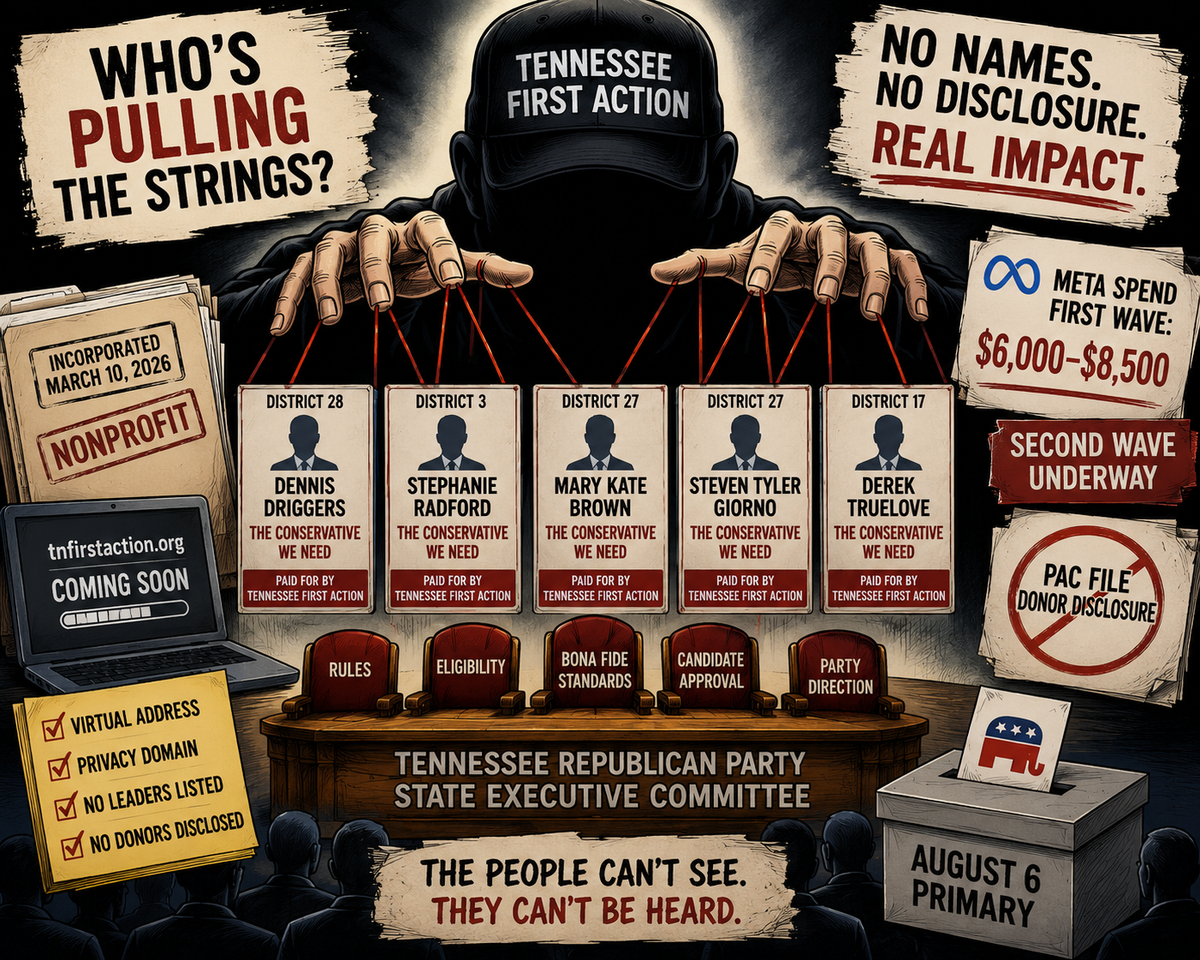
- Thousands have already been spent—with more advertising following. Meta's Ad Library shows the first wave of advertising exceeded initial estimates, and a second coordinated round of ads is already underway targeting multiple State Executive Committee races.
- The money behind the campaign remains hidden. Because State Executive Committee races fall under a unique area of Tennessee law, the organization's financial backers are not currently disclosed through the state's traditional campaign finance system.
- The biggest questions remain unanswered. Who conceived Tennessee First Action? Who retained the law firm? Who is financing the operation? And who is attempting to influence the future leadership of the Tennessee Republican Party while remaining anonymous?
When TruthWire first reported on Tennessee First Action on July 22, the organization behind a coordinated series of Facebook advertisements supporting selected Tennessee Republican State Executive Committee candidates was little more than a name attached to a handful of digital ads. Less than a week later, the public record paints a much clearer picture of how the organization was built. Ironically, the more we now know, the more significant the unanswered questions have become.
Here Are the Facts
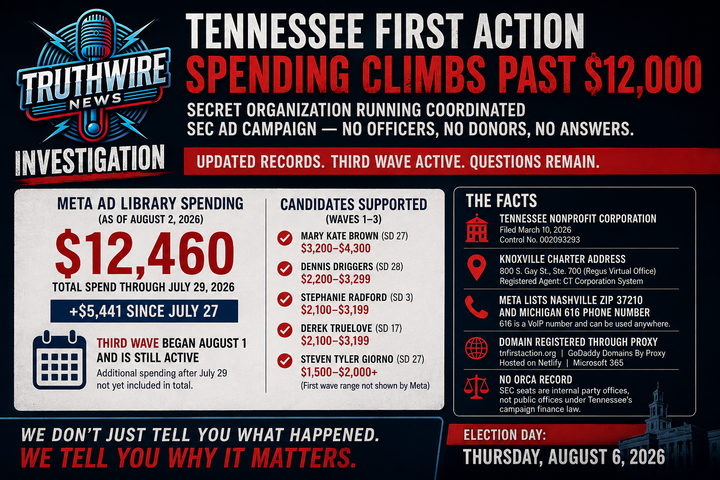
Tennessee First Action is a Tennessee nonprofit corporation, Control No. 002093293, chartered on March 10, 2026. The Articles of Incorporation identify Nashville attorney Lauren LaRue Topping as the incorporator who established the organization. Secretary of State records list C T Corporation System as the registered agent and a Regus virtual office in Knoxville as both the principal and mailing address.
Topping is not simply a local attorney filing paperwork for a nonprofit. Before entering private practice, she served as General Counsel for the Tennessee Bureau of Ethics and Campaign Finance, where she developed extensive expertise in Tennessee election law and campaign finance. She now serves as Of Counsel with Holtzman Vogel, one of the nation's premier Republican political law firms.
Holtzman Vogel represents Republican candidates, national party committees, Super PACs, politically active nonprofit organizations, and advocacy groups across the country. The firm's work also extends directly into Tennessee politics. Most recently, Holtzman Vogel attorney Brandon J. Smith represented U.S. Senator Marsha Blackburn in a July 27 legal demand involving an advertisement from the American Exceptionalism Institute. Blackburn's longtime political strategist and campaign manager is Ward Baker, founder of Baker Group Strategies.
There is no public evidence connecting Senator Blackburn, Ward Baker, or Baker Group Strategies to Tennessee First Action. However, the representation illustrates that the same law firm that formed Tennessee First Action is actively providing legal counsel to one of Tennessee's most influential Republican political operations. It establishes that Tennessee First Action was created by attorneys operating within the highest levels of Republican political law.
The documentary record also reveals a carefully constructed digital footprint. The domain tnfirstaction.org was registered on July 16 using GoDaddy's Domains By Proxy privacy service, shielding the registrant's identity from public view. The website remains a Netlify-hosted "Coming Soon" page with Microsoft 365 email configured but no publicly available information identifying its officers, directors, or financial supporters.
Meanwhile, the advertising campaign has continued to expand. Updated figures from Meta's Ad Library now place the first wave of Facebook advertising between approximately $6,000 and $8,500, higher than the estimates available when TruthWire first reported on the effort. Then, on July 27, a second coordinated wave of advertisements appeared using virtually identical messaging, graphics, and strategy across multiple State Executive Committee races.
Candidates benefiting from the advertisements have publicly stated they do not know who is funding the effort. At the same time, no Tennessee political action committee or campaign finance reports currently identify Tennessee First Action because State Executive Committee races occupy a unique position under Tennessee law. Since these are internal party offices rather than public offices, many of the disclosure requirements that apply to legislative and statewide campaigns simply do not apply in the same manner.
What It Means
Standing alone, none of these facts necessarily indicate wrongdoing. Using an attorney to establish a corporation is perfectly normal. Virtual office addresses are common. Privacy registration for internet domains is legal. Tennessee law allows organizations participating in State Executive Committee races to operate with substantially less public disclosure than campaigns for public office.
Investigative reporting, however, is rarely about one isolated fact. It is about what emerges when multiple documented facts are viewed together.
Viewed collectively, Tennessee First Action does not resemble an organization that sprang together after a few grassroots activists decided to boost a handful of Facebook posts.
Instead, the documentary record reflects a professionally organized nonprofit created nearly five months before Republican voters ever saw its first advertisement. It was incorporated by experienced election-law counsel from one of the nation's premier Republican political law firms, protected through privacy registration, established using a virtual office, and launched with a coordinated statewide advertising campaign targeting the governing body of the Tennessee Republican Party.
That does not tell us who controls Tennessee First Action.
But it does tell us this organization was built with a level of legal sophistication that extends well beyond simply creating a Facebook page and purchasing a few advertisements.
The broader context surrounding Holtzman Vogel makes that observation even more significant. Nationally, the firm has represented Republican candidates, national party committees, Super PACs, and politically active nonprofit organizations operating within the campaign finance system that developed after the Supreme Court's Citizens United decision. A 2017 Washington Post investigation described the firm's specialty as representing organizations engaged in election advocacy, including nonprofit entities that are not required under federal law to publicly disclose their donors. That reporting did not involve Tennessee First Action or Lauren Topping specifically, nor does it establish who is funding this organization today. It does, however, provide important context for the type of sophisticated political organizations the firm routinely represents.
That naturally raises a question the public record still cannot answer: Who retained Holtzman Vogel to create Tennessee First Action?
The incorporation documents identify the attorney who formed the corporation. They do not identify the client.
That question matters because retaining one of the country's premier Republican political law firms is not something most grassroots activists do when creating a nonprofit to purchase Facebook advertisements. It suggests planning, resources, and political sophistication well beyond what the public has thus far been shown.
Was Tennessee First Action conceived by local grassroots activists?
Was it organized by established Republican political consultants?
Was it financed by a handful of major donors?
Was it created on behalf of another organization or political network whose involvement remains undisclosed?
Today, the public simply does not know.
The Questions That Matter
As additional records emerge, the central questions have become increasingly focused rather than less so.
Who made the decision to establish Tennessee First Action in March?
Who retained Holtzman Vogel?
Who paid the legal fees associated with its formation?
Who controls the organization's Meta advertising accounts?
Who determines which State Executive Committee candidates receive financial support?
How much money has actually been committed beyond the spending ranges visible through Meta?
Will additional advertising continue before Republican voters cast their ballots on August 6?
And why has every step of the organization's formation—from experienced political counsel, to a virtual office, to private domain registration, to the absence of publicly identified leadership—resulted in so little information being available to the Republican voters whose party leadership it is attempting to influence?
The Tennessee Republican State Executive Committee is not merely ceremonial. It establishes party rules, resolves internal disputes, influences future primary procedures, and helps determine the direction of the Republican Party in Tennessee. Any coordinated effort to reshape that governing body deserves the same public scrutiny as campaigns for public office.
Transparency is not about restricting political speech. Individuals and organizations have every right to advocate for the candidates of their choosing.
Transparency is about allowing Republican voters to understand who is attempting to influence the future leadership of their party.
Today, the documentary record establishes several things with certainty. Tennessee First Action was professionally organized months before its advertising campaign began. It was formed by an attorney with one of the nation's premier Republican political law firms. It has spent thousands of dollars on a coordinated statewide advertising campaign. Yet the identities of the individuals directing and financing the organization remain largely unknown.
That may all be entirely lawful.
But in politics—particularly when the goal is to influence who governs a political party—lawfulness and transparency are not the same thing.
Until the people behind Tennessee First Action choose to identify themselves, the story is no longer simply about the candidates they are promoting.
It is about who is choosing to remain unseen while attempting to shape the future leadership of the Tennessee Republican Party.
If you want to support what we do, please consider donating a gift in order to sustain free, independent, and TRULY CONSERVATIVE media that is focused on Middle Tennessee and BEYOND!
Comments ()