Tennessee’s Bail Amendment: The Warnings Came Before the Election. The Consequences Are Already Emerging
Less than a week after Tennessee approved Amendment 1, a defense attorney warns of troubling courtroom consequences. Why did conservatives vote to expand government power, and what will it take to undo a constitutional change that can't simply be repealed?

5 Key Takeaways
1. Warnings Are Already Materializing: Less than a week after Amendment 1 passed, a Tennessee defense attorney reports judges attempting to deny bail without evidentiary hearings, relying primarily on allegations in police reports.
2. Presumption of Innocence Is at Stake: Expanding judicial authority to deny bail raises serious due process concerns, particularly when defendants may be detained without a meaningful opportunity to challenge the accusations against them.
3. Conservative Principles Shouldn't Depend on Party Affiliation: Why would voters who champion limited government approve an expansion of government power? A Republican supermajority's endorsement should never substitute for constitutional scrutiny.
4. Constitutional Amendments Are Not Easily Undone: Unlike ordinary legislation, reversing Amendment 1 requires another lengthy constitutional amendment process involving two successive General Assemblies and ultimately Tennessee voters.
5. All Three Amendments Deserved Greater Scrutiny: Before the election, I advised everyone who asked me to vote NO on all three amendments. My concerns centered on government authority, constitutional protections, and the long-term consequences of permanently altering Tennessee's foundational governing document.
Less than a week after Tennessee voters approved Constitutional Amendment 1, a defense attorney is raising concerns about how judges are exercising their newly expanded authority, underscoring why constitutional amendments deserve far greater scrutiny than ordinary legislation.
Tennessee voters were warned. Now, less than a week after the November 3 election, the consequences of Constitutional Amendment 1 may already be unfolding in courtrooms across the state.
In a November 9 Facebook post, a Tennessee criminal defense attorney known online as “Attorney Christmas,” who had warned about the amendment's potential consequences, described judges attempting to detain defendants without bond, without evidentiary hearings, and without requiring evidence beyond allegations contained in police reports.
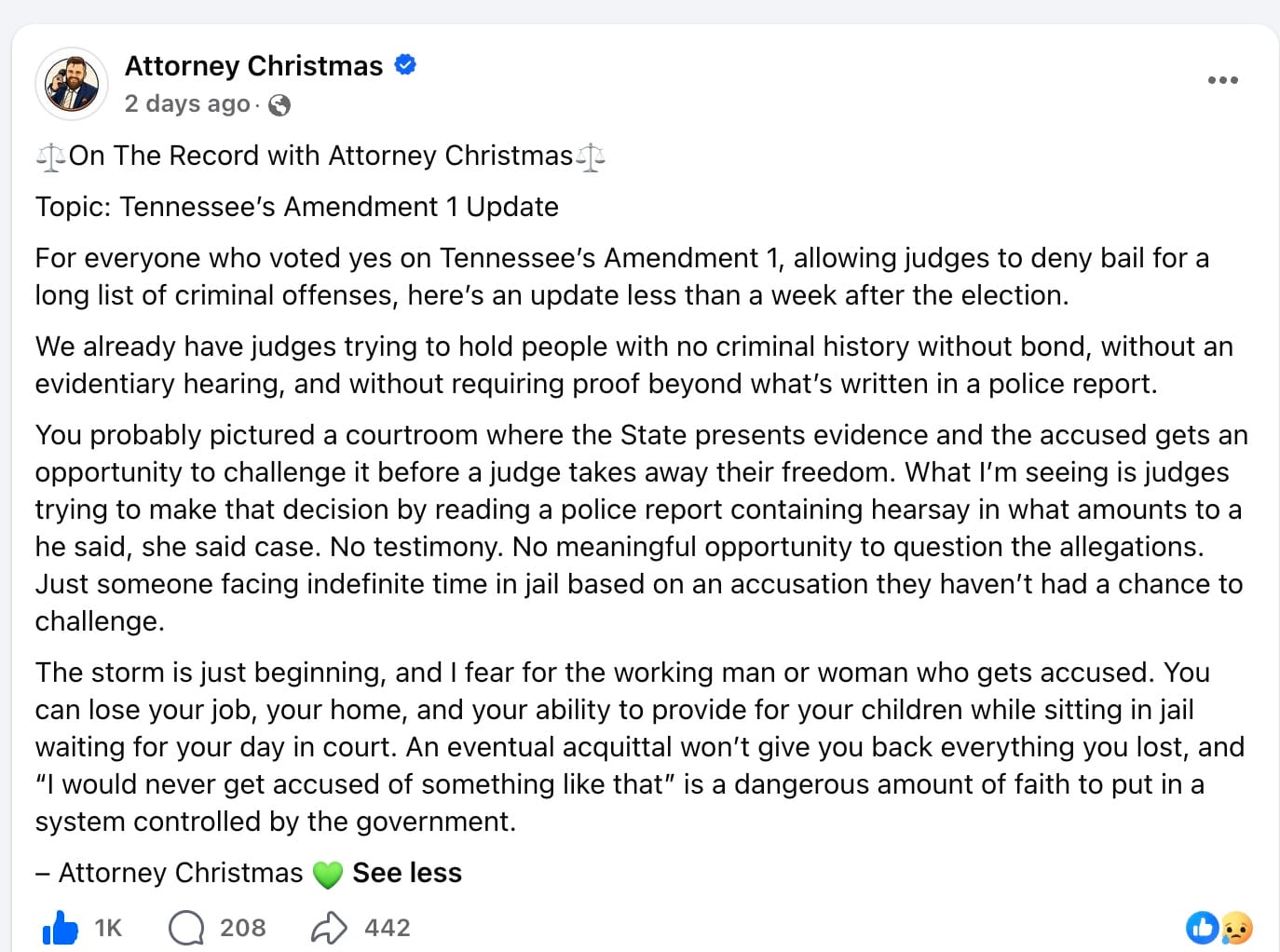
According to the attorney, some of those defendants have no prior criminal history.
“We already have judges trying to hold people with no criminal history without bond, without an evidentiary hearing, and without requiring proof beyond what's written in a police report,” the attorney wrote.
These are the attorney's reported courtroom observations, not independently verified judicial findings. Nevertheless, they raise precisely the constitutional questions opponents warned voters about before the election.
What Tennessee Voters Actually Approved
Amendment 1 altered Article I, Section 15 of the Tennessee Constitution, expanding the circumstances under which judges may deny bail to individuals who have not been convicted of a crime.
Previously, Tennessee's Constitution guaranteed bail except in capital cases where the proof was evident or the presumption great. The amendment extended that exception to additional serious offenses, including second-degree murder, aggravated rape, terrorism, and certain violent offenses carrying an 85-percent minimum service requirement.
The amendment also requires judges to explain their decisions on the record.
Importantly, it did not eliminate the constitutional standard that the proof be evident or the presumption great. Nor did it authorize automatic detention based solely on an accusation.
That distinction matters enormously.
The concern raised by Attorney Christmas is that judges may exercise their expanded authority without providing defendants a meaningful opportunity to challenge the allegations against them.
An arrest is not a conviction. A police report is not a judicial determination of guilt. And the constitutional presumption of innocence does not disappear because the allegations are serious.
The Human Cost of Getting It Wrong
Supporters of Amendment 1 argued that expanding judicial discretion would better protect victims and the public from dangerous offenders.
Protecting the public is unquestionably a legitimate responsibility of government. But protecting the public and protecting constitutional rights should never be treated as mutually exclusive obligations.
Attorney Christmas described what can happen when someone is jailed awaiting trial without an adequate opportunity to challenge the allegations.
A working parent could lose employment, housing, financial stability, and the ability to provide for children before ever standing trial.
An eventual acquittal does not restore lost wages, repair a destroyed career, or return months of separation from one's family.
And as the attorney warned, believing that such circumstances could never happen to an innocent person places extraordinary faith in the government's ability to get everything right.
The entire purpose of constitutional protections is to recognize that government does not always get everything right.
When Did Expanding Government Become a Conservative Principle?
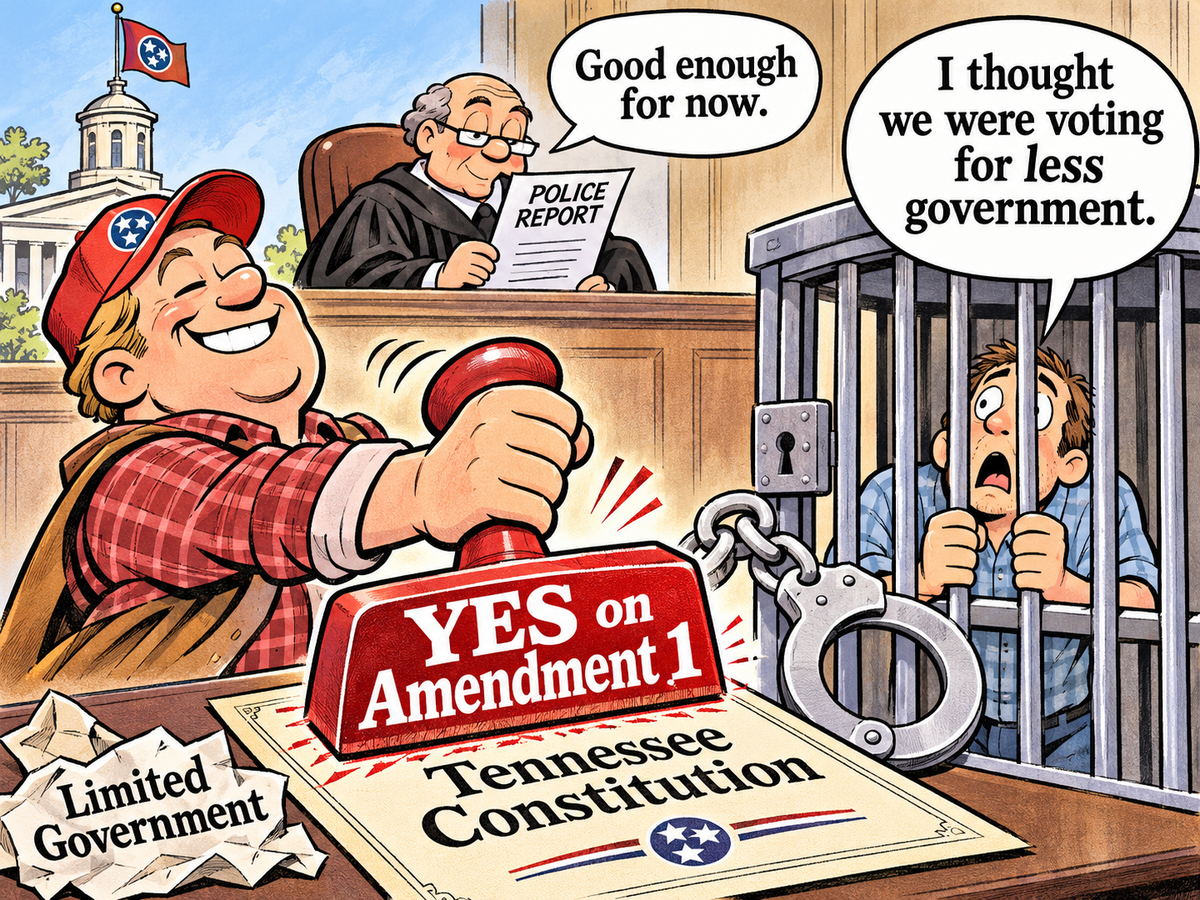
There is another question Tennessee conservatives should be asking themselves: Why would voters who routinely profess their commitment to limited government approve a constitutional amendment that explicitly expands the government's authority to deprive citizens of their liberty before conviction?
Was it because the amendment came from a Republican-controlled General Assembly? Did its passage through two consecutive legislatures dominated by Republican supermajorities reassure voters that it must therefore be consistent with conservative principles?
The amendment received overwhelming support from Republican lawmakers. But legislative approval, regardless of the margins or political affiliation of those voting, does not establish whether voters understood the constitutional implications.
In the weeks leading up to the election, quite a few people reached out to me asking how I intended to vote on Tennessee's three proposed constitutional amendments. My answer was consistent: I recommended voting NO on all three.
Each presented concerns about government authority, constitutional protections, or the potential consequences of changing our state's foundational governing document. For me, those concerns were simply too significant to overlook, regardless of which political party proposed the amendments.
My opposition wasn't rooted in distrust of Republicans specifically, but in a fundamental distrust of expanding government authority without sufficient justification and safeguards.
Conservatism has traditionally emphasized limited government, individual liberty, due process, and skepticism toward concentrated state power. Those principles are not supposed to become negotiable simply because Republicans control the government exercising that power.
Public safety was the argument used to justify Amendment 1, and protecting citizens from violent criminals is a legitimate responsibility of government. But constitutional protections were never intended to apply only when exercising them is politically convenient.
If conservatives would question handing this additional authority to a Democrat-controlled government, why should they be any less concerned when Republicans are the ones asking for it?
A Republican supermajority is not a substitute for constitutional scrutiny. Constitutional principles shouldn't change depending on who controls the legislature.
Unlike a Law, This Cannot Simply Be Repealed
Perhaps the most troubling aspect of Amendment 1 is how difficult it will be to reverse if its consequences prove more damaging than voters anticipated.
An ordinary Tennessee statute can be amended or repealed through the legislative process. A constitutional amendment is entirely different.
Under Article XI, Section 3 of the Tennessee Constitution, reversing Amendment 1 through another amendment would require approval by a majority of both legislative chambers, followed by approval from two-thirds of each chamber in the next General Assembly.
Only then could voters decide whether to restore the previous constitutional protection. The earliest regular gubernatorial election for such a vote would be November 2030, assuming lawmakers begin the process in 2027 and secure the necessary approvals.
A constitutional convention provides another, considerably more complicated avenue for constitutional change.
Courts may also address improper detention procedures or constitutional violations in individual cases, and lawmakers can establish procedural safeguards. Neither, however, is equivalent to simply repealing the constitutional change.
That is the distinction voters must understand.
Tennessee voters were not approving a temporary policy experiment. They were changing the state's foundational governing document, one that exists, in significant part, to restrain government power.
The attorney's warning should serve as a reminder that constitutional protections are not designed exclusively for people we like, trust, or believe to be innocent. They exist precisely because government possesses enormous power over everyone.
And once that power is expanded through constitutional amendment, reclaiming the protection surrendered is considerably harder than voting it away.
TruthWire exists to provide independent investigative journalism that holds Tennessee’s political establishment accountable.
Independent journalism depends on the support of readers who believe in that mission.
Your contributions help us continue investigating the issues, asking difficult questions, and reporting the stories that matter to Tennesseans. If you value our work, please consider becoming a monthly supporter. Every contribution makes a difference.