Tennessee's Election Night Warning: The Biggest Threat to Republican Control May Be Republicans Who Stop Showing Up
Blackburn won, but Tennessee's election exposed warning signs: nearly 200,000 votes for independent David Hatley, Democratic gains, and widespread nonparticipation. Is the GOP taking conservative voters for granted—and following California's path?

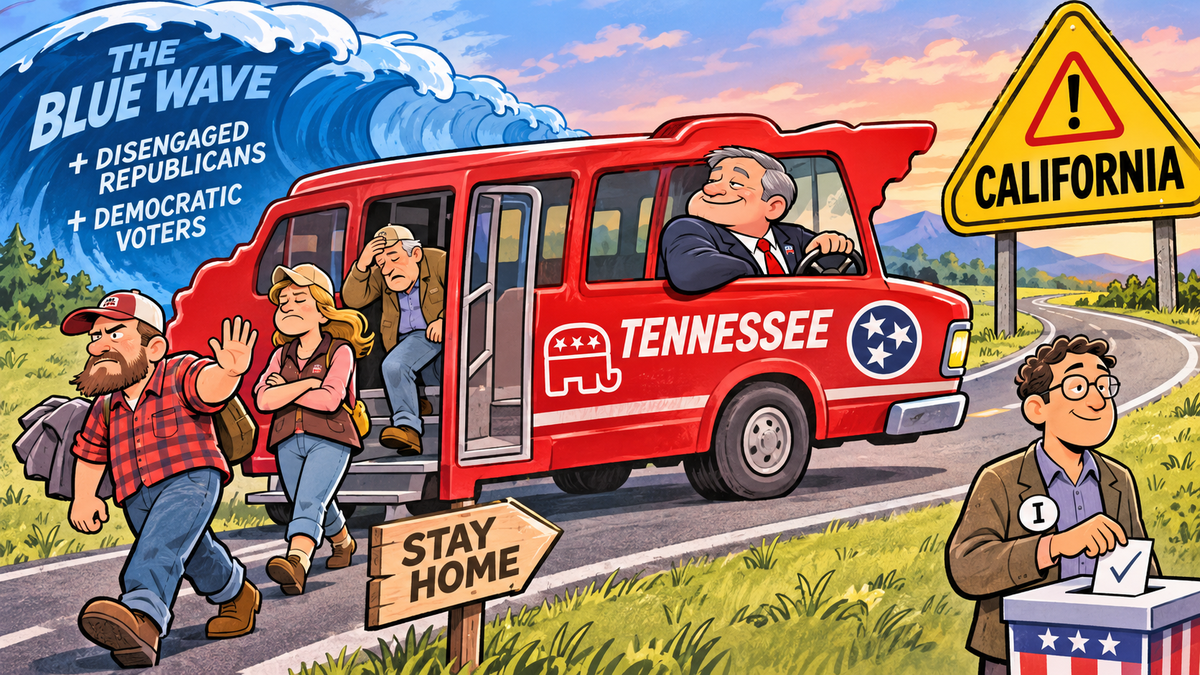
Blackburn wins with less than half the vote, Democrats make significant gains, and independent David Hatley delivers a historic showing despite nearly $10 million in opposition spending. For those who remember when California was reliably Republican, Tennessee's election results offer a cautionary tale.
By Kelly M. Jackson | TruthWire News | November 4, 2026
Tennessee Republicans won the governor's office Tuesday night, but anyone celebrating the results as an affirmation of the state's Republican establishment might want to examine the numbers before popping the champagne.
According to the November 3 unofficial election returns, Republican Marsha Blackburn won with 957,136 votes, or 45.52%, narrowly defeating Democrat Jerri Green, who received 902,953 votes, or 42.95%. Independent David Hatley captured 195,564 votes, representing 9.3% of the total. Blackburn's margin was just 54,183 votes in a state routinely described as one of America's most reliably Republican strongholds.
But the most revealing numbers may not be found in Blackburn's victory margin. They are found among the millions of Tennesseans who never voted, the nearly 200,000 who chose an independent candidate, and the six Republican state House incumbents defeated by Democrats.
Taken together, these results raise an uncomfortable question: Is Tennessee's Republican dominance as secure as its political establishment believes, or has the party mistaken decades of voter loyalty for unconditional obedience?
The 56% Who Didn't Vote
With approximately 4.8 million registered voters and roughly 2.1 million votes cast in the gubernatorial contest, participation amounted to approximately 44%, leaving an estimated 56% without a recorded vote for governor. These are approximate figures based on available registration estimates and unofficial election returns, rather than certified statewide turnout statistics.
We cannot know precisely why those voters stayed home or skipped the governor's race. Some may have disliked their choices, others faced practical obstacles, and many may simply have been disengaged.
But the political implications remain significant. Tennessee's next governor was elected with the support of approximately one-fifth of the state's registered voters, hardly an overwhelming expression of confidence from the electorate as a whole.
Interestingly, early and absentee voting increased 45% over 2022, with more than 1.28 million Tennesseans voting before Election Day. That suggests considerable engagement among those who participated, even as a majority of registered voters remained outside the gubernatorial contest.
For Republican leadership, that should raise a more consequential question than whether one independent candidate made the election too close: What happens when enough Republican-leaning voters simply stop showing up?
David Hatley Wasn't a Spoiler. His Voters Didn't Belong to Anyone Else.
Perhaps the most predictable reaction to Tuesday's results was the immediate rush to label independent David Hatley a spoiler. From both sides came accusations that his candidacy had siphoned or split votes, as though nearly 196,000 Tennesseans had somehow deprived Marsha Blackburn or Jerri Green of ballots that rightfully belonged to them.
But that argument rests on an assumption deserving considerably more scrutiny.
For the logic of siphoning or splitting votes to establish that Hatley changed the outcome, one must reasonably demonstrate that his supporters would otherwise have voted for one of the major-party nominees in sufficient numbers to make that difference. Merely assuming conservative voters would have supported Blackburn, or that voters dissatisfied with Blackburn would have supported Green, proves nothing.
The critical question is not which candidate Hatley voters most closely resembled politically. It is whether those voters would have supported either major-party nominee at all.
I can speak to that personally because I was one of them. I would not have voted for Marsha Blackburn or Jerri Green regardless of whether David Hatley appeared on the ballot. Had there been no independent candidate I could support in good conscience, I would have left the governor's race blank or written in another name.
Neither major-party candidate was ever going to receive my vote, and conversations with other voters have convinced me that I was far from alone.
A voter who would otherwise abstain from a particular contest does not subtract a vote from either major-party candidate by choosing an independent. That voter adds a vote that otherwise would not have been cast for either nominee.
And that is precisely what the spoiler accusation fails to account for. Many Hatley supporters weren't choosing between Blackburn and Green in the first place. They had already rejected both candidates, and Hatley's presence on the ballot gave them an opportunity to participate in a race they otherwise might have skipped. Without evidence establishing that those voters would have supported one of the major-party nominees, the claim that Hatley siphoned their votes is an assumption dressed up as electoral analysis.
You cannot steal a vote from a candidate who was never going to receive it.
Hatley's performance also deserves recognition beyond the spoiler debate. His 195,564 votes represent the largest independent gubernatorial vote total in Tennessee in more than six decades, approaching the 203,765 votes received by independent William Anderson in 1962. By comparison, independent John Jay Hooker received just 30,579 votes in 2014.
Hatley attracted more than six times Hooker's support, a historically significant showing for an independent candidate in modern Tennessee politics.
And he accomplished that despite a political opposition campaign costing millions.
Nearly $10 Million Spent Attacking Hatley—Not Green
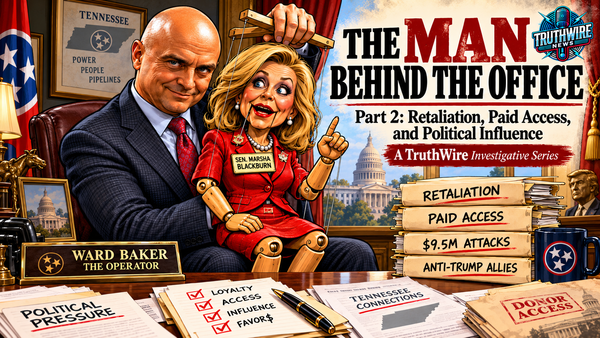
According to an October 30 Tennessee Lookout investigation, two outside expenditure groups spent approximately $9.5 million attacking Hatley. The Choose Freedom Fund accounted for roughly $6.5 million, while the Tennessee Freedom Fund spent another $3 million.
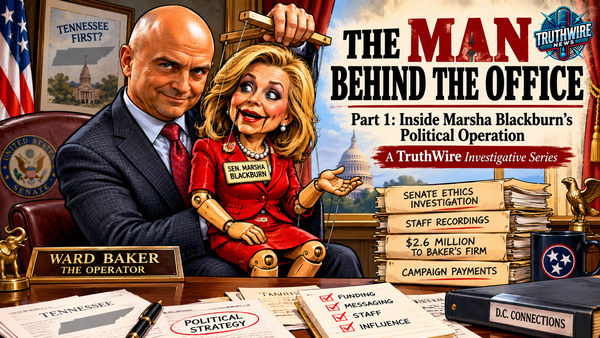
The Tennessee Freedom Fund received funding connected to Blackburn's political operation, including her Senate campaign account, billionaire Jeff Yass, and the pro-Blackburn Team Tennessee PAC. The Choose Freedom Fund's ultimate contributors were harder to identify because millions flowed through a nonprofit whose donors were not publicly disclosed.
These were independent expenditures rather than spending directly controlled by Blackburn's gubernatorial campaign. Nevertheless, their target was unmistakable.
The millions were directed toward Hatley, not Democrat Jerri Green, who ultimately came within approximately 54,000 votes of defeating Blackburn. Blackburn's campaign also created an attack website targeting Hatley shortly after the August primary. Clearly, a decision had to be made about where the resources would be focused, and which threat was the most in need of mitigation. The Blackburn campaign decided that Hatley was the greater threat. Not the "Memphis Marxist", Jerri Green.
That allocation of political resources deserves examination. Why did organizations supporting the Republican nominee devote so much money to attacking an independent candidate rather than the Democrat who nearly won?
If the assumption Hatley voters heard ad nauseam from those who were disgruntled by the camapaign's existence and the voters it was drawing, "an independent JUST CAN'T WIN!" why divert millions of dollars to stop it?
The spending records establish the targets, though not every calculation behind those decisions. What they also establish is that Hatley was taken seriously enough to attract millions in negative advertising.Despite that effort, nearly 200,000 Tennesseans supported him anyway.
Perhaps the more revealing question is why neither major-party candidate persuaded those voters.
When Did Voting Your Conscience Become Irresponsible?
Another accusation directed at Hatley voters deserves attention: the suggestion that voting for an independent candidate was somehow "irresponsible".
Hatley was not a symbolic write-in candidate operating without the means to compete. He was a self-funded businessman who invested approximately $12 million in his campaign, hired professional consultants, organized statewide events, and presented voters with a developed alternative to the major-party nominees.
Yet some conservatives insisted supporting him was "irresponsible" because doing so might produce an outcome they considered unacceptable.
Apparently, having the resources to compete is not enough. One must also have the blessing of the political establishment.
The troubling implication is that voters have an obligation to subordinate their judgment to the preferences of their party and fellow voters. Under this reasoning, the responsible choice is whichever candidate others have determined offers the most acceptable collective outcome.
Does that sound familiar?
I find it particularly ironic coming from conservatives who vehemently rejected the collective-responsibility arguments used during COVID to justify mask and vaccine mandates. Remember the relentless appeals to "We're all in this together" and the insistence that individual choices should yield to what authorities considered the greater good?
Many conservatives rejected that reasoning with extraordinary zeal, defending personal autonomy and individual conscience against demands for conformity.
Now, some invoke a remarkably similar argument about voting: Set aside your convictions, disregard your objections, and support the party's nominee because failing to do so might produce an outcome others find unacceptable.
Public-health policy and voting involve different legal considerations, but the rhetorical similarity is difficult to miss. Individual dissent becomes irresponsible because others believe conformity is necessary to secure their preferred result.
There is nothing wrong with discussing the strategic consequences of supporting an independent candidate. But there is a considerable difference between persuasion and declaring someone irresponsible for refusing to comply.
If individual liberty and freedom of conscience are foundational conservative principles, they cannot suddenly become liabilities when someone exercises them inside a voting booth.
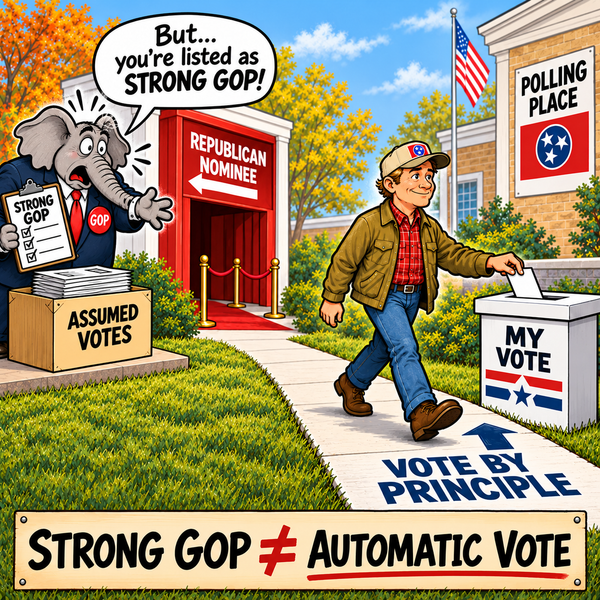
The ballot belongs to the voter. Not the party, not the nominee, and certainly not the people demanding everyone else fall in line.
Tennessee Is Red. But How Conservative Is Its Government?
For more than a decade, Tennessee Republicans have reminded voters that they live in one of America's most reliably conservative states. Republicans have controlled the governorship since 2011 and both legislative chambers since 2010, eventually establishing supermajorities with extraordinary authority over state policy.
But there is a considerable difference between electing Republicans and consistently governing according to conservative principles. Tennessee's record offers more than a few examples.
Start with spending. Under Republican Governors Bill Haslam and Bill Lee, Tennessee's total proposed budget increased from approximately $37 billion in fiscal year 2018 to $59.5 billion in fiscal year 2026—an increase of approximately 61%. Those totals include federal funding and other revenues, and they are not inflation-adjusted. Nevertheless, the growth deserves scrutiny from a party that campaigns on fiscal restraint.
Then there was COVID. Under Republican Governor Bill Lee, Tennessee restricted gatherings, closed gyms, limited restaurant operations, and eventually required residents to remain home except for essential activities. These were not hypothetical restrictions Democrats might have imposed. They were implemented under a Republican governor with a Republican-controlled legislature.
Following the Covenant School shooting in 2023, Senate Majority Leader Jack Johnson was recorded discussing how the term red flag could doom proposed legislation and how extreme risk protection order might be better received. Johnson maintained that the recording was taken out of context and that he opposed unconstitutional red-flag laws. Nevertheless, the conversation raised questions about why Republican leadership was discussing how to rebrand legislation strongly opposed by Second Amendment activists.
And what happened to Tennessee's abortion ban? Republicans enacted the Human Life Protection Act in 2019, establishing sweeping abortion restrictions triggered by the reversal of Roe v. Wade. After the Supreme Court's 2022 Dobbs decision, Republican lawmakers revisited that law, ultimately enacting narrow medical exceptions in 2023. Supporters called them necessary medical clarifications; opponents, including Tennessee Right to Life, objected to changing the original protections.
Then there is the unelected bureaucracy responsible for implementing policy. When Republican Bill Haslam succeeded Democratic Governor Phil Bredesen in 2011, he retained officials from the previous administration, including commissioners and senior agency personnel. Susan Cooper, for example, served as health commissioner under both governors.
That administrative continuity raises questions about whether changing the party occupying the governor's office necessarily changes the policies implemented throughout state government.
Consider Governor Lee's education appointments, Penny Schwinn and her successor, Lizzette Gonzalez Reynolds. Schwinn oversaw controversial education reforms, including school vouchers and a new school-funding formula. Reynolds arrived from ExcelinEd, the education reform organization associated with Jeb Bush, bringing an extensive background in standardized accountability and school-choice policy. Both appointments have drawn objections from conservatives concerned about state-directed education reform and local control.
These appointments illustrate why grassroots conservatives question whether Republican administrations consistently translate their campaign promises into the policies administered by their agencies.
And these examples barely scratch the surface. A recent TruthWire News interview with Republican Senator Janice Bowling revealed that her earlier legislation restricting gender-transition-related medical procedures involving minors had been denied hearings for two years despite Republicans controlling the state government. Similar protections eventually became law in 2023.
And then there's Hughes v. Lee, in which a Tennessee court declared two longstanding gun-control statutes unconstitutional, including the state's 19th-century “intent to go armed” law, with roots in the Jim Crow era. Yet Republican Governor Bill Lee and Attorney General Jonathan Skrmetti—touted as one of Tennessee's most conservative attorneys general—appealed the ruling, arguing in part that it created public-safety and enforcement problems. What does it say about Tennessee's supposedly conservative government when its Republican leadership goes to court to preserve gun restrictions rooted in an era of racial discrimination rather than working to replace them with laws that respect constitutional rights?
These were controversies arising under Republican governance, not evidence of Democrats exercising control over the state.
Tennessee is unquestionably red at the ballot box. But the policies enacted, the administrative decisions made, and the legislation prevented from advancing have not always reflected the conservative principles voters were promised.
That distinction deserves considerably more attention than another warning about what Democrats might do if they gained power.
The Democratic Vote Wasn't an Accident
In 2018, Republican Bill Lee defeated Democrat Karl Dean by approximately 21 percentage points, winning nearly 60% of the vote. Eight years later, Blackburn's margin was just 2.57 points, while Green secured nearly 43%.
Green's support extended beyond Nashville and Memphis. Knox, Hamilton, and Rutherford counties also favored the Democratic gubernatorial nominee.
Democratic gains extended into the General Assembly, where six Republican incumbents lost their House seats. Three defeats occurred in Rutherford County alone, with additional Democratic gains in Knox, Montgomery, and Shelby counties.
Republicans retained their supermajority, but the House delegation fell from 74 seats to 68. Democrats increased their representation to 31, the party's first multiple-seat gain since 1996.
That does not mean Tennessee has suddenly become a Democratic state. It does mean Republican victories should no longer be treated as inevitable.
For years, the TNGOP has relied on a remarkably simple argument: Whatever frustrations conservatives have with Republican leadership, electing Democrats would be worse.
There are genuine policy differences between the parties. But when Republicans control the legislative machinery, including committees, appropriations, and the advancement of bills, they cannot blame Democrats for every conservative priority that fails to become law.
The Democratic minority has little power to block Republican legislation on its own. Republican leadership must accept responsibility for how it exercises the authority voters have repeatedly entrusted to it.
The influence of political donors adds another dimension. Millions flow into Tennessee campaigns through wealthy contributors, corporations, and political organizations, many headquartered outside the state. Contributions do not automatically establish corruption, but voters have every reason to examine whether those financial relationships influence governing priorities.
The question is straightforward: When political interests invest millions in electing candidates, what do they expect in return, and whose interests take precedence once those candidates hold office?
Fear of Democrats cannot substitute indefinitely for accountability among Republicans.
A Cautionary Tale From a Once-Red State Called California
There was once a beautiful, prosperous, politically influential state called California that Republicans could reliably compete for and frequently win. It was the state that gave America Ronald Reagan, first as governor and later as president. It subsequently elected Republican governors George Deukmejian and Pete Wilson, and for decades its electoral votes helped send Republicans to the White House.
For those who know California only as the progressive stronghold it is today, that history might come as a surprise.
I grew up in that California. And I remember when being a Republican in California wasn't an exercise in political futility.
Between 1952 and 1988, California voted Republican for president in every election except Lyndon Johnson's 1964 landslide. As late as 1994, Republican Pete Wilson won reelection as governor, and Republicans remained competitive in legislative races.
But political dominance is not a permanent entitlement.
California's transformation involved changing demographics, economic pressures, contentious immigration politics, and Republican leadership that struggled to maintain its electoral coalition. Democrats capitalized on those changes while Republicans lost ground in communities that once sustained their victories.
The transformation did not happen overnight. Nor can it be attributed to one candidate, election, or policy. But the consequences were unmistakable. A state that once helped elect Republican presidents became one of the Democratic Party's most reliable strongholds.
And here is what Tennessee Republicans should consider: California didn't have to become entirely progressive for Republicans to lose their ability to govern it. Democrats simply had to assemble a durable electoral majority while Republicans lost the support or participation of enough voters to remain competitive.
There are still millions of conservative and moderate Californians. But their influence over statewide policy is limited when their political coalition cannot win elections.
I have already watched one state that helped shape modern American conservatism become a place where conservatives struggle to influence statewide government. I have no desire to watch Tennessee repeat that history.
The Real Warning: Republicans Who Stop Showing Up
Hatley's candidacy will undoubtedly remain a convenient explanation for Tuesday's close gubernatorial election. Yet the results suggest a problem substantially larger than an independent appearing on the ballot.
Blackburn won, but Green came within 54,183 votes. Democrats captured six Republican-held House seats, nearly 200,000 Tennesseans supported an independent, and more than half the state's registered voters cast no vote for governor. Those numbers deserve reflection, not another round of accusations against voters who refused to fall in line.
Democrats need not convert large numbers of committed conservatives to make substantial gains. They can organize their supporters, appeal to dissatisfied voters, and compete in communities where Republican victories were previously assumed.
And they do not need every disaffected Republican to vote Democratic.
They need enough Republicans to become discouraged, disengaged, or simply unwilling to show up.
Republican leaders can continue treating independent candidates as spoilers, grassroots critics as troublemakers, and dissatisfied voters as people who do not understand the stakes. Or they can examine whether their governing record has earned the loyalty they expect.
The greatest threat to Republican dominance in Tennessee may not be the voters who have started voting Democratic. It may be the conservatives who no longer see enough reason to vote Republican.
California's Republican decline demonstrates that political dominance can erode while party leaders are still convinced their voters have nowhere else to go. Tennessee Republicans have an opportunity to examine the warning signs before those signs become a political reality.
California was not always blue. Tennessee will not necessarily always be red. And a political party that mistakes its voters' loyalty for unconditional obedience may eventually discover the difference.
Election figures reflect unofficial returns reported November 3–4, 2026, and remain subject to certification. Statewide participation estimates are approximate.
TruthWire News — We don't just tell you what happened. We explain why it matters.
TruthWire exists to provide independent investigative journalism that holds Tennessee’s political establishment accountable.
Independent journalism depends on the support of readers who believe in that mission.
Your contributions help us continue investigating the issues, asking difficult questions, and reporting the stories that matter to Tennesseans. If you value our work, please consider becoming a monthly supporter. Every contribution makes a difference.