
Trump's Endorsement or the Voting Record? What Republican Voters Should Consider in Tennessee's 9th Congressional Race
Does President Trump's endorsement outweigh a proven voting record? A data-driven comparison of Todd Warner and Brent Taylor examines Tennessee voting records, legislative trends, and the Tennessee Legislative Report Card to help voters decide.
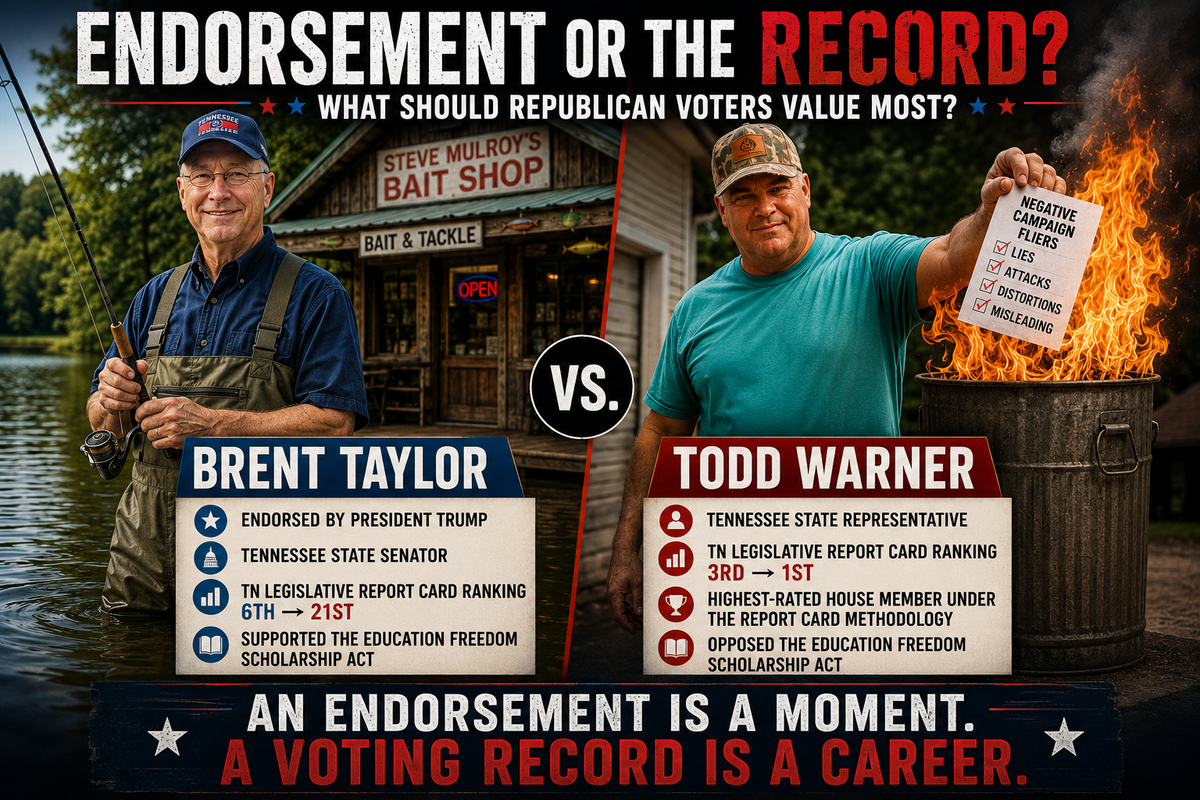
Key Takeaways
- Trump's endorsement and a legislative voting record measure different things. An endorsement reflects political support, while a voting record documents years of actual governing decisions.
- Todd Warner's Tennessee Legislative Report Card ranking improved from #3 to #1, while Brent Taylor's declined from #6 to #21 under the same published methodology.
- The Tennessee Legislative Report Card evaluates governing philosophy, not just individual issues. While the legislation changes each session, the constitutional and conservative principles used to score lawmakers remain consistent.
- The Education Freedom Scholarship Act exposed a clear philosophical divide. Warner opposed Governor Lee's voucher expansion, while Taylor supported Republican leadership on one of the most divisive issues in recent Tennessee politics.
- The central question for Republican voters is simple: Should one endorsement outweigh years of publicly recorded votes, or is a candidate's legislative record the better predictor of how they will govern in Washington?
President Donald Trump's endorsement of State Senator Brent Taylor immediately changed the dynamics of Tennessee's 9th Congressional District Republican primary. For many Republican voters, Trump's endorsement remains one of the most influential factors in choosing a candidate. Throughout the last decade, Trump has reshaped the Republican Party and earned the trust of millions of conservatives who view his judgment as a reliable guide in contested primaries.
At the same time, not every endorsement has been without controversy among the grassroots. Over the years, some of President Trump's endorsements have left conservative activists scratching their heads, particularly when he has backed candidates they viewed as more closely aligned with the Republican establishment than with the populist movement that helped propel Trump to the White House. In many of those races, grassroots conservatives questioned whether endorsements were based solely on a candidate's conservative record or whether other political considerations, including incumbency, relationships, electability, or party unity, also played a role.
That broader conversation now finds itself at the center of Tennessee's 9th Congressional District.
The question facing Republican primary voters is not whether President Trump's endorsement matters. It clearly does. The question is whether an endorsement should outweigh years of documented legislative decisions when the two appear to point in different directions.
One way to answer that question is by examining Tennessee's legislative record through a consistent and transparent standard. That is where the Tennessee Legislative Report Card becomes relevant.
How This Scorecard Differs From Others & Why It Matters
Legislative scorecards have become commonplace in American politics, but many measure only a narrow slice of a legislator's work. National advocacy organizations often select a handful of bills that align with their own policy priorities and grade lawmakers based on those specific votes. Those scorecards can be useful for understanding where a legislator stands on a particular issue, but they often provide only a partial picture of a legislator's overall governing philosophy.
The Tennessee Legislative Report Card was designed differently. Rather than focusing on a single issue, its methodology evaluates legislation through a consistent set of constitutional and conservative principles, including limited government, individual liberty, private property rights, fiscal responsibility, and government accountability. While the legislation changes every session because Tennessee faces new challenges every year, the constitutional principles used to evaluate those bills remain consistent.
That distinction is significant. Legislators never vote on the exact same bills from one General Assembly to the next. New legislation addresses new problems. A philosophy based methodology allows voters to compare legislators across multiple sessions by asking a simple question, did they consistently apply the same governing principles regardless of the issue before them?
Whether the debate involved school choice, election integrity, immigration, artificial intelligence, religious liberty, parental rights, fiscal policy, or property rights, the Tennessee Legislative Report Card attempts to evaluate legislators using the same constitutional framework. Readers may agree or disagree with the methodology, but it is transparent, publicly available, and applied consistently across the General Assembly. Every scored bill is published, committee votes are included alongside floor votes, and anyone can review the underlying legislation before deciding what weight the score deserves.
Unlike many national scorecards, the Tennessee Legislative Report Card is focused exclusively on Tennessee's General Assembly. It is built around the legislative battles that shape state government and reflects the priorities of people who have spent years engaged in Tennessee's grassroots conservative movement. Rather than measuring lawmakers against the priorities of a national organization, it evaluates how consistently they govern according to a constitutional philosophy applied to the issues facing Tennessee.
Following the Trend
Perhaps the most revealing comparison between Todd Warner and Brent Taylor is not where they rank today. It is the direction their legislative records have moved over time.
Todd Warner entered the previous legislative session already ranked among the most conservative members of the Tennessee House. Following the 2026 session, he improved from third to first under the Tennessee Legislative Report Card's methodology, becoming the highest rated member of the House.
Brent Taylor's trajectory moved in the opposite direction. Taylor entered the previous session ranked sixth among Tennessee senators. Following the 2026 legislative session, his ranking declined to twenty first, reflecting significantly less alignment with the governing philosophy outlined in the Report Card's published methodology.
Some critics dismiss legislative scorecards altogether, arguing that each legislative session considers different bills. That observation is true, but it also misses the point. The Tennessee Legislative Report Card does not attempt to compare identical legislation from year to year. It compares whether legislators consistently applied the same constitutional and conservative principles to whatever legislation came before them during each session. If the methodology is sound and applied consistently, then changes in a legislator's ranking become meaningful because the measuring standard remains the same even though the legislation changes.
The Voucher Vote
One of the clearest examples separating Warner and Taylor involved Governor Bill Lee's Education Freedom Scholarship Act, more commonly known as the statewide voucher bill. Few issues have divided Tennessee Republicans more sharply in recent years.
Todd Warner voted against the legislation, maintaining that his constituents and his understanding of conservative principles required him to oppose expanding the program. Brent Taylor supported the legislation alongside Governor Lee and Republican leadership.
Whether voters supported or opposed the voucher bill is ultimately a matter of public policy and reasonable conservatives reached different conclusions. What cannot be disputed is that the legislation became one of the defining votes separating the two candidates.
Following Warner's vote, discussion spread throughout Tennessee Republican political circles about recruiting and financially supporting a primary challenger. There were also anecdotal reports that at least one prospective candidate was allegedly offered a six figure financial commitment to challenge Warner in a Republican primary. Additionally, ultra wealthy PAC's American Federation For Children and Americans For Prosperity mounted campaigns against Warner, ultimately spending millions of dollars targeting him, and any other representatives that opposed the voucher bill. These efforts illustrate how politically significant Warner's vote became among influential supporters of the legislation.
Looking Beyond the Endorsement
President Trump's endorsement deserves consideration. His influence within the Republican Party is undeniable, and many voters rightly place significant value on his recommendations. At the same time, endorsements and legislative records measure different things. A presidential endorsement may reflect many factors, including relationships, loyalty, incumbency, electability, and broader political strategy. A legislative voting record reflects something much narrower, but arguably more measurable, how an elected official has actually governed over time.
Measured under the Tennessee Legislative Report Card's published methodology, Todd Warner's voting record has become more closely aligned with the constitutional and conservative governing principles that the organization evaluates. Brent Taylor's record has moved in the opposite direction during the same period.
That fact alone does not tell voters who they should support. It does, however, provide Republican primary voters with objective, Tennessee based data that deserves careful consideration.
Ultimately, every voter must decide which carries greater weight, an endorsement from a respected political leader or a legislative record built one vote at a time. If Republican voters have long argued that actions speak louder than words, then perhaps the most important question in Tennessee's 9th Congressional District is not who has the strongest endorsement. Perhaps it is which candidate has demonstrated, through years of recorded votes and a consistently applied methodology, the governing philosophy that most closely reflects the constitutional principles Tennessee conservatives want represented in Washington.
If you want to support what we do, please consider donating a gift in order to sustain free, independent, and TRULY CONSERVATIVE media that is focused on Middle Tennessee and BEYOND!

Comments ()