
Tennessee First Action Spending Climbs Past $12,000 as New Records Deepen Questions About Secret SEC Advertising Campaign
UPDATE: TruthWire's investigation finds Tennessee First Action's coordinated SEC ad campaign has grown beyond $12,000. New records reveal a larger operation, while key questions remain: Who created it, who funds it, and why?
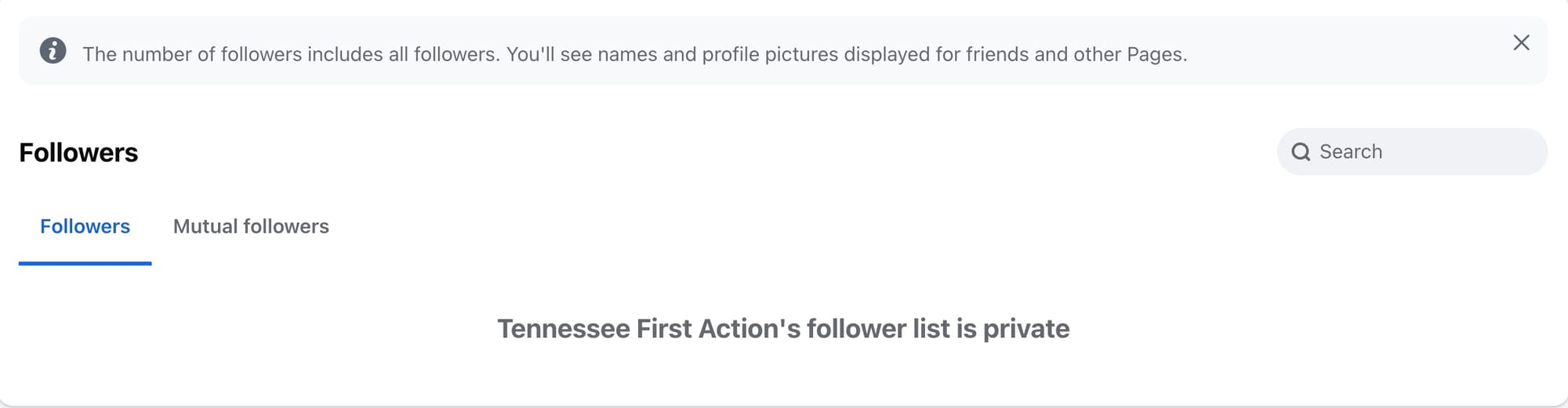
When TruthWire first reported on Tennessee First Action on July 22, the organization appeared to have materialized almost overnight. Its Facebook page was only days old, its website contained little more than a name and slogan, and the first visible advertisements supporting selected Tennessee Republican State Executive Committee candidates appeared to represent a relatively modest digital campaign. (Update: Tennessee First Action now has a total of 8 followers but the organization has chosen to keep even those shielded from public view).
Less than two weeks later, the picture has changed considerably.
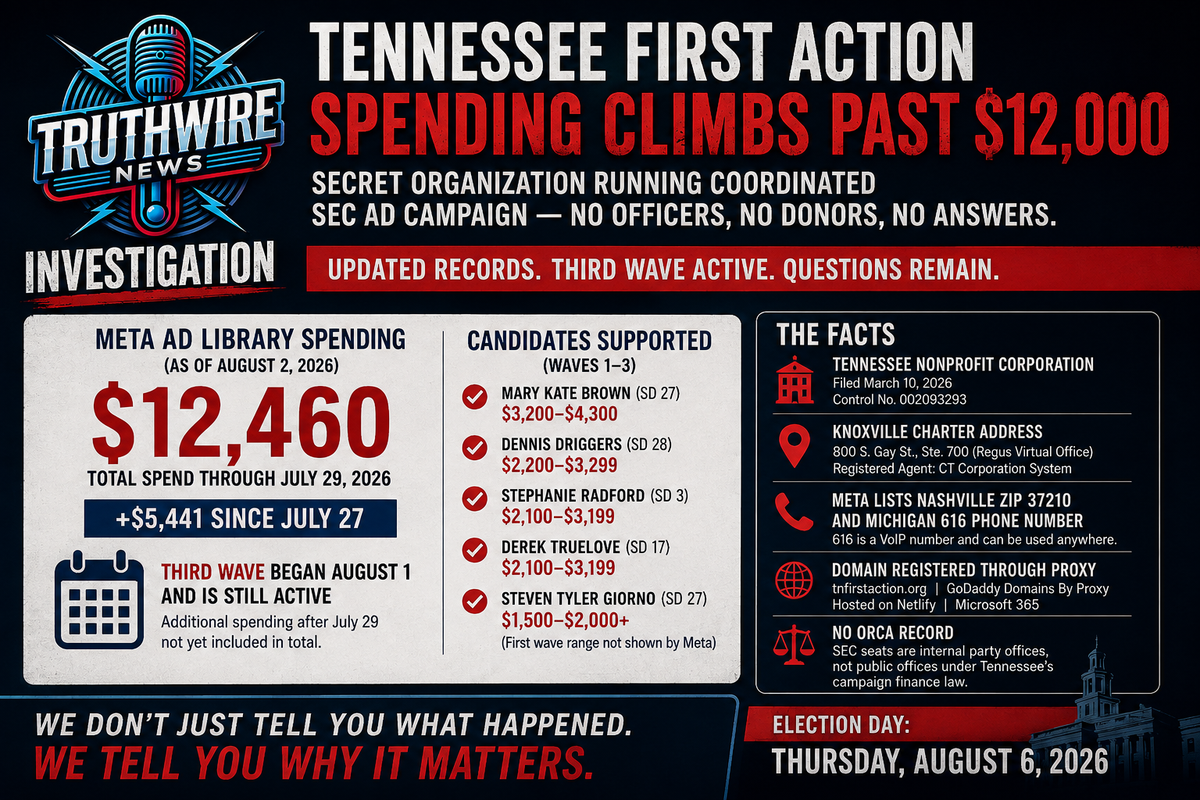
Tennessee First Action is now confirmed to be an active Tennessee nonprofit created months before its advertisements became public. Its legal formation traces back to an attorney with extensive experience in election and campaign finance law. Its advertising has expanded through three coordinated waves across multiple State Executive Committee districts. Meta’s public records now show at least $12,460 in spending through July 29, with additional advertisements launched after that reporting cutoff and still accumulating expenses as of August 2.
Yet despite the growing scale of the campaign, Republican voters still do not know who controls Tennessee First Action, who financed it, or why its resources have been directed toward challengers attempting to unseat several of the Tennessee Republican Party’s most recognizable grassroots conservatives.
Here Are the Facts
Tennessee First Action is a Tennessee nonprofit corporation, Control No. 002093293, chartered on March 10, 2026. The organization existed for more than four months before its Meta advertisements began appearing in mid-July.
Its Articles of Incorporation identify Nashville attorney Lauren LaRue Topping as the incorporator who established the organization. Topping previously served as General Counsel for the Tennessee Bureau of Ethics and Campaign Finance and now serves as Of Counsel with Holtzman Vogel, a national Republican political law firm whose practice includes election law, campaign finance, political committees, Super PACs, nonprofit advocacy organizations, and Republican campaigns.
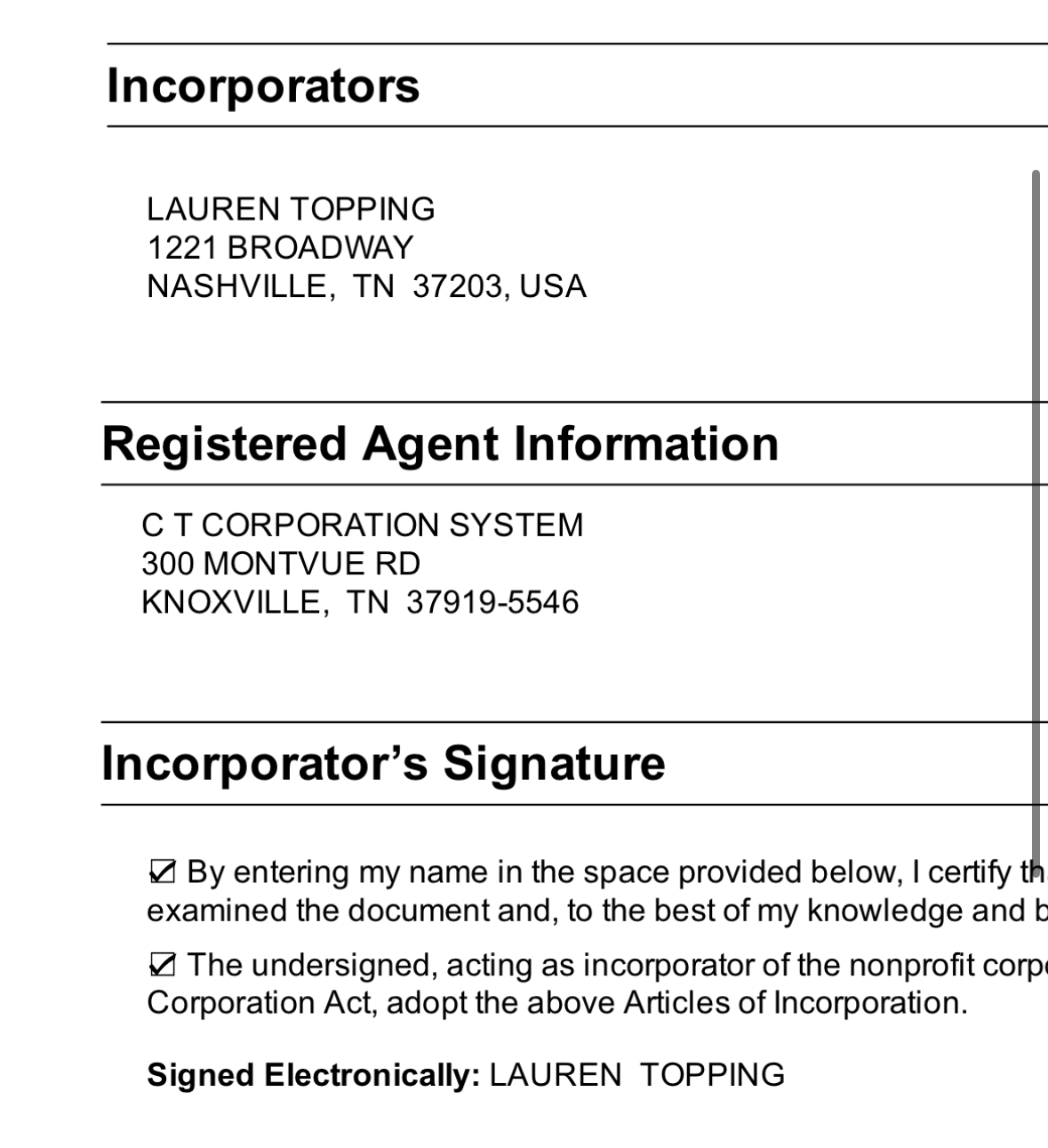
The public filings identify the attorney who formed Tennessee First Action, but not the client who retained her, the people directing the organization, or its financial supporters.
Secretary of State records list C T Corporation System as the registered agent and identify a Regus virtual-office suite at 800 S. Gay Street in Knoxville as the organization’s principal and mailing address. Meta’s advertiser information, however, lists only a Nashville ZIP code, 37210, and a telephone number with a western Michigan 616 area code. The number has been identified as a Voice over Internet Protocol line, meaning it can be obtained and operated from virtually anywhere.
The organization’s website adds another layer of privacy. The domain tnfirstaction.org was registered through GoDaddy’s Domains By Proxy service, hosted through Netlify, and configured with Microsoft 365. The site still provides no information identifying officers, directors, donors, a treasurer, or any individual responsible for the organization.
The Knoxville corporate address, Nashville Meta location, and Michigan telephone number do not align. None of the public-facing records identifies a natural-person officer, donor, page administrator, or decision-maker.
What has become clearer is the size and organization of the advertising campaign.
When TruthWire first reviewed Tennessee First Action’s Meta advertisements, the visible spending ranges suggested the organization had spent or planned to spend at least $2,300 to $2,795 supporting five State Executive Committee candidates. Updated Meta records later placed the first two advertising waves between approximately $6,000 and $8,500.
The latest pull shows the campaign was larger still.
Meta’s advertiser page reported $12,460 in total spending through July 29, including $7,818 spent during the single week between July 23 and July 29. The advertiser total had stood at approximately $7,019 on July 27, meaning it increased by $5,441 in only a matter of days.
That total does not include the full scope of the campaign.
A third get-out-the-vote wave began August 1 and remained active as of August 2. Those advertisements supported Mary Kate Brown in Senate District 27, Dennis Driggers in District 28, Stephanie Radford in District 3, and Derek Truelove in District 17. Because Meta’s organization-wide total only extended through July 29, at least part of the third wave sits outside the reported $12,460 figure.
The available advertisement ranges now show Tennessee First Action spending approximately $3,200 to $4,300 supporting Brown across three waves. Driggers received an estimated $2,200 to $3,299 in advertising, while Radford and Truelove each received approximately $2,100 to $3,199. Steven Tyler Giorno’s visible second wave accounted for an additional $1,500 to $2,000, although Meta did not display a spending range for his first advertisement and no third-wave advertisement was identified in the August 2 review.
Every advertisement carries the disclaimer, “Paid for by Tennessee First Action,” and uses matching or nearly identical creative across the different districts. The advertisements follow the same general timing, language, and design, pointing to a single centralized buyer rather than unrelated local efforts.
The organization has supported Giorno and Brown in District 27, Driggers in District 28, Truelove in District 17, and Radford in District 3. None of the candidates are seeing vacated positions. They are challenging incumbent State Executive Committee members who have developed strong support within Tennessee’s grassroots conservative movement, including Steve Allbrooks and Cyndi Miller in District 27, Chris Morris in District 28, and Brad Lytle in District 17.
Candidates benefiting from the advertising have publicly said they do not know who is funding Tennessee First Action.
The organization also does not appear as a registered political action committee under that name in Tennessee’s Online Registry of Campaign Activity. That initially raised questions because the advertising had exceeded the $1,000 threshold commonly associated with political committee reporting. The newer legal analysis provides important context.
Tennessee’s political campaign committee statute is written around spending to support or oppose candidates for specified public offices. State Executive Committee seats are internal party offices rather than public offices listed under the statute. If Tennessee First Action’s spending remains limited to SEC contests, the lack of an ORCA registration appears consistent with the statute as written. Meta’s political-ad authorization and disclaimer requirements are platform rules, not Tennessee campaign finance filings.
That distinction does not resolve the transparency issue. It exposes it.
What It Means
Nothing in the available public record establishes that Tennessee First Action has violated the law.
Hiring an attorney to create a nonprofit is routine. Commercial registered agents are common. Virtual offices are legal. Private domain registration is widely used. Voice over Internet Protocol numbers can be purchased remotely. Tennessee law appears to allow organizations spending exclusively in internal party elections to operate without the disclosure requirements that would apply to campaigns for the General Assembly or statewide office.
Investigative reporting, however, is not limited to asking whether each individual step is legal. It also examines what those steps reveal when viewed together.
Tennessee First Action does not resemble an organization hastily assembled by a few local activists who decided to boost several Facebook posts.
The documentary record instead reflects a professionally structured political operation created nearly five months before voters encountered its first advertisement. It was formed through experienced election-law counsel, established using a commercial registered agent and virtual office, protected by private domain registration, and launched with centralized advertising across multiple State Executive Committee districts.
Its campaign did not stop after a first test run. It expanded through three distinct waves, including a final get-out-the-vote push immediately before Election Day. By July 29, Meta showed more than $12,000 in spending, with additional costs continuing to accrue after August 1.
That amount may be small compared with a statewide gubernatorial or congressional campaign, but State Executive Committee races are not statewide public-office contests. They are often low-budget, low-information elections in which many voters know little about the candidates appearing near the bottom of the ballot. In that environment, several thousand dollars in targeted advertising can have an outsized effect on what voters see and how a candidate is defined.
The organization’s target selection also matters.
Tennessee First Action has directed its resources toward several challengers running against incumbent SEC members associated with the party’s grassroots conservative wing. Those incumbents have been outspoken on Republican bylaws, candidate qualifications, crossover voting, party registration, legislative accountability, and the direction of the Tennessee Republican Party.
No public statement from Tennessee First Action explains why these races were chosen, what failures it believes justify replacing the incumbents, or what changes it wants the supported candidates to make if elected.
The public record therefore establishes the existence of a coordinated effort to influence the Tennessee Republican Party’s governing body without identifying the people financing or directing that effort.
The State Executive Committee is not ceremonial. Its members elect party leadership, adopt and amend bylaws, determine candidate qualification rules, resolve internal disputes, and influence how Republican primaries and party operations function across Tennessee.
That makes the transparency gap especially important.
An organization can spend thousands of dollars helping determine who governs the Republican Party while disclosing less information than would be required if it spent the same money influencing a race for the Tennessee General Assembly. Republican voters are being asked to evaluate advertisements about who should govern their party without being told whose interests are behind the message.
The latest records narrow the questions, but they do not answer them.
Who retained Holtzman Vogel to establish Tennessee First Action?
Who paid the legal and organizational expenses?
Who controls the Meta advertising account?
Who selected these five candidates?
Who authorized three coordinated advertising waves?
How much has been spent since Meta’s July 29 reporting cutoff?
And why have the people attempting to influence control of the Tennessee Republican Party chosen not to identify themselves?
Tennessee First Action may be operating entirely within the law. But legality and transparency are not the same thing.
What began as a report about a nearly empty Facebook page has now become a story about a professionally organized, multi-district political operation spending more than $12,000 to shape the governing body of the Tennessee Republican Party while its financial and strategic leadership remains hidden.
The question is no longer whether Tennessee First Action is a serious political operation. The spending records have answered that. The question Republican voters still deserve answered is who built it, who paid for it, and what they expect in return.
TruthWire exists to provide independent investigative journalism that holds Tennessee's political establishment accountable. We aren't funded by corporations, political parties, or large media companies. We're funded by readers who believe the truth is worth defending. If this reporting has informed you or helped your community, please consider becoming a monthly supporter.

Comments ()